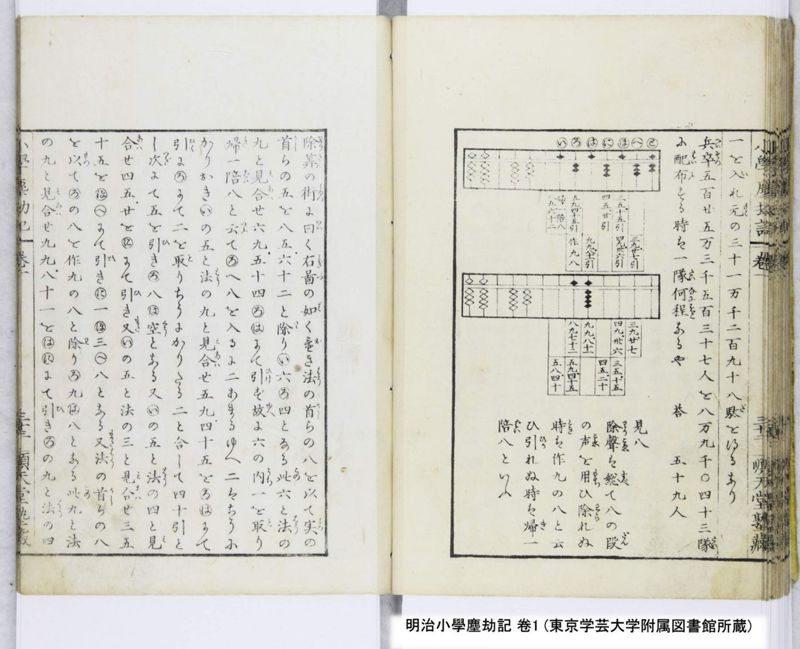
翻刻
【右丁】
一を入(い)れ元(もと)の三十一万千二百九十八 駄(だ)を得るなり
兵卒(へいそつ)五百廿五万三千五百三十七人を八万九千〇四十三 隊(たい)
に配布(はいふ)する時は一 隊(たい)何程(なにほど)なるや 答 五十九人
【2個の算珠盤図を挟み上中下】
㋣
㋬ 三九.廿七引 三九.廿七
㋭ 三五.十五引 四九.丗六引 四九.丗六 三五.十五
㋥ 四五.廿引 四五.二十
㋩ 九九.八十一引 九九.八十一
㋺ 五九.四十五引 作九八 八九.七二 五九.四十五
㋑ 《割書:帰一陪八|八五.六十二》 五八.四十
【図解の下】
見八
除声(わりこゑ)は総(すべ)て八の段(だん)
の声(こゑ)を用(もち)ひ除(わら)れぬ
時(とき)は作九の八と云
ひ引(ひか)れぬ時は帰(き)一
陪(ばい)八といふ
【左丁】
除算(わりさん)の術(しゆつ)に曰(いは)く右図(みぎづ)の如(ごと)く置(お)き法(はう)の首(かし)らの八を以て実(じつ)の
首(かし)らの五を八五.六十二と除(わ)り㋑六㋺四となる此(この)六と法(はう)の
九と見合(みあは)せ六九.五四㋺㋩にて引(ひけ)ず故(ゆへ)に六の内(うち)一を取(と)り
帰(き)一 陪(ばい)八と云(いふ)て㋺へ八を入るに二あまるゆへ二はちうに
かりおき㋑の五と法(はう)の九と見合(みあは)せ五九.四十五を㋺㋩にて
引(ひく)に㋺にて二を取(と)りちうにかりたる二と合して四十引と
し次(つぎ)にて五を引(ひ)き㋺八㋩空(くう)となる又㋑の五と法(はう)の四と見(み)
合(あは)せ四五.廿を㋥にて引(ひ)き又(また)㋑の五と法の三と見合(みあは)せ三五
十五を㋭㋬にて引(ひ)き㋥一㋭三㋬八となる又(また)法(はう)の首(かし)らの八
を以(もつ)て㋺の八を作九の八と除(わ)り㋺九㋩八となる此(この)九と法
の九と見合(みあは)せ九九.八十一を㋩㋥にて引(ひ)き㋺の九と法(はう)の四
現代語訳
【右丁】
一を入れ、元の三十一万千二百九十八駄を得るのである。
兵卒五百二十五万三千五百三十七人を八万九千〇四十三隊に配布するとき、一隊は何人になるか。
答 五十九人
【算盤図(2個)を挟んで上・中・下に配置】
㋣
㋬ 三×九=二十七 引 三×九=二十七
㋭ 三×五=十五 引 四×九=三十六 引 四×九=三十六 三×五=十五
㋥ 四×五=二十 引 四×五=二十
㋩ 九×九=八十一 引 九×九=八十一
㋺ 五×九=四十五 引 作九の八 八×九=七十二 五×九=四十五
㋑ 《割書:帰一陪八|八×五=六十二》 五×八=四十
【図解の下】
見八
除声はすべて八の段の声を用い、割られないときは「作九の八」といい、引かれないときは「帰一陪八」という。
【左丁】
除算の術について:右図のように置き、法の頭の八を以て実の頭の五を八×五=六十二(「見八除五進六二」)と割り、㋑六㋺四となる。この六と法の九とを見合わせ、六×九=五十四を㋺㋩で引こうとするが引けないため、六の内から一を取り、「帰一陪八」といって㋺へ八を入れると二余るので、その二は一時的に「宙」(中空)にかりおき、㋑の五と法の九とを見合わせ、五×九=四十五を㋺㋩にて引く際、㋺にて二を取り、宙にかりておいた二と合わせて四十として引き、次にて五を引き、㋺八㋩空となる。また㋑の五と法の四とを見合わせ、四×五=二十を㋥にて引き、また㋑の五と法の三とを見合わせ、三×五=十五を㋭㋬にて引き、㋥一㋭三㋬八となる。また法の頭の八を以て㋺の八を「作九の八」と割り、㋺九㋩八となる。この九と法の九とを見合わせ、九×九=八十一を㋩㋥にて引き、㋺の九と法の四と……
英語訳
[Right page]
...enter one, thus obtaining the original 311,298 *da* (pack-horse loads).
When distributing 5,253,537 soldiers into 89,043 units, how many soldiers are in each unit?
Answer: 59 persons
[Two abacus diagrams with operational steps arranged above, between, and below]
㋣
㋬ 3×9=27 subtract 3×9=27
㋭ 3×5=15 subtract 4×9=36 subtract 4×9=36 3×5=15
㋥ 4×5=20 subtract 4×5=20
㋩ 9×9=81 subtract 9×9=81
㋺ 5×9=45 subtract change-nine-8 8×9=72 5×9=45
㋑ [Double-column note: "return-one multiply-eight | 8×5=62"] 5×8=40
[Below the diagram]
*Ken hachi* (見八)
All division calls use the eight-times table. When division is not possible, say "change nine to eight" (*sakukyū no hachi*); when subtraction is not possible, say "return one, multiply eight" (*kīchi bai hachi*).
[Left page]
Regarding the technique of division: Arrange as shown in the right diagram. Using the leading digit 8 of the divisor, divide the leading digit 5 of the dividend by the rule "8 divides 5, yield 6 remainder 2" (*hachi go roku jū ni*), making ㋑6㋺4. Match this 6 with the divisor's 9: 6×9=54, but this cannot be subtracted from ㋺㋩. Therefore, take 1 from the 6, apply "return-one multiply-eight," entering 8 into ㋺, with 2 remaining. This remainder of 2 is temporarily held "in the air" (*chū ni karioki*). Match ㋑'s 5 with the divisor's 9: 5×9=45. When subtracting from ㋺㋩, take 2 from ㋺, combine it with the 2 held "in the air" to make 40, subtract it, then subtract 5 at the next step, making ㋺8㋩empty. Also match ㋑'s 5 with the divisor's 4: 4×5=20, subtract from ㋥. Also match ㋑'s 5 with the divisor's 3: 3×5=15, subtract from ㋭㋬, making ㋥1㋭3㋬8. Also, using the divisor's leading 8, divide ㋺'s 8 by "change nine to eight," making ㋺9㋩8. Match this 9 with the divisor's 9: 9×9=81, subtract from ㋩㋥. Match ㋺'s 9 with the divisor's 4...