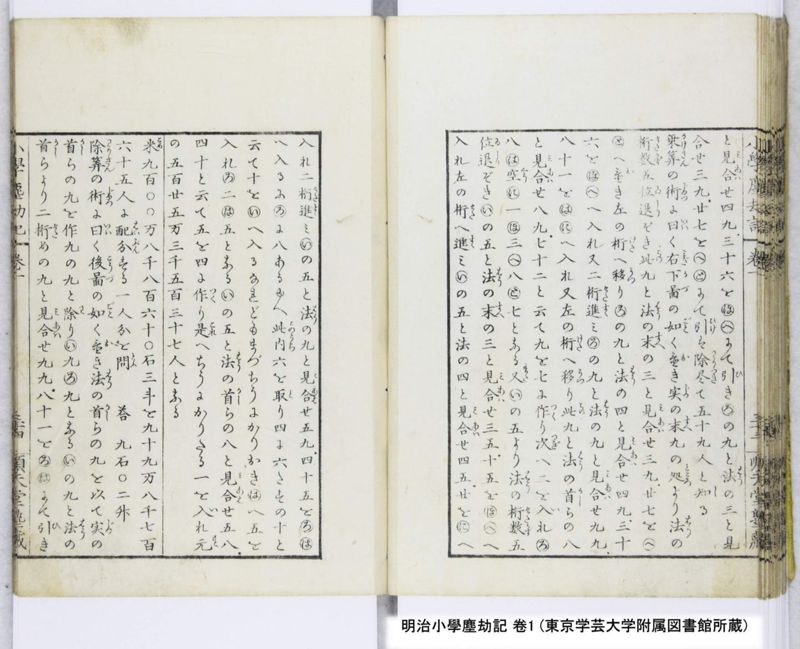
翻刻
【右丁】
と見合(みあは)せ四九.三十六を㋭㋬にて引(ひ)き㋺の九と法(はう)の三と見
合せ三九.廿七を㋬㋣にて引(ひけ)は除尽(わりつき)て五十九人と知(し)る
乗算(かけさん)の術(じゆつ)に曰(いは)く右(みぎ)下図(かづ)の如(ごと)く置(お)き実(じつ)の末(すへ)九の処(ところ)より法(はう)の
桁数(けたかず)五 位(ゐ)退(しり)ぞき此(この)九と法(はう)の末(すへ)の三と見合(みあは)せ三九.廿七を㋬
㋣へ置(お)き左の桁(けた)へ移(うつ)り㋺の九と法(はう)の四と見合(みあは)せ四九.三十
六を㋭㋬へ入れ又二 桁(けた)進(すゝ)み㋺の九と法(はう)の九と見合(みあは)せ九九.
八十一を㋩㋥へ入れ又左の桁(けた)へ移(うつ)り此(この)九と法(はう)の首(かし)らの八
と見合(みあは)せ八九.七十二と云て九を七に作(つく)り次(つぎ)へ二を入(い)れ㋺
八㋩空(くう)㋥一㋭三㋬八㋣七となる又(また)㋑の五より法(はう)の桁数(けたかず)五
位(ゐ)退(しり)ぞき㋑の五と法(はう)の末(すへ)の三と見合(みあは)せ三五.十五を㋭㋬へ
入れ左の桁(けた)へ進(すゝ)み㋑の五と法(はう)の四と見合(みあは)せ四五.廿を㋥へ
【左丁】
入れ二 桁(けた)進(すゝ)み㋑の五と法(はう)の九と見合(みあは)せ五九.四十五を㋺㋩
へ入るに㋺に八あるゆへ此内(このうち)六を取(と)り四に六たすの十と
云て十を㋑へ入るなれどもまづちうにかりおき㋩へ五を
入れ㋺二㋩五となる㋑の五と法(はう)の首(かし)らの八と見合(みあは)せ五八.
四十と云て五を四に作(つく)り是(これ)へちうにかりたる一を入(い)れ元(もと)
の五百廿五万三千五百三十七人となる
米(こめ)九百〇〇万八千八百六十〇石三斗を九十九万八千七百
六十五人に配分(はいぶん)する一人分を問(とふ) 答九石〇二升
除算(わりさん)の術(じゆつ)に曰(いは)く後図(こうず)の如(ごと)く置(お)き法(はう)の首(かし)らの九を以て実(じつ)の
首(かし)らの九を作九の九と除(わ)り㋑九㋺九となる㋑の九と法(はう)の
首(かし)より二 桁(けた)めの九と見合(みあは)せ九九.八十一を㋺㋩にて引(ひ)き
現代語訳
【右丁】
と見合わせ、四九=三十六を㋭㋬で引き、㋺の九と法の三と見合わせ、三九=二十七を㋬㋣で引けば、割り切れて五十九人と分かる。
乗算の術について:右下図のように置き、実(被乗数)の末の九の位置から法(乗数)の桁数五位退き、この九と法の末の三とを見合わせ、三九=二十七を㋬㋣へ置き、左の桁へ移り、㋺の九と法の四とを見合わせ、四九=三十六を㋭㋬へ入れ、また二桁進み、㋺の九と法の九とを見合わせ、九九=八十一を㋩㋥へ入れ、また左の桁へ移り、この九と法の頭の八とを見合わせ、八九=七十二といって九を七に作り、次へ二を入れ、㋺八㋩空㋥一㋭三㋬八㋣七となる。また㋑の五より法の桁数五位退き、㋑の五と法の末の三とを見合わせ、三五=十五を㋭㋬へ入れ、左の桁へ進み、㋑の五と法の四とを見合わせ、四五=二十を㋥へ
【左丁】
入れ、二桁進み、㋑の五と法の九とを見合わせ、五九=四十五を㋺㋩へ入れようとすると、㋺に八があるため、このうち六を取り、「四に六足すの十」といって十を㋑へ入れるが、まず中借りしておき、㋩へ五を入れて㋺二㋩五となる。㋑の五と法の頭の八とを見合わせ、「五八=四十」といって五を四に作り、これへ中借りした一を入れて、元の五百二十五万三千五百三十七人となる。
【新問題】
米九百〇〇万八千八百六十石三斗を九十九万八千七百六十五人に配分する。一人分を問う。 答 九石〇二升
除算の術について:後図のように置き、法の頭の九を以て実の頭の九を「作九の九」と割り、㋑九㋺九となる。㋑の九と法の頭より二桁目の九とを見合わせ、九九=八十一を㋺㋩で引き、
英語訳
[Right page]
Match with the divisor's 4: 49=36, subtract from ㋭㋬. Match ㋺'s 9 with the divisor's 3: 39=27, subtract from ㋬㋣, and the division is completed, confirming the answer of 59 people.
Regarding multiplication technique: Arrange as shown in the lower right diagram. Starting from the position of the 9 at the end of the multiplicand, move back five places (the number of digits in the multiplier). Match this 9 with the last digit 3 of the multiplier: 3×9=27, place in ㋬㋣. Move to the next left column, match ㋺'s 9 with the multiplier's 4: 4×9=36, enter into ㋭㋬. Advance two more columns, match ㋺'s 9 with the multiplier's 9: 9×9=81, enter into ㋩㋥. Move to the next left column, match this 9 with the leading digit 8 of the multiplier: 8×9=72 — make the 9 into 7 and carry 2 to the next position — making ㋺8, ㋩empty, ㋥1, ㋭3, ㋬8, ㋣7. Then, starting from ㋑'s 5, move back five places (the number of digits in the multiplier). Match ㋑'s 5 with the last digit 3 of the multiplier: 3×5=15, enter into ㋭㋬. Move to the next left column, match ㋑'s 5 with the multiplier's 4: 4×5=20, enter into ㋥.
[Left page]
Advance two columns, match ㋑'s 5 with the multiplier's 9: 5×9=45 — when entering into ㋺㋩, since ㋺ already has 8, take 6 from this, saying "add 6 to 4 to make ten," and enter 10 into ㋑, but first hold it in temporary carry, then enter 5 into ㋩, making ㋺2, ㋩5. Match ㋑'s 5 with the leading digit 8 of the multiplier: 5×8=40 — make the 5 into 4, and add the temporarily borrowed 1 to it, restoring the original 5,253,537 people.
[New problem]
9,008,860 koku 3 to of rice is to be distributed among 998,765 people. What is each person's share? Answer: 9 koku 0 shō 2 shō [9 koku and 2 gō]
Regarding division technique: Arrange as shown in the following diagram. Using the divisor's leading 9, divide the dividend's leading 9 by the "change-nine-to-nine" method, making ㋑9, ㋺9. Match ㋑'s 9 with the second digit 9 from the top of the divisor: 9×9=81, subtract from ㋺㋩,