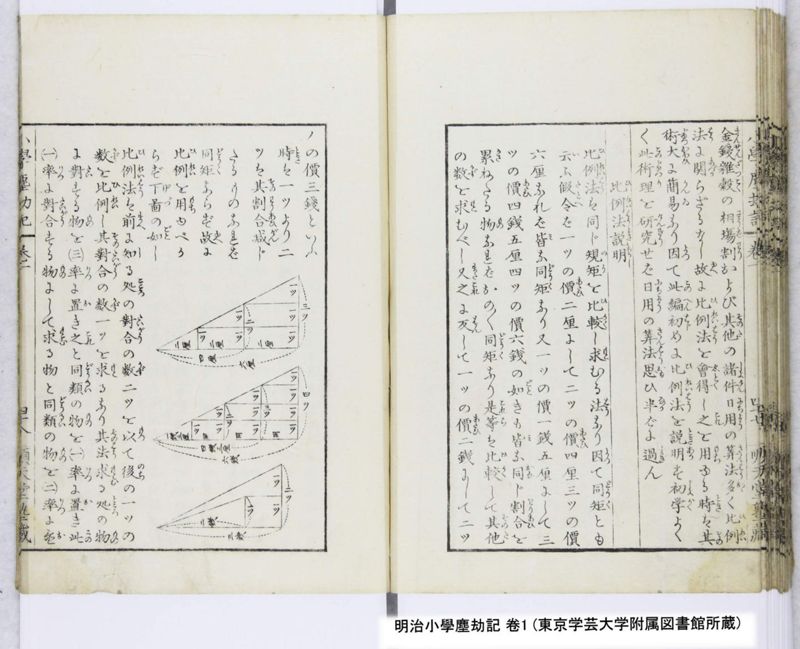
翻刻
【右丁】
金銭(きんせん)雑穀(ざつこく)の相場割(さうばわり)および其他(そのた)の諸件(しよけん)日用(にちよう)の算法(さんはう)多(おゝ)く比例(ひれい)
法(はう)に関(あづか)らざるなし故(ゆへ)に比例法(ひれいはう)を会得(ゑとく)し之(これ)を用(もち)ゆる時(とき)は其(その)
術(じゆつ)大(おほひ)に簡易(かんゐ)なり因(よつ)て此編(このへん)初(はじ)めに比例法(ひれいはう)を説明(ときあか)す初学(しよかく)よく
〳〵此(この)術理(じゆつり)を研究(けんきう)せば日用(にちよう)の算法(さんはう)思(おも)ひ半(なか)ばに過(すぎ)ん
比例法(ひれいはう)説明(ときあかし)
比例法(ひれいはう)は同じ䂓矩(のり)を比較(ひかく)し求(もと)むる法(はう)なり因(よつ)て同矩(どうく)とも
云(い)ふ仮令(たとへ)ば一ツの価(あたひ)二厘にして二ツの価(あたひ)四厘三ツの価
六厘なれば皆(み)な同矩(どうく)なり又一ツの価一銭五厘にして三
ツの価(あたひ)四銭五厘四ツの価六銭の如(ごと)きも皆(み)な同(おな)じ割合(わりあひ)を
累(かさ)ねたる物(もの)なればおの〳〵同矩(どうく)なり是等(これら)は比較(ひかく)して其他(そのた)
の数(かず)を求(もと)むべし又(また)之(これ)に反(はん)して一ツの価(あたひ)二銭にして二ツ
【左丁】
ノの価三銭といふ
時(とき)一ツより二
ツは其(その)割合(わりあひ)減(げん)じ
たるものなれば
同矩(どうく)ならず故(ゆへ)に
比例(ひれい)を用ゆべか
らず下図(げづ)の如(ごと)し
比例法(ひれいはう)は前(まへ)に知(し)る処(ところ)の対合(たいがう)の数(かず)二ツを以(もつ)て後(のち)の一ツの
数(かず)を比例(ひれい)し其(その)対合(たいがう)の数(かず)一ツを求(もと)#1るなり其法(そのはう)求(もとむ)る処(ところ)の物(もの)
に対(たい)する物(もの)を㈢率(りつ)に置(お)き之(これ)と同類(どうるい)の物(もの)を㈠率(りつ)に置(お)き此(この)
㈠率(りつ)に対合(たいがう)する物(もの)にして求(もとむ)る物と同類(どうるい)の物(もの)を㈡率(りつ)の置(お)
【図解上】
三ツ
一ツ 一ツ 一ツ
厘
二 厘
一ツ 一ツ 六
厘
二 厘
一ツ 四
厘
二
【図解中】
四ツ
一ツ 一ツ 一ツ 一ツ
同
三ツ
一ツ 一ツ 一ツ
同 銭
二ツ 厘 六
一ツ 一ツ 五
同 銭
四
一ツ
厘
五
銭
一
【図解下】
二ツ
一ツ 一ツ
一ツ 銭
三
銭
二
現代語訳
【右丁】
金銭や雑穀の相場割り、およびその他の諸事について、日常の計算法の多くは比例法に関わらないものはない。それゆえ、比例法を会得してこれを用いるときは、その術は大いに簡便となる。よって、この編の初めに比例法を説き明かす。初学の者はくれぐれもこの術の理をよく研究すれば、日常の計算法は思いの半ば以上に及ぶであろう。
比例法の説明
比例法とは、同じ規則(のり)を比較して求める方法である。それゆえ「同矩(どうく)」ともいう。たとえば、一つの価が二厘で、二つの価が四厘、三つの価が六厘であれば、皆同矩である。また、一つの価が一銭五厘で、三つの価が四銭五厘、四つの価が六銭のようなものも、皆同じ割合を重ねたものであるから、それぞれ同矩である。これらは比較してその他の数を求めるべきである。また、これに反して、一つの価が二銭で、二つ
【左丁】
の価が三銭というとき、一つより二つはその割合が減じたものであるから、同矩ではない。それゆえ比例を用いるべきではない。下図のとおりである。
比例法は、あらかじめ知っている対になる数(対合の数)二つをもって、後の一つの数を比例し、その対合の数一つを求めるものである。その方法は、求める物に対する物を第三率に置き、これと同類の物を第一率に置き、この第一率に対合する物であって求める物と同類の物を第二率に置く。
【図解:上(一つの価が二厘の場合)】
三つ
一つ 一つ 一つ
厘
二 厘
一つ 一つ 六
厘
二 厘
一つ 四
厘
二
【図解:中(一つの価が一銭五厘の場合)】
四つ
一つ 一つ 一つ 一つ
同
三つ
一つ 一つ 一つ
同 銭
二つ 厘 六
一つ 一つ 五
同 銭
四
一つ
厘
五
銭
一
【図解:下(同矩でない例:一つ二銭、二つ三銭の場合)】
二つ
一つ 一つ
一つ 銭
三
銭
二
英語訳
[Right page]
There is virtually no aspect of daily calculation — be it currency exchange rates, grain prices, or any other miscellaneous matter — that does not involve the method of proportion (*hirei-hō*). Therefore, once one has mastered the method of proportion and applies it, the technique becomes greatly simplified. For this reason, this volume begins by explaining the method of proportion. If beginning students study the principles of this technique thoroughly, they will find that more than half of all everyday calculations become manageable.
Explanation of the Method of Proportion
The method of proportion is a method of comparing things that follow the same rule (*nori*), and seeking an unknown quantity. It is therefore also called *dōku* ("same measure"). For example, if the price of one item is 2 *rin*, the price of two items is 4 *rin*, and the price of three items is 6 *rin*, then all of these are *dōku*. Likewise, if the price of one item is 1 *sen* 5 *rin*, the price of three items is 4 *sen* 5 *rin*, and the price of four items is 6 *sen*, these too are all cases where the same ratio is repeated, and therefore each is *dōku*. From such cases, one can compare and find the remaining unknown number. Conversely, however, if the price of one item is 2 *sen* and the price of two items
[Left page]
is 3 *sen*, then from one item to two items the ratio has *decreased*, and so this is not *dōku*. Therefore, the method of proportion must not be applied in such a case. This is illustrated in the diagram below.
The method of proportion uses two known paired numbers (*taigō no kazu*) to find the unknown third number through proportion, thereby obtaining one of the paired numbers. The procedure is as follows: place the quantity corresponding to the thing one wishes to find as the *third term* (㈢率); place the quantity of the same kind as the third term as the *first term* (㈠率); and place the quantity that is paired with the first term and belongs to the same kind as the thing to be found as the *second term* (㈡率).
[Diagram — Upper (case where the price of one item is 2 rin):]
Three items
One One One
rin
2 rin
One One 6
rin
2 rin
One 4
rin
2
[Diagram — Middle (case where the price of one item is 1 sen 5 rin):]
Four items
One One One One
same
Three items
One One One
same sen
Two items rin 6
One One 5
same sen
4
One item
rin
5
sen
1
[Diagram — Lower (non-*dōku* example: one item = 2 sen, two items = 3 sen):]
Two items
One One
One item sen
3
sen
2