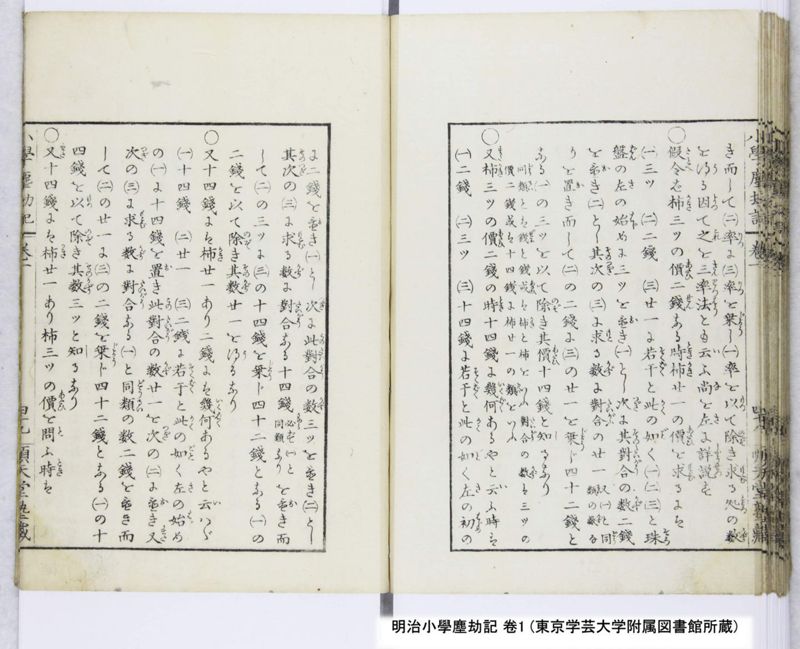
翻刻
【右丁】
き而して㈡率(りつ)に㈢率(りつ)を乗(じよう)し㈠率を以(もつ)て除(のぞ)き求(もとむ)る処(ところ)の数(かず)
を得(う)る因(よつ)て之(これ)を三率法(さんりつはう)とも云(い)ふ尚(な)を左(さ)に詳説(しやうせつ)す
○仮令(たとへ)ば柿(かき)三ツの価(あたひ)二 銭(せん)なる時(とき)柿(かき)廿一の価(あたひ)を求(もとむ)るには
㈠三ツ ㈡二銭 ㈢廿一に若干(そくばく)と此(かく)の如(ごと)く㈠㈡㈢と珠(そろ)
盤(ばん)の左(さ)の始(はじ)めに三ツを置(お)き㈠とし次(つぎ)に其(その)対合(たいがう)の数(かず)二銭
を置(お)き㈡とし其次(そのつぎ)の㈢に求(もと)る数(かず)に対合(たいがふ)の廿一《割書:又㈠と同(どう)|類(るい)の数(かず)な》
《割書:り》を置(お)き而して㈡の二銭に㈢の廿一を乗(じよう)じ四十二銭と
なる㈠の三ツを以て除(のぞ)き其 価(あたひ)十四銭と知(し)るなり
《割書:同類(どうるい)とは銭(ぜに)と銭 或(あるひ)は柿(かき)と柿をいふ対合(たいがう)の数(かず)は三ツの|価二銭或は十四銭に柿廿一の類(るい)をいふ》
○又(また)柿(かき)三ツの価(あたひ)二銭の時(とき)十四銭に幾何(いくばく)あるやと云(い)ふ時は
㈠二銭 ㈡三ツ ㈢十四銭に若干(そくばく)と此(かく)の如(ごと)く左(さ)の初(はじめ)の#1
【左丁】
に二銭を置(お)き㈠とし次(つぎ)に此(この)対合(たいがう)の数(かず)三ツを置き㈡とし
其次(そのつぎ)の㈢に求(もとむ)る数(かず)に対合(たいがう)なる十四銭《割書:必(かなら)ず㈠と|同類なり》を置(お)き而
して㈡の三ツに㈢の十四銭を乗(じよう)じ四十二銭となる㈠の
二銭を以て除(のぞ)き其数(そのかず)廿一を得(う)るなり
○又十四銭には柿(かき)廿一あり二銭には幾何(いくばく)あるやと云(い)はゞ
㈠十四銭 ㈡廿一 ㈢二銭に若干(そくばく)と此(かく)の如(ごと)く左(さ)の始め
の㈠に十四銭を置(お)き此(この)対合(たいがう)の数(かず)廿一を次(つぎ)の㈡に置(お)き又(また)
次(つぎ)の㈢に求(もとむ)る数(かず)に対合(たいがう)なる㈠と同類(どうるい)の数二銭を置き而
して㈡の廿一に㈢の二銭を乗(じよう)じ四十二銭となる㈠の十
四銭を以(もつ)て除(のぞ)き其数(そのかず)三ツと知(し)るなり
○又(また)十四銭には柿(かき)廿一あり柿三ツの価(あたひ)を問(と)ふ時(とき)は
現代語訳
【右丁】
こうして、第二率(㈡率)に第三率(㈢率)を掛け、第一率(㈠率)で割ることによって、求める数を得る。それゆえ、これを「三率法(さんりつほう)」とも呼ぶ。さらに詳しくは以下に説明する。
○たとえば、柿三つの値段が二銭であるとき、柿二十一個の値段を求めるには、
「㈠三つ ㈡二銭 ㈢二十一に対していくらか」というように、次のとおり、そろばんの左の始めに三つを置いて㈠とし、次にその対となる数、二銭を置いて㈡とし、その次の㈢に、求める数に対合する二十一(※㈠と同類の数である)を置く。そして㈡の二銭に㈢の二十一を掛けると四十二銭となる。㈠の三つで割ると、その値段は十四銭とわかる。
(「同類」とは、銭と銭、あるいは柿と柿をいう。「対合の数」とは、三つの値が二銭、あるいは十四銭に対して柿二十一、というような組み合わせをいう。)
○また、柿三つの値段が二銭のとき、十四銭では何個あるかというときは、
「㈠二銭 ㈡三つ ㈢十四銭に対していくらか」というように、左の始めの
【左丁】
㈠に二銭を置き、次にこの対となる数、三つを置いて㈡とし、その次の㈢に、求める数に対合する十四銭(必ず㈠と同類である)を置く。そして㈡の三つに㈢の十四銭を掛けると四十二銭となる。㈠の二銭で割ると、その数は二十一と得られる。
○また、十四銭に柿が二十一個あり、二銭には何個あるかというならば、
「㈠十四銭 ㈡二十一 ㈢二銭に対していくらか」というように、左の始めの㈠に十四銭を置き、この対となる数、二十一を次の㈡に置き、さらに次の㈢に、求める数に対合する㈠と同類の数、二銭を置く。そして㈡の二十一に㈢の二銭を掛けると四十二銭となる。㈠の十四銭で割ると、その数は三つとわかる。
○また、十四銭に柿が二十一個あり、柿三つの値段を問うときは、
英語訳
[Right page]
Then, multiply the second term (㈡) by the third term (㈢), and divide by the first term (㈠) to obtain the number sought. For this reason, this method is also called the "three-term method" (*sanritsu-hō*). A more detailed explanation follows below.
○For example, when the price of three persimmons is 2 *sen*, and one wishes to find the price of 21 persimmons:
Set up the terms as "㈠ three items ㈡ 2 *sen* ㈢ 21 — how much?", as follows. On the abacus, place three in the first position on the left as ㈠; next, place its paired number, 2 *sen*, as ㈡; and in the next position ㈢, place 21 — which is paired with the quantity sought and is of the same kind as ㈠. Then multiply ㈡ (2 *sen*) by ㈢ (21) to get 42 *sen*. Divide by ㈠ (three), and the price is found to be 14 *sen*.
(Note: "Same kind" [*dōrui*] means *sen* with *sen*, or persimmons with persimmons. "Paired numbers" [*taigō no kazu*] refers to combinations such as: the price of three items is 2 *sen*, or 14 *sen* paired with 21 persimmons.)
○Next, when the price of three persimmons is 2 *sen*, and one asks how many persimmons there are for 14 *sen*:
Set up as "㈠ 2 *sen* ㈡ three items ㈢ 14 *sen* — how many?", placing
[Left page]
2 *sen* at the first position on the left as ㈠; next, place its paired number, three items, as ㈡; and in the next position ㈢, place 14 *sen* (which is necessarily of the same kind as ㈠), paired with the quantity sought. Multiply ㈡ (three items) by ㈢ (14 *sen*) to get 42 *sen*. Divide by ㈠ (2 *sen*), and the number 21 is obtained.
○Further, if there are 21 persimmons for 14 *sen*, and one asks how many there are for 2 *sen*:
Set up as "㈠ 14 *sen* ㈡ 21 ㈢ 2 *sen* — how many?", placing 14 *sen* at the first position on the left as ㈠; place its paired number, 21, as ㈡; and in the next position ㈢, place 2 *sen* — a number of the same kind as ㈠ and paired with the quantity sought. Multiply ㈡ (21) by ㈢ (2 *sen*) to get 42 *sen*. Divide by ㈠ (14 *sen*), and the number is found to be three.
○Further, if there are 21 persimmons for 14 *sen*, and one asks for the price of three persimmons: