翻刻
【右丁】
金貨(きんくわ)
千/円(ゑん). 百円. 廿五円. 十円. 五円. 二円. 一円.《割書:以下銀貨|を用ゆ》
旧貨(きうくわ) 両(りやう).《割書:一円に|おなし》 歩(ぶ).《割書:廿五銭なり|又百匹といふ》 朱(しゆ).《割書:六銭二厘|五毛なり》 枚(まい).《割書:七両二分|をいふ》
銀貨(ぎんくわ)
一/円(ゑん). 五十/銭(せん). 廿銭. 十銭. 五銭.《割書:以下銭貨|を用ゆ》
旧貨 両.《割書:四匁三分|なり》 枚.(まい)《割書:四十三匁|なり》
銅貨(どうくわ)
二/銭(せん). 一銭. 五厘. 一厘.
旧貨(きうくわ) 天保銭(てんほうせん)《割書:八厘|なり》 寛永浪銭(くわんゑいなみせん)《割書:二厘|なり》 天保浪銭(てんほうなみせん)《割書:一厘五毛|なり》
寛永銅銭(くわんゑいどうせん)《割書:一厘に当る昔時|之を一文といふ》
算珠盤(そろばん)用(もち)ひようの事
【左丁】
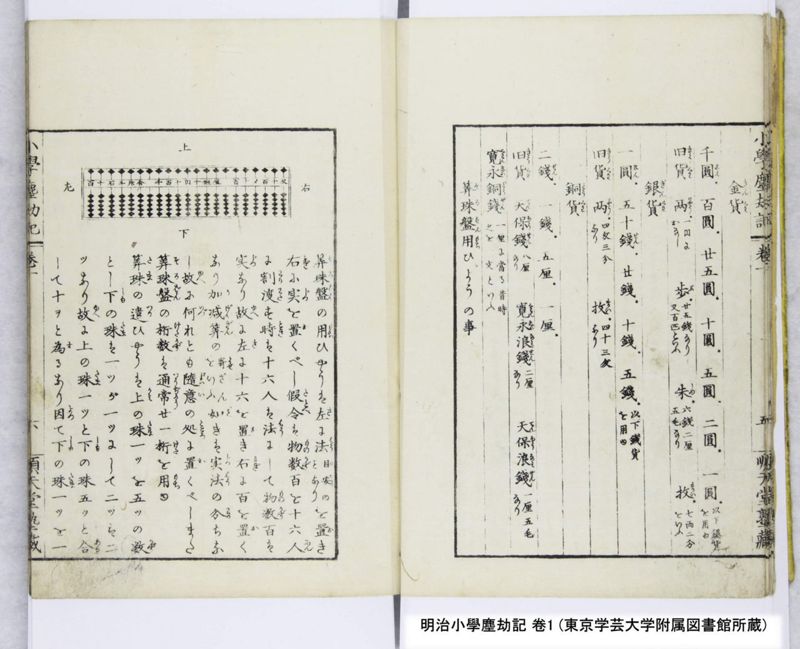
【上部に算珠盤の図】
【図の下】
算珠盤(そろばん)の用(もち)ひやうは左(さ)に法(はう)《割書:目安(めやす)の|ことなり》を置(お)き
右(みぎ)に実(じつ)を置(お)くべし仮令(たとへ)は物数(ものかず)百を十六/人(にん)
に割渡(わりわた)す時(とき)は十六人は法(はう)にして物数(ものかず)百は
実(じつ)なり故(ゆへ)に左(さ)に十六を置(お)き右(みぎ)に百を置(お)く
なり加減算(かげんざん)の《割書:寄(よせ)ざん|をいふ》如(ごと)きは実法(じつはう)の分(わか)ちな
し故(ゆへ)に何(いづ)れとも随意(ずいい)の処(ところ)に置(お)くべしまた
算珠盤(そろばん)の桁数(けたかず)は通常(つうぢよう)廿一/桁(けた)を用(もち)ゆ
算珠(たま)の遣(つか)ひやうは上(かみ)の珠(たま)一ッを五ッの数(かず)
とし下(しも)の珠(たま)は一ッが一ッにして二ッは二
ッなり故(ゆへ)に上の珠(たま)一ッと下(しも)の珠五ッと合(あわ)
して十ヲと為(す)るなり因(よつ)て下(しも)の珠(たま)一ッを一
【算珠盤の図】
右
◆匁◆◆◆◆◆
◆十◆◆◆◆◆
◆百◆◆◆◆◆
◆〆◆◆◆◆◆
◆十◆◆◆◆◆
◆百◆◆◆◆◆
◆ ◆◆◆◆◆
◆厘◆◆◆◆◆
◆銭◆◆◆◆◆
◆十◆◆◆◆◆
上 ◆円◆◆◆◆◆ 下
◆十◆◆◆◆◆
◆百◆◆◆◆◆
◆千◆◆◆◆◆
◆ ◆◆◆◆◆
◆合◆◆◆◆◆
◆升◆◆◆◆◆
◆斗◆◆◆◆◆
◆石◆◆◆◆◆
◆十◆◆◆◆◆
◆百◆◆◆◆◆
左
現代語訳
【右丁】
金貨
千円、百円、二十五円、十円、五円、二円、一円(以下銀貨を用いる)
旧貨:両(一円と同じ)、歩(二十五銭である、また百疋という)、朱(六銭二厘五毛である)、枚(七両二分をいう)
銀貨
一円、五十銭、二十銭、十銭、五銭(以下銅貨を用いる)
旧貨:両(四匁三分である)、枚(四十三匁である)
銅貨
二銭、一銭、五厘、一厘
旧貨:天保銭(八厘である)、寛永並銭(二厘である)、天保並銭(一厘五毛である)
寛永銅銭(一厘に当たる、昔はこれを一文という)
そろばんの使用方法について
【左丁】
【上部にそろばんの図】
【図の下】
そろばんの使い方は、左に法(目安のことである)を置き、右に実を置くべきである。たとえば、物の数百を十六人に割り当てる時は、十六人は法であり物の数百は実である。故に左に十六を置き、右に百を置くのである。加減算(足し算をいう)のようなものは実法の区別がないので、どちらでも任意の場所に置くべきである。また、そろばんの桁数は通常二十一桁を用いる。
そろばんの珠の使い方は、上の珠一つを五つの数とし、下の珠は一つが一つで二つは二つである。故に上の珠一つと下の珠五つと合わせて十とするのである。よって下の珠一つを一
【そろばんの図】
(右から左へ:匁、十、百、〆、十、百、厘、銭、十、円、十、百、千、合、升、斗、石、十、百の順で桁が配置されている)
英語訳
【Right Page】
Gold Coins
One thousand yen, one hundred yen, twenty-five yen, ten yen, five yen, two yen, one yen (silver coins are used below this)
Old currency: Ryō (same as one yen), Bu (twenty-five sen, also called hyaku-hiki), Shu (six sen two rin five mō), Mai (meaning seven ryō two bu)
Silver Coins
One yen, fifty sen, twenty sen, ten sen, five sen (copper coins are used below this)
Old currency: Ryō (four monme three fun), Mai (forty-three monme)
Copper Coins
Two sen, one sen, five rin, one rin
Old currency: Tenpō-sen (eight rin), Kan'ei nami-sen (two rin), Tenpō nami-sen (one rin five mō)
Kan'ei copper coins (equivalent to one rin, in old times this was called ichi-mon)
On the Use of the Abacus
【Left Page】
【Diagram of an abacus at the top】
【Below the diagram】
The method of using the abacus is to place the divisor (which means the standard) on the left and the dividend on the right. For example, when distributing one hundred items to sixteen people, the sixteen people are the divisor and the one hundred items are the dividend. Therefore, place sixteen on the left and one hundred on the right. For addition and subtraction (meaning addition), there is no distinction between dividend and divisor, so they may be placed anywhere as desired. Also, the number of columns on an abacus is usually twenty-one.
The method of using the beads is that one upper bead represents five, and the lower beads are one for one and two for two. Therefore, one upper bead and five lower beads together make ten. Thus, one lower bead represents one...
【Abacus Diagram】
(Columns arranged from right to left: monme, ten, hundred, tome, ten, hundred, rin, sen, ten, en, ten, hundred, thousand, gō, shō, to, koku, ten, hundred)