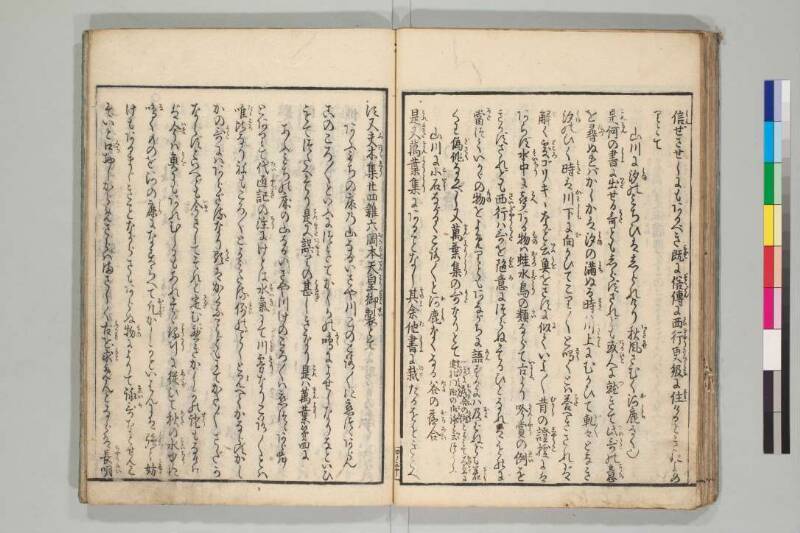
翻刻
【右丁】
信(しん)ぜさせしにもあるべき既(すで)に俗伝(ぞくでん)に西行(さいぎやう)更科(さらしな)に住(すみ)けるときによめ
りとて
山川に汐(しほ)のみちひはしられけり秋風(あきかせ)さむく河鹿(かしか)なく也
是(これ)何(なん)の書(しよ)に出(いだ)せる哥(うた)ともしらずされども或人(あるひと)に就(つ)きて此哥(このうた)の意(こゝろ)
を尋(たづ)ぬればかしかは汐(しほ)の満(みち)ぬる時(とき)は川上(かわかみ)にむかひて軋々(ぎし〳〵)となき
汐(しほ)のひく時(とき)は川下(かわしも)に向(む)かひてこり〳〵と鳴(なく)くとは答(こた)へきされば
解(と)く処(ところ)ゴリキヽなど云(いふ)魚(うを)をさすに似(に)ていよ〳〵昔(むかし)の証拠(しやうこ)には
あらず水中(すいちう)に声(こへ)ある物(もの)は蛙(かわつ)水鳥(みづとり)の類(るい)ならて古(いにしへ)より吟賞(きんしやう)の例(れい)を
きかずされども西行(さいぎやう)は哥(うた)を随意(ずいゐ)につらねたるひとなれはものに
当(あた)つていかゞの物(もの)をよめりともあながちに語(ろん)ずるには及(およ)ばねども若(もし)
くは偽作(ぎさく)なるべし又 萬葉集(まんようしう)の哥(うた)なりとて《割書:一説( せつ)に落合(おちあい)の滝(たき)とよみて大原(おほはら)に|建礼門院(けんれいもんゐん)の御詠(こゑい)と云(いゝ)つたふ》
山川に小石(こいし)ながるゝころ〳〵と河鹿(かしか)なくなる谷(たに)の落合(おちあひ)
是又(これまた)萬葉集(まんようしう)にあることなし其余(そのよ)他書(たしよ)に載(のせ)#1たるをもきこへ
【左丁】
す又 夫木集(ふほくしう)廿四雜六 岡本天皇(おかもとてんわう)御製(ぎよせい)とて
あふみちの床の山なるいさや川このころ〳〵に恋つゝあらん
このころ〳〵といふにつきてかしかの鳴(なく)によせしなりなといひ
もてつたへたり是又(これまた)誤(あやま)りの甚(はなはだ)しきなり是(これ)は萬葉(まんよう)第四に
あふみちの床の山なるいさや川けのころ〳〵は恋つゝあらむ
とありて代匠記(たいしやうき)の注(ちう)にけとは水気(すいき)にて川霧(かわきり)なりころ〳〵とは
唯(たゝ)頃(ころ)なりねもころ〳〵とよみたる例(れい)のごとしと見(み)へてかならずかし
かの哥(うた)にはあらざるなり歌(うた)はかゝることどもにてかた〴〵さだか
ならずといへども今(いま)さしてそれと定(さだ)むべきかしかの証(せう)もなけれ
ば今(いま)は魚(うを)にもあれむしにもあれたゞ流行(りうかう)に従(したが)ひて秋(あき)の水中(すいちう)に
鳴(な)くものを河の鹿(しか)になすらへて凢(およそ)かしかといはんには強(しゐ)て妨(さまた)
けもあるまじきことながらさもあらぬ物(もの)によりて詠哥(ゑいか)などせんこ
そいと口(くち)おしからめさらばまさしく古(ふるき)を求(もと)めんとならは長明(ちやうめい)
現代語訳
【右丁】
信じさせたところもあるのであろう。すでに俗伝によれば、西行が更科に住んでいたときに詠んだとして、
山川に汐のみちひはしられけり秋風さむく河鹿なく也
という歌がある。これがどの書物に出ている歌かも定かではない。しかしながら、ある人に就いてこの歌の意味を尋ねたところ、「かじかは潮が満ちてくる時は川上に向かってギシギシと鳴き、潮が引く時は川下に向かってコリコリと鳴く」と答えた。そうなると、解釈するところがゴリ・キキなどいう魚を指すように思われ、ますます昔の証拠とはなりえない。水中に声のあるものは蛙や水鳥の類であって、古くから吟誦・鑑賞の対象とされた例は聞かない。もっとも、西行は歌を思うままに詠み連ねた人であるから、何かに見立てていかなるものを詠んだとしても、あながちに論ずるにも及ばない。しかし、おそらくは偽作であろう。また、万葉集の歌であるとして、《割書:一説に落合の滝と読んで、大原における建礼門院の御詠とも伝える》
山川に小石ながるゝころ〳〵と河鹿なくなる谷の落合
という歌があるが、これもまた万葉集に存在しない。その他、他の書物に載せたという話も聞こえ
【左丁】
ない。また、夫木集・第二十四・雑六に岡本天皇の御製として、
あふみちの床の山なるいさや川このころ〳〵に恋つゝあらん
という歌があり、この「ころ〳〵」という言葉に引きつけて、かじかの鳴き声に見立てたのだなどと言い伝えられてきた。これもまた甚だしい誤りである。この歌は万葉集・第四巻に、
あふみちの床の山なるいさや川けのころ〳〵は恋つゝあらむ
とあって、「代匠記」の注に「け」とは水気のことで川霧のことである、「ころ〳〵」とはただ「頃(ころ)」のことであり、「ねもころ〳〵」と読む例のようなものだと記されており、必ずしもかじかの歌ではないのである。歌については、こうしたことどもで、諸々定かではないとはいえ、今さら特にこれと定めるべきかじかの証拠もないことから、今は魚であれ虫であれ、ただ流行に従って、秋に水中で鳴くものを「川の鹿」になぞらえておよそ「かじか」と言うことについては、あえて妨げることもあるまい。しかしながら、そうでもない根拠の怪しいものに依って詠歌などするのは、実に残念なことである。それならば、まさしく古いものを求めるというのであれば、長明(鴨長明)が……
英語訳
**[Right Page]**
...there may well have been cases where people were made to believe it. According to popular tradition, it has been transmitted as a poem composed by the poet Saigyō when he was living in Sarashina:
*Yamagawa ni shio no michihi wa shirarekeri akikaze samuku kajika naku nari*
(In the mountain stream, the ebb and flow of the tide can be felt — the autumn wind is cold, and the kajika cries.)
It is unclear from which book this poem originates. Nevertheless, when I asked a certain person about the meaning of this poem, they answered: "When the tide comes in, the kajika faces upstream and cries 'gishi-gishi,' and when the tide goes out, it faces downstream and cries 'kori-kori.'" In that case, the interpretation seems to point to fish such as the gori and kiki, which makes it even less convincing as ancient evidence. As for things that make sounds in the water, these are generally frogs or waterfowl, and one does not hear of precedents for their being subjects of poetic appreciation and recitation since ancient times. That said, Saigyō was a person who composed verses freely as he pleased, and even if he likened something to some creature in his poem, there is no particular need to argue about it. Still, this poem is most likely a forgery. Furthermore, there is a poem said to be from the *Man'yōshū* — with a side note reading: *One account reads this as the "Falls of Ochiai" and transmits it as a poem composed by Kenreimon'in at Ōhara* —
*Yamagawa ni koishi nagaruru koro-koro to kajika naku naru tani no ochiai*
(In the mountain stream, pebbles flow along — koro-koro — and in the gorge's confluence, the kajika cries.)
This poem also does not exist in the *Man'yōshū*. Nor have I heard of it being recorded in any other texts.
**[Left Page]**
Furthermore, in the *Fubokushū*, Volume 24, Miscellaneous Section 6, there is a poem attributed as an imperial composition by Emperor Okamoto:
*Ōumiji no toko no yamanaruisaya-gawa kono koro-koro ni koitsu tsu aran*
(On the road of Ōmi, in the Isaya River that flows by Mount Toko — in these koro-koro days, I shall remain longing.)
This has been handed down with the claim that the "koro-koro" in the poem was meant to evoke the cry of the kajika. This too is a most egregious error. This poem appears in *Man'yōshū*, Volume 4, as:
*Ōumiji no toko no yamanaruisaya-gawa ke no koro-koro wa koitsu tsua ramu*
(On the road of Ōmi, in the Isaya River that flows by Mount Toko — in these misty days of "koro-koro," I shall remain longing.)
The commentary in the *Daishōki* notes that "ke" refers to moisture/vapor, meaning river mist, and that "koro-koro" simply means "days" (koro), just as in the reading of "nemokoro-koro" — and thus this is by no means a poem about kajika. While the poetic evidence for kajika is uncertain in various respects, since there is at present no definitive proof to identify it as one thing or another, whether it be a fish or an insect, there would be no particular objection to simply following popular convention and calling whatever cries in the water in autumn a "kawa-no-shika" (river deer), or broadly speaking, a "kajika." However, it would be truly lamentable to compose poetry based on something whose foundation is so dubious. If one genuinely wishes to seek the proper ancient usage, then Chōmei (Kamo no Chōmei)...