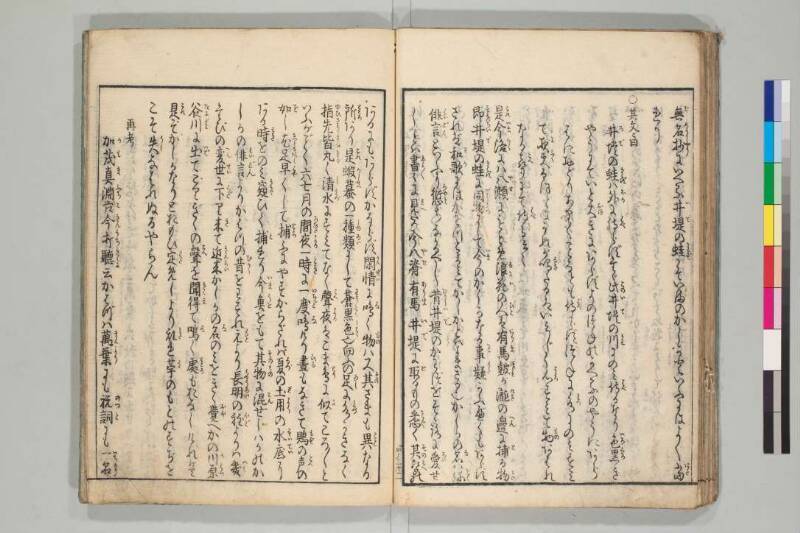
翻刻
【右丁】
無名抄(むめうしやう)にいへる《振り仮名:井堤の蛙|い で かわず》こそいまのかしかといふにはよく当(あた)
れり
○其文に曰
《振り仮名:井堤の蛙|い で かわず》は外(ほか)に侍(はべ)らずたゞ此(この)井堤(いて)の川(かわ)にのみ侍(はべ)るなり色(いろ)黒(くろ)き
やうにていと大(おほ)きにあらずよのつねのかへるのやうにあら
はにおどりありくことなとも侍(はべ)らずつねに水(みつ)にのみすみ
て夜更(よふく)るほどにかれが鳴(なき)たるはいみじく心(こゝろ)すみて物(もの)あはれ
なる声(こへ)にて侍(はべ)る云々
是今(これいま)洛(らく)には八瀬(やせ)にもとめ浪花(なには)の人(ひと)は有馬(ありま)《振り仮名:鼓が滝|つゞみ たき》の辺(へん)に捕(と)る物(もの)
即(すなはち)《振り仮名:井堤の蛙|い で かはず》に同物(どうぶつ)にして今(いま)のかしかなる事(こと)疑(うた)かふべくもあらず
されば和歌(わか)にはかわつとよみてかしかとはよまざる也かしかの名(な)は弥(いよ〳〵)
俳言(はいごん)といふに愆(あやま)ちなかるべし昔(むかし)井堤(いで)のかわずをそゝろに愛(あい)せ
しことは書々(しよ〳〵)に見(みへ)たり今 八脊(やせ)有馬(ありま)井堤(いで)に取(と)るもの悉(こと〴〵)く其声(そのこへ)の
【左丁】
あるにもあらずかならず閑情(かんせい)に鳴(な)く物(もの)は又 其(その)さまも異(こと)なる
所(ところ)あり是(これ)蝦蟇(かしま)の一 種類(しゆるい)にして蒼黒色(さうこくしよく)也向ふの足(あし)に水(みづ)かきなく
指先(ゆひさき)皆(みな)丸(まる)く清水(しみづ)にすみてなく声(こへ)夜(よる)はこま鳥(とり)に似(に)てころ〳〵と
いふがごとく六七月の間(あひた)夜(よる)一時( とき)に一度(いちど)鳴(な)けり昼(ひる)もなきて鵙(もず)の声(こへ)の
如(ごと)し尤(もつとも)足(あし)早(はや)くして捕(とら)ふにやすからざれば夏(なつ)の土用(どよう)の水底(すいてい)に
ある時(とき)をのみ窺(うかゞ)ひて捕(と)れり今(いま)魚(うを)をもて其物(そのもの)に混(こん)ぜしはかのか
しかの俳言(はいごん)よりかはつの昔(むかし)をわすれ元(もと)より長明(ちやうめい)の程(ほど)よりは幾(いく)
たびの変世(へんせい)に下(くだ)り来(き)て近来(きんらい)かしかの名(な)のみをきゝ覚(おぼ)へかの川原(かはら)
谷川(たにがわ)に出(いで)てごりぎくの声(こへ)を聞得(きゝえ)て鳴(な)く処(ところ)もおなしければ
是(これ)ぞかしかなりとおもひ定(さだ)めしより乱(みた)れ苧(を)のもとのすぢを
こそ失(うし)なはれぬるやらん
再考
賀茂真淵(かもまふち)古今打聴(こきんうちきゝに)云#1かはづは万葉(まんよう)にも祝詞(のつと)にも一名(いちめう)
現代語訳
【右丁】
(前ページより続く)長明の『無名抄』に述べられている「井堤の蛙(いでのかわず)」こそが、今日「かしか」と呼ばれているものに、まさしく当てはまるのである。
○その文に曰く:
「井堤の蛙は他の場所にはおらず、ただこの井堤の川にのみおります。色はやや黒く、それほど大きくはありません。普通の蛙のように、あらわに飛び跳ね歩き回るようなこともありません。常に水中にのみ棲んでおり、夜が更けるころに鳴く声は、まことに澄み渡って、もののあわれを感じさせる声でございます。(云々)」
これは現在、京(洛中)では八瀬で求められ、浪花(大阪)の人々は有馬の鼓が滝の辺りで捕らえるものである。すなわちこれは「井堤の蛙」と同じ生き物であり、今日の「かしか」に他ならないことは、疑う余地もない。
それゆえ、和歌においては「かわつ」と詠まれ、「かしか」とは詠まれないのである。「かしか」という名称は、俳言(俳諧の言葉)として用いるのに誤りはないであろう。昔、「井堤のかわず」がしみじみと愛でられたことは、さまざまな書物に見られる。今日、八瀬・有馬・井堤で捕らえられるものは、すべてその(美しい)声を持つわけではなく、必ずや閑かな情趣の中で鳴くものは、またその様子も他と異なるところがある。
【左丁】
これは蝦蟇(ひきがえる)の一種であり、青黒色をしている。後ろ足に水かきはなく、指先はみな丸く、清水に棲んで鳴く声は、夜はコマドリ(駒鳥)に似て、「ころころ」というようで、六月・七月の間は、夜に一刻(約二時間)に一度鳴く。昼も鳴き、その声はモズ(鵙)の声のようである。特に足が速く、捕まえることは容易でないため、夏の土用に水底にいる時をのみ狙って捕らえるのである。
現在、魚をもってこの生き物と混同されているのは、あの「かしか」という俳言が広まるにつれ、昔の「かわつ」のことを忘れ、もともと長明の時代よりも幾度もの世の移り変わりを経て下り来るうちに、近ごろでは「かしか」という名だけを聞き覚え、あの川原・谷川に出て「ごりぎく」の声を聞き得て、鳴く場所も同じであることから、「これぞかしかである」と思い定めた時から、乱れた麻糸のもとの筋を失ってしまったようである。
再考
賀茂真淵『古今打聴』に云う:「かはづは万葉にも祝詞にも、一名(別名)として……」
英語訳
**[Right Page]**
(Continuing from the previous page) What Chōmei described as the "ide-no-kawazu" (well-bank frog) in his *Mumyōshō* is precisely what is called "kashika" today.
○ The text states:
"The ide-no-kawazu is found nowhere else but only in this stream at Ide. It is somewhat dark in color and is not very large. It does not leap about openly as ordinary frogs do. It lives entirely in the water, and when it cries in the late hours of the night, its voice is remarkably clear and evokes a deep sense of *mono no aware* (pathos)." (And so forth.)
This creature is now sought in Yase in the capital (Kyoto), and the people of Naniwa (Osaka) capture it near the Tsuzumi Falls at Arima. It is, without doubt, the same creature as the "ide-no-kawazu," and there is no room for doubt that this is indeed the "kashika" of today.
Therefore, in *waka* poetry it is read as "kawatsu," and not as "kashika." The name "kashika" should be perfectly appropriate as a *haigon* (colloquial word used in haikai poetry). That the "ide-no-kawazu" was fondly admired in ancient times is seen in numerous texts. Not all of the creatures captured today at Yase, Arima, and Ide necessarily possess that (beautiful) voice; only those that cry with quiet elegance have a character distinct from the rest.
**[Left Page]**
This is a variety of toad (*hikigaeru*), bluish-black in color. Its hind feet have no webbing, all its toe-tips are round, and it lives in clear water. Its nighttime cry resembles that of the *koma-dori* (Japanese Robin), sounding like "*koro-koro*"; during the sixth and seventh months it cries once every *hitotoki* (approximately two hours) through the night. It also cries during the day, when its voice resembles that of a shrike (*mozu*). Since it is particularly quick on its feet and not easy to catch, one can only capture it by watching for the moment during the summer *doyo* period when it rests on the riverbed.
The current confusion that mixes fish with this creature stems from the spread of the *haigon* "kashika," through which people forgot the ancient "kawatsu." Since the time of Chōmei, the world has changed many times over, and in recent years people have only heard the name "kashika" and, going out to riverbanks and mountain streams, have heard the sound of the *gori-giku* fish and, because the location where it cries is the same, concluded "this must be the kashika"—from which point the original thread, tangled as disordered hemp fibers, was lost.
**Reconsideration**
Kamo no Mabuchi, in *Kokin Uchikiki*, states: "The *kawazu*, found both in the *Man'yōshū* and in the *norito* (Shinto ritual prayers), has as one of its names..."