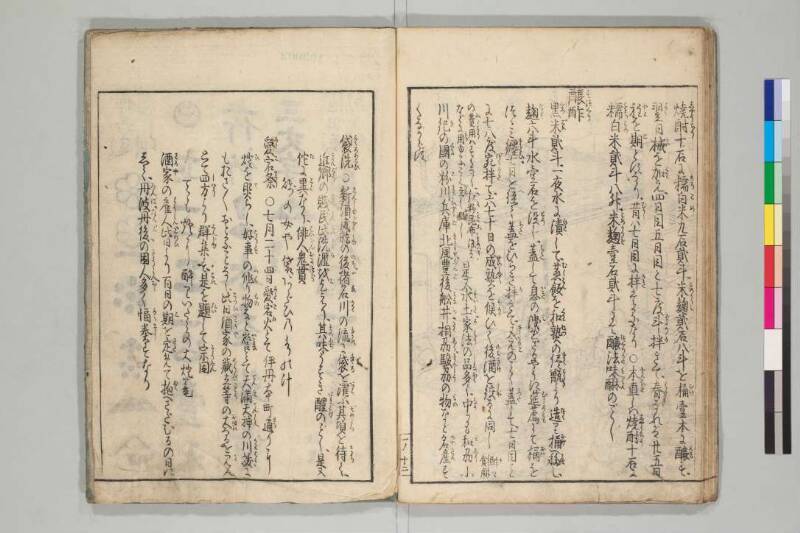
翻刻
【右丁】
焼酎(しやうちう)十石に糯白米(もちこめ)九石弐斗。米麹(こめかうし)弐石八斗を桶(おけ)壱本に醸(かも)す。
翌(よく)日/械(かい)を加(くわ)え。四日目五日目と七度/斗(ばかり)拌(か)きて。春なれば廿五日
程(ほと)を期(ご)とすなり。昔(むかし)は七日目に拌(かき)たるなり○本直(ほんなを)しは焼酎(しやうちう)十石に
糯白米(もちこめ)弐斗八升。米麹(こめかうじ)壱石弐斗にて醸法(つくりかた)味醂(みりん)のごとし
醸酢(すつくり)
黒米(くろごめ)弐斗。一夜水に漬(ひた)して。蒸飯(むしはん)を和熱(くわねつ)の侭(まゝ)甑(こしき)より造(つく)り桶(おけ)へ移(うつ)し。
麹(かうじ)六斗。水壱石を投(とう)じ。蓋(ふた)して息(いき)の洩(も)れざるやうに筵(むしろ)薦(こも)にて桶(おけ)を
つゝみ纏(まとひ)。七日を経(へ)て蓋(ふた)をひらき拌(か)きて。又(また)元(もと)のごとく蓋(ふた)して。七日目こと
に七八度/宛(づゝ)拌(かき)て。六七十日の成熟(せいしゆく)を候(うかゞ)ひて後(のち)酒(さけ)を絞(しぼ)るに同し《割書:酢(す)は|食用(しよくよう)》
《割書:の費用(ひくよう)はすくなし。紅粉(へに)。昆布(こんふ)。染色(そめいろ)。|などに用(もち)ゆること至(いたつ)て夥(おびたゝ)し》是又/水土(すいと)。家法(かはう)の品(しな)多(おゝ)く。中(なか)にも和州(わしう)小
川/紀(き)の国(くに)の粉川(こかわ)。兵庫(ひやうご)北風(きたかぜ)。豊後(ぶんご)船井(ふなゐ)。相州(さうしう)。駿州(すんしう)。の物(もの)など名産す
くなからず
【左丁】
袋洗(ふくろあらひ)○新酒(しんしゆ)成就(しやうしゆ)の後(のち)。猪名川(いなかわ)の流(なかれ)に袋(ふくろ)を濯(あら)ふ其頃(ぞのころ)を待(まち)て。
近郷(きんごう)の賎民(せんみん)此(この)洗瀝(しる)を乞(こ)えり。其(その)味(あぢ)うすき醴(あまさけ)のごとし。是又
佗(た)に異(こと)なり。俳人(はいじん)鬼貫(おにつら)
賎の女や袋あらひの水の汁
愛宕祭(あたこまつり)○七月二十四日/愛宕火(あたこひ)とて伊丹本町/通(とを)りに
燈(ひ)を照(て)らし。好事(こうす)の作(つく)り物(もの)なと営(いとな)みて天満天神(てんまてんしん)の川祓(かわはらへ)#1に
もおさ〳〵おとることなし。此日(このひ)酒家(さかや)の蔵立(くらたて)等(とう)の大(おほひ)なるを見(み)ん
とて四方(しはう)より群集(くんじゆ)す。是(これ)を題(たい)して宗因(そうゐん)
ても燈に酔りいたみの大燈篭
酒屋(さかや)の雇人(ようしん)。此日(このひ)より百日の期(こ)を定(さた)めて抱(かゝ)へさだむるの日に
して。丹波(たんば)。丹後(たんご)。困人(きうしん)多(おゝ)く幅奏(ふくそう)すなり
現代語訳
【右丁】
**焼酎の醸造**
焼酎十石に糯白米九石二斗、米麹二石八斗を桶一本で醸造する。翌日に撹拌を加え、四日目・五日目というように七度ほど撹拌して、春であれば二十五日ほどを期間の目安とする。昔は七日目に撹拌したものである。○本直しは焼酎十石に糯白米二斗八升、米麹一石二斗で、醸造方法は味醂と同様である。
**酢の醸造**
黒米二斗を一晩水に浸して、蒸したご飯を温かいまま甑から造り桶へ移し、麹六斗・水一石を投じ、蓋をして息(蒸気)が漏れないよう筵・薦で桶を包み巻く。七日を経て蓋を開け撹拌して、また元のように蓋をして、七日ごとに七〜八度ずつ撹拌し、六〜七十日の成熟を見計らったうえで、酒を絞るのと同じように搾る。
《割注:酢は食用としての費用は少ない。紅粉・昆布・染色などに用いることが非常に多い》
これもまた水土・家法によって品が多く、中でも大和国(やまとのくに)の小川、紀伊国の粉川、兵庫の北風(家)、豊後の船井、相模国、駿河国のものなど名産は少なくない。
【左丁】
**袋洗い**
新酒が出来上がった後、猪名川の流れで袋を洗う、その頃を待って近隣の貧しい民がこの洗い汁を乞う。その味は薄い甘酒のようである。これもまた他とは異なる風情がある。俳人・鬼貫の句:
賎の女や袋あらひの水の汁
**愛宕祭り**
七月二十四日、愛宕火とて伊丹本町通りに灯りを照らし、趣向を凝らした作り物などを設けて、天満天神の川祓いにも少しも劣ることがない。この日、酒家の蔵立てなどの大きなものを見ようとして、四方から人々が群集する。これを題として宗因の句:
ても燈に酔りいたみの大燈篭
酒屋の雇い人はこの日から百日の期を定めて雇い入れを決める日であり、丹波・丹後から困窮した人々が多く群れ集まって来るのである。
英語訳
**【Right Page】**
**Shochu Brewing**
To brew shochu: use ten *koku* of shochu with nine *koku* and two *to* of glutinous white rice, and two *koku* and eight *to* of rice koji, all brewed together in a single vat. The following day, stirring is applied, and continuing on the fourth and fifth days, stirring is carried out about seven times in total. In spring, a period of approximately twenty-five days is the standard. In former times, stirring was done on the seventh day. ○ For *honnashi* (a type of sweet liquor), ten *koku* of shochu is used with two *to* and eight *shō* of glutinous white rice and one *koku* and two *to* of rice koji; the brewing method is the same as for mirin.
**Vinegar Brewing**
Soak two *to* of black rice in water overnight, then transfer the steamed rice, while still warm, from the steaming vessel (*koshiki*) into a brewing vat. Add six *to* of koji and one *koku* of water, cover the vat, and wrap it tightly with straw mats and rush mats so that no air escapes. After seven days, open the lid, stir, then re-cover as before. Repeat stirring seven or eight times every seven days, and after monitoring the maturation process over sixty to seventy days, press it in the same manner as pressing sake.
《Side note: Vinegar is inexpensive as a foodstuff. It is used extensively for rouge (*beni*), kelp (*konbu*) processing, and dyeing, among other purposes.》
This product also varies greatly by local water conditions and household methods. Notable regional varieties include those from Ogawa in Yamato Province, Kokawa in Kii Province, Kitakaze in Hyōgo, Funai in Bungo, Sagami Province, and Suruga Province, among many other famous products.
**【Left Page】**
**Bag Washing**
After the new sake is complete, the pressing bags are washed in the waters of the Inagawa River. Around that time, the poor folk of the nearby villages come to beg for the washing water. Its taste resembles thin *amazake* (sweet rice drink). This too is a charm found nowhere else. A verse by the haiku poet Onitsura:
*Shizu no me ya fukuro arai no mizu no shiru*
(The humble women — the watery juice from washing the sake bags)
**Atago Festival**
On the twenty-fourth day of the seventh month, during the event called *Atago-bi* (Atago Fire), the main street of Itami is lit with lanterns, and elaborate decorative displays are set up, in no way inferior to the river purification ceremony (*kawabārae*) of Tenma Tenjin. On this day, people gather from all directions to view the grand *kuradatē* (vat-setting ceremonies) of the sake breweries. Sōin composed a verse on this theme:
*Temo hi ni you ri Itami no ōdōrō*
(Even so, intoxicated by the lantern light — the great lanterns of Itami)
The hired workers of the sake breweries mark this day as the occasion to formally engage workers for a period of one hundred days, and many people in need from Tanba and Tango provinces come crowding in.