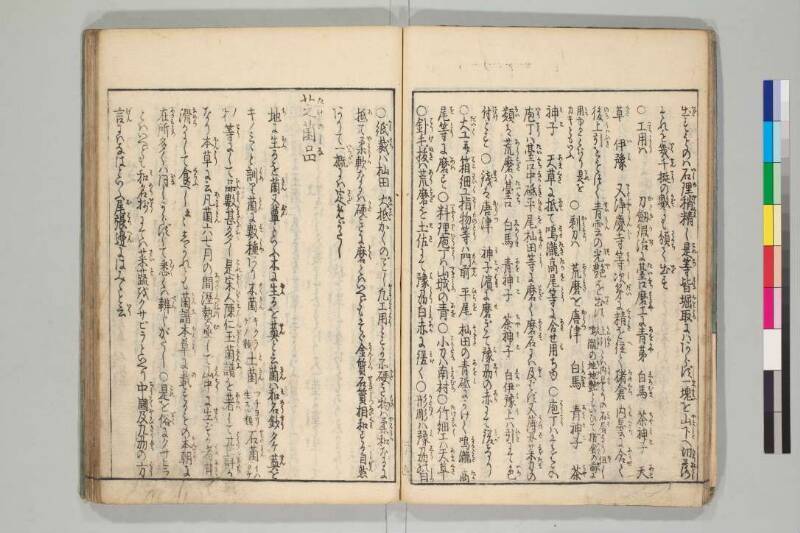
翻刻
【右丁】
出(いだ)すものは石理(いしめ)稍(やゝ)精(くわ)し是等(これら)皆(みな)堀取(ほりとる)にはあらず一塊(いつくわい)を山下(やました)へ切落(きりおとし)
それを幾千(いくせん)挺(てう)の数(かず)にも頒(わかち)て出(いだ)す
○工用(こうよう)は 刀剣(かたな)鍛治(かぢ)#1に台口(たいくち)磨工(ときや)に青茅(あをかや) 白馬(しろむま) 茶神子(ちやみこ) 天(あま)
草(くさ) 伊予(いよ) 又(また)浄慶寺(じやうけんじ)等(とう)次第(しだい)に精(くわしき)を経(へ)て猪倉(ゐのくら)内曇(うちくもり)に合(あわせ)て
後(のち)上引(うわひき)をもつて青雲(せいうん)の光艶(つや)を出(いた)す《割書:上引(うはひき)とは内曇(うちくも)りの石屑(こつぱ)なり但(たゝ)し|鳴瀧(なるたき)の地地艶(ちつや)#2ともいひて猪倉(いのくら)の前(まへ)に》
《割書:用(もち)ゆることあり是(これ)を|カキともいふ》○剃刀(かみそり)は 荒磨(あらとき)を唐津(からつ) 白馬(しろむま) 青神子(あをみこ) 茶(ちや)
神子(みこ) 天草(あまくさ)に抵(あて)て鳴瀧(なるたき)高尾(たかを)等(とう)に合(あわ)せ用(も)ちゆ○庖丁(はうてう)はたばこ
庖丁(はうてう)は台口(たいくち)中砥(なかとき)平尾(ひらを)杣田(そまた)等(とう)に磨(とぎ)て磨石(あわす)には及(およ)ばず又/薄刃(うすば)菜刀(ながたな)の
類(るい)は荒磨(あらとぎ)は台口(たいくち) 白馬(しろうま) 青神子(あをみこ) 茶神子(ちやみこ) 白伊予(しろいよ)上(う)は引(ひき)にて色(いろ)
付(つけ)とす○銭(せに)は唐津(からつ) 神子浜(みこがはま)に磨(と)ぎて予州(よしう)の赤(あか)にて鎈(みが)けり
○大工(だいく)《割書:并|》箱細工(はこさいく)指物(さしもの)等(とう)は門前(もんせん) 平尾(ひらを) 杣田(そまた)の青砥(あをと)にかけて鳴瀧(なるたき) 高(たか)
尾(を)等(とう)に磨(あは)す○料理庖丁(りやうりはうてう)は山城(やましろ)の青(あを)○小刀(こかたな)は南村(みなむら)○竹細工(たけさいく)は天草(あまくさ)
○針(はり)毛抜(けぬき)は荒磨(あらとぎ)を土佐(とさ)にて予州(よしう)白赤(しろあか)に鎈(みが)く○形彫(かたほり)は予州(よしう)の白(しろ)
【左丁】
○紙裁(かみたち)は杣田/大抵(たいてい)かくのごとし凡(およそ)工用(こうよう)とする所/硬(かた)き物(もの)は柔和(やわらか)なるに
抵(あ)て柔軟(やわらか)なるは硬(かた)きに磨(とく)とはいへどもたゞ金質(きんしつ)石質(せきしつ)相(あい)和(くわ)する自然(しぜん)
ありて一概(いちがい)には定(さだ)めがたし
芝菌品(たけのしな)
地(ち)に生(おふ)るを菌(きん)又/蕈(じん)といふ木に生(おふ)るを䓴(せん)と云/菌(きん)は和名鈔(わめうせう)タケ䓴(せん)を
キノミヽと訓(よめ)り菌(きん)に数種(すしゆ)あり木菌(もくきん)《割書:キクラ|ゲノ類》土菌(ときん)《割書:ツチヨリ|生スル類》石菌(せききん)《割書:イハ|タケ》
《割書:ノ|ルイ》等(とう)にして品数(ひんすう)甚(はなはだ)多(おゝ)し是(これ)宋人(そうひと)陳仁玉(ちんしんぎよく)菌譜(きんふ)を著(あらは)して甚(はなはた)詳(つまひら)か
なり本草(ほんさう)に云/凡(およそ)菌(きん)六七月の間(あいた)湿熱(しつねつ)蒸(む)して山中(さんちう)に生(せう)ずる者(もの)甘(あまく)
滑(なめら)かにして食(くらふ)べし云々しかれとも菌譜(きんふ)本草(ほんさう)に載(の)するもの本朝(ほんてう)に
在(ある)所(ところ)多くは同(おな)しからずして悉(こと〳〵)くは弁(べん)じがたし○是(これ)を俗(ぞく)にクサヒラ
とはいへども和名抄(わめうせう)にては菜蔬(さいそ)をクサビラといへり中国(ちうこく)及(および)九州(きうしう)の方(はう)
言(げん)にはなはといふ尾張(おはり)辺(へん)にはみゝと云(いう)
現代語訳
## 【右丁】
産出するものは石の目がやや細かく、これらはいずれも掘り取るのではなく、一塊を山の下へ切り落として、それを何千挺もの数に分けて出荷する。
### ○工用(用途別使い方)
**刀剣・鍛冶の場合:** 台口(粗砥)から始まり、磨き職人が青茅・白馬・茶神子・天草・伊予・浄慶寺などを順次細かいものへと経て、猪倉・内曇に仕上げ、その後「上引き」をもって青雲の光艶を出す。
※上引きとは内曇りの石屑のことである。ただし鳴瀧の「地艶(ちつや)」ともいい、猪倉の前に用いることがある。これを「カキ」ともいう。
**剃刀の場合:** 荒磨きを唐津・白馬・青神子・茶神子・天草に当てて、鳴瀧・高尾などに合わせて用いる。
**庖丁の場合:** タバコ包丁は台口・中砥の平尾・杣田などで研いで仕上げ砥(磨せ)には及ばない。また薄刃・菜刀の類は、荒磨きは台口・白馬・青神子・茶神子・白伊予を用い、上引きで色付けとする。
**銭(鋳銭)の場合:** 唐津・神子浜で研いで、予州(伊予)の赤砥で磨く。
**大工・箱細工・指物などの場合:** 門前・平尾・杣田の青砥にかけて、鳴瀧・高尾などで仕上げる。
**料理包丁の場合:** 山城の青砥を用いる。
**小刀の場合:** 南村の砥を用いる。
**竹細工の場合:** 天草の砥を用いる。
**針・毛抜きの場合:** 荒磨きを土佐で行い、予州の白・赤砥で磨く。
**形彫りの場合:** 予州の白砥を用いる。
## 【左丁】
**紙裁ち(断裁刃)の場合:** 杣田を用いる。
おおよそ以上の通りである。一般に用途とするところ、硬いものは柔らかな砥石に当て、柔らかなものは硬い砥石で研ぐとはいえ、ただ金属の質・石の質が自然に相和するものがあって、一概には定めがたい。
---
## 芝菌品(たけのしな)—キノコの品種
地に生えるものを「菌(きん)」または「蕈(じん)」といい、木に生えるものを「䓴(せん)」という。「菌」は『和名類聚抄』で「タケ」、「䓴」を「キノミヽ」と読んでいる。菌には数種あり、木菌(キクラゲの類)・土菌(土より生ずる類)・石菌(イワタケの類)などがあり、品数は甚だ多い。これについては宋人・陳仁玉が『菌譜』を著してはなはだ詳しい。
『本草綱目』にいわく、「およそ菌は六・七月の間、湿熱が蒸して山中に生ずるもので、甘くなめらかにして食べることができる」云々。しかしながら、『菌譜』や『本草綱目』に載せるものは本朝(日本)に存在するものと多くは一致せず、ことごとく弁別しがたい。
○これを俗に「クサヒラ」というが、『和名類聚抄』では菜蔬(野菜・草類)を「クサビラ」と言っている。中国(中国地方)および九州の方言では「なは」という。尾張あたりでは「ミヽ」という。
英語訳
## [Right Page]
Those produced [in Yōshū/Iyo] have somewhat fine-grained stone texture. None of these are extracted by digging; instead, a single mass is cut and dropped down the mountain, then divided into many thousands of pieces for distribution.
### ○ Uses by Trade (Kōyō)
**For sword and blade smiths:** Starting from the coarsest grade (daiguchi), polishing craftsmen proceed through stages of progressively finer stones — blue-green kaya (aokaya), white horse (shirōma), tea-colored miko (chamiko), Amakusa, Iyo, Jōkenji, and so on — before finishing with Inokura and uchikumori. After this, "uwahiki" is applied to bring out the deep blue-black gleaming luster (seiunno tsuya).
※ "Uwahiki" refers to stone chips from uchikumori stone. However, this is sometimes also called "chitsуya (ground luster)" from Narutaki, used before the Inokura step. It is also called "kaki."
**For razors:** Coarse sharpening is applied using Karatsu, shirōma, aomiko, chamiko, and Amakusa stones, then finished using Narutaki, Takao, and similar stones.
**For kitchen knives:** Tobacco knives are sharpened on daiguchi and medium-grade stones such as Hirao and Somata, without reaching the level of finishing stones. For thin-bladed vegetable knives (usuba, nagatana), the coarse sharpening uses daiguchi, shirōma, aomiko, chamiko, and white Iyo stones, and uwahiki is used to apply a final color-finish.
**For coins (cast copper coins):** These are sharpened/polished on Karatsu and Mikogahama stones, then finished with the red stone of Yōshū (Iyo Province).
**For carpenters, box-makers, and cabinetmakers (sashimono):** These are applied to the aoto (blue-green stones) of Monzen, Hirao, and Somata, then finished on Narutaki, Takao, and similar stones.
**For culinary knives:** The blue-green stone of Yamashiro is used.
**For small knives (kogatana):** The stone from Minamimura is used.
**For bamboo crafts:** Amakusa stone is used.
**For needles and tweezers:** Coarse sharpening is done with Tosa stone, then finished with the white and red stones of Yōshū.
**For mold carving (katagaeri):** The white stone of Yōshū is used.
## [Left Page]
**For paper cutting (kamisachi) blades:** Somata stone is used.
This is the general outline. In principle, when working on hard materials, a softer stone is used, and when working on soft materials, a harder stone is used — yet because there is a natural affinity between the quality of the metal and the quality of the stone, no universal rule can be firmly established.
---
## Shikin-hin (芝菌品) — Varieties of Mushrooms and Fungi
That which grows on the ground is called "kin (菌)" or "jin (蕈)," and that which grows on trees is called "sen (䓴)." In the *Wamyō Ruijushō* (Japanese lexicon), "kin" is read as "take (タケ)" and "sen" is read as "kinomimi (キノミヽ)." There are several types of kin: wood fungi (mokukin; things like kikurage / wood ear mushrooms), earth fungi (dokin; types that grow from the soil), and stone fungi (sekkin; things like iwatake / rock tripe), among others, with a great many varieties in total. On this subject, the Song-dynasty scholar Chen Renyu compiled the *Kinpu (菌譜, Treatise on Fungi)*, which is exceedingly thorough.
The *Honzō Kōmoku* (Bencao Gangmu, Compendium of Materia Medica) states: "In general, fungi grow in the mountains during the sixth and seventh months when heat and humidity cause steaming. Those that are sweet and smooth to the touch may be eaten," and so on. However, many of the fungi recorded in the *Kinpu* and the *Honzō Kōmoku* do not correspond to those found in Japan, and it is difficult to classify them all completely.
○ These are commonly called "kusahira" in vernacular speech, though in the *Wamyō Ruijushō*, the word "kusabira" refers to vegetables and edible herbs in general. In the dialects of the Chūgoku region and Kyushu, mushrooms are called "naha." In the area around Owari Province, they are called "mimi."