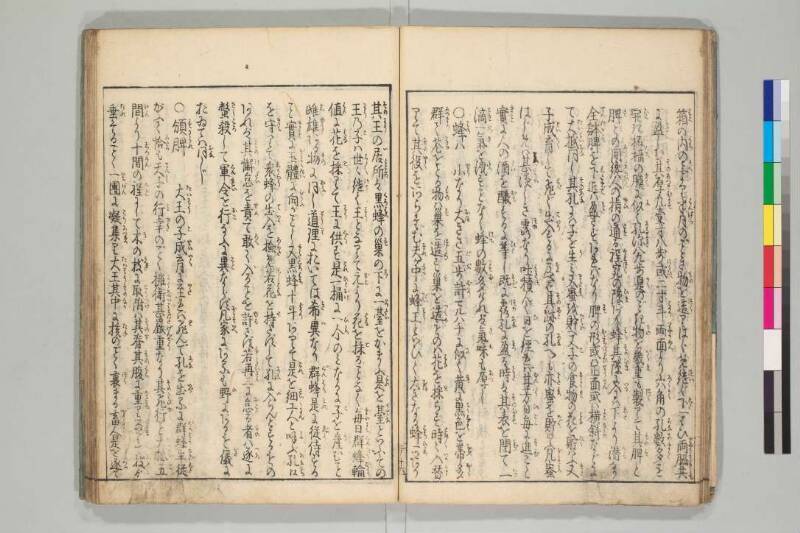
翻刻
【右丁】
箱(はこ)の内(うち)の上(うへ)より半月(はんげつ)のごとき物(もの)を造(つく)りはじめ継(つい)で下(した)一はひ両脇(りやうわき)共(とも)
に盈(みた)しむ其(その)厚(あつさ)凡(およそ)壱寸八歩/或(あるひは)二寸/斗(はかり)両面(りやうめん)より六角(ろくかく)の孔(あな)数多(あまた)を
開(ひら)き柘榴(ざくろ)の膜(まく)に似(に)て孔(あな)深(ふかさ)八九歩/是(かく)のごとき物(もの)を幾重(いくえ)も製(つく)りて其(その)脾(す)と
脾(す)との間(あいた)纔(わつか)人(ひと)の指(ゆひ)の通(とを)る程宛(ほとつゝ)の隙(ひま)あり蜂(はち)其隙(そのひま)に入(いる)には下(した)より潜(くゝる)なり
全体(せんたい)脾(す)を下(した)迄(まで)は盈(みた)さずあればなり脾(す)の形(かたち)或(あるひ)は正面(せうめん)或は横(よこ)斜(なゝめ)などに
て大抵(たいてい)同(おな)し其孔(そのあな)には子を生(う)み又(また)蜜(みつ)を貯(たくは)へ又 子(こ)の食物(しよくもつ)の花(はな)を貯(たく)はふ又(また)
子/成育(せいいく)して飛(とん)で出入(ていり)するに及(およ)べば其跡(そのあと)の孔(あな)へも亦(また)蜜(みつ)を貯(たく)はふ凡(およそ)蜜(みつ)
はじめは甚(はなはた)淡(あは)しき露(つゆ)なり吐積(はきつ)んで日(ひ)を経(へ)れば甘芳(かんはう)日毎(ひごと)に進(すゝむ)こと
実(まこと)に人の酒(さけ)を醸(かも)するに等(ひと)し既(すで)に露孔(つゆあな)に盈(みつ)る時(とき)は其(その)表(おもて)を閉(とぢ)て一(いつ)
滴(てき)一気(いつき)を洩(もら)すことなし蜂(はち)の数(かず)多(おゝ)ければ気味(きみ)も厚(あつ)し
○蜂(はち)は小(せう)なり大(おほ)きさ五歩(ごぶ)許(ばかり)マルハチに似(に)て黄(き)に黒色(こくしよく)を帯(おぶ)多(おゝく)
群(あつまり)て花(はな)をとる物(もの)は巣(す)を造(つくら)ず巣(す)を造(つくる)ものは花(はな)を採(と)らず時々(とき〳〵)入替(いりかわ)
りて其(その)役(やく)をあらたむ夫(それ)が中(なか)に蜂王(だいわう)といひて大(おほ)きなる蜂(はち)一(ひとつ)つあり
【左丁】
其(その)王(わう)の居所(いところ)は黒蜂(くろはち)の巣(す)の下(した)に一台(いつたい)をかまふ是(これ)を台(うてな)といふその
王(わう)の子(こ)は世々(よ 〳〵)継(つき)て王(わう)となりて元(もと)より花(はな)を採(と)ることなく毎日(まいにち)群蜂輪(くんほうかわり)
値(はん)に花(はな)を採(と)りて王(わう)に供(くう)す是(これ)一桶(ひとおけ)に一个(ひとつ)のみなるに子(こ)を産(う)むこと
雌雄(しゆう)ある物(もの)に同(おな)し道理(とうり)においては希異(きい)なり群蜂(ぐんはう)是(これ)に従侍(じうじ)する
こと実(まこと)に玉体(ぎよくたい)に向(むかふ)がごとし又(また)黒蜂(くろはち)十/斗(ばかり)ありて是(これ)を細工人(さいくにん)と呼(よ)ぶ孔口(あなくち)
を守(まも)りて衆蜂(しうはう)の出入(ていり)を撿(あらた)め若(もし)花(はな)を持(も)たずして孔(あな)に入(い)らんとするもの
あれば其(その)懈怠(けだい)を責(せめ)て敢(あへ)て入(い)ることを許(ゆる)さず若(もし)再三(さいさん)に怠(おこた)る者(もの)は遂(つゐ)に
螫殺(さしころ)して軍令(くんれい)を行(おこ)なふに異(こと)ならず凡(およそ)家(いへ)にあるも野(の)にあるも儀(ぎ)に
おゐては同(おな)じ
○ 頒脾(すわかれ) 大王(たいわう)の子(こ)成育(せいいく)に至(いた)れば飛(と)んで孔(あな)を出(いづ)るに群蜂(ぐんはう)半(なかば)従(した)
がふて恰(あたか)も天子(てんし)の行幸(みゆき)のごとく擁衛(ようゑい)甚(はなはた)厳重(げんぢう)なり其(その)飛行(とびゆく)こと大抵(たいてい)五(ご)
間(けん)より十間(じつけん)の程(ほど)にして木(き)の枝(えだ)に取附(とりつけ)は其脊(そのせ)其腹(そのはら)に重(かさな)り留(とゞま)りて枝(えだ)ゟ(より)
垂(たれ)たるごとく一団(いちだん)に凝(こり)集(あつま)り大王(たいわう)其中(そのなか)に核(たね)のごとく裹(つゝ)#2まる畜人(やしなふひと)是を逐(おふ)て
現代語訳
【右丁】
箱の内の上より半月のような物を造り始め、続いて下へ一杯、両脇ともに満たしていく。その厚さはおよそ一寸八分、あるいは二寸ばかり。両面より六角の穴を数多く開け、柘榴の膜に似て、穴の深さは八・九分。このような物を幾重にも作り、その巣と巣との間にわずかに人の指が通るほどの隙間がある。蜂がその隙間に入るには、下から潜るようにして入る。全体として巣を下まで満たさないようにしてあるためである。巣の形はあるいは正面、あるいは横・斜めなどで、大体同じである。その穴には子を産み、また蜜を貯え、また子の食物となる花粉を貯える。また子が成育して飛んで出入りするようになると、その後の穴へも再び蜜を貯える。そもそも蜜は最初は甚だ淡い露のようなものである。吐き積んで日を経れば、甘く芳しくなること日ごとに進み、実に人が酒を醸すのに等しい。すでに露が穴に満ちる時は、その表面を閉じて一滴一気たりとも漏らすことがない。蜂の数が多ければ、気味(風味)も濃い。
○蜂は小さい。大きさは五分ばかりで、丸蜂に似て、黄色に黒色を帯びている。多く集まって花を採るものは巣を造らず、巣を造るものは花を採らない。時々入れ替わりてその役目を改める。その中に女王蜂といって、大きな蜂が一つある。
【左丁】
その王の居所は、黒蜂の巣の下に一台を構える。これを台(うてな)という。その王の子は代々継いで王となり、もとより花を採ることなく、毎日、群れの蜂が交代番に花を採って王に供する。これは一桶に一つのみであるのに子を産むこと、雌雄ある生き物と同じであり、道理においては希異(珍しい)なことである。群蜂がこれに従い侍することは、まことに天子の玉体に向かうがごとしである。また黒蜂が十匹ほどあって、これを細工人と呼ぶ。穴口を守って、衆蜂の出入りを改め(検査し)、もし花を持たずして穴に入ろうとする者があれば、その怠惰を責めて、敢えて入ることを許さない。もし再三に怠る者は、遂に螫し殺して、軍令を行うのと異ならない。およそ家にあっても野にあっても、その仕組みにおいては同じである。
○分巣(巣別れ) 女王蜂の子が成育に至れば、飛んで穴を出るに、群蜂の半ばが従って、まるで天子の行幸のごとく、擁護・護衛することが甚だ厳重である。その飛び行くことはおよそ五間より十間の程にして、木の枝に取り付き、その背に、その腹に重なり留まって、枝より垂れたるごとく一団に凝り集まり、女王蜂はその中に核(種)のごとく包まれる。飼い主はこれを追って…
英語訳
【Right page】
Starting from the top inside the box, they begin constructing something resembling a half-moon shape, then proceed to fill it downward, filling the entire space including both sides. The thickness is approximately one sun and eight bu, or about two sun. Numerous hexagonal cells are opened from both faces, resembling the membrane of a pomegranate, with each cell about eight to nine bu deep. Such structures are made in multiple layers, with just enough space between one comb and the next for a human finger to pass through. The bees enter these gaps by crawling in from below, as the combs are deliberately not filled all the way to the bottom. The orientation of the combs may be frontal, horizontal, or diagonal, but are generally the same. In these cells, they lay eggs, store honey, and store the flower pollen that serves as food for the larvae. Once the larvae mature and begin flying in and out, honey is again stored in the vacated cells. In the beginning, honey is an extremely thin, dew-like substance. As it accumulates over days through regurgitation, its sweetness and fragrance improve daily — truly comparable to how humans brew sake. Once the cells are filled with this liquid, their surfaces are sealed so that not a single drop nor breath escapes. The more bees there are, the richer the flavor of the honey.
○The bee is small — about five bu in size, resembling the maru-bachi (a type of bee), tinged black on yellow. Those that gather in large groups to collect flowers do not build nests; those that build nests do not collect flowers. They periodically swap roles. Among them is one larger bee called the queen bee.
【Left page】
The queen's dwelling is established on a single platform below the black bees' comb. This is called the "utena" (pedestal/platform). The queen's offspring succeed her generation after generation as queens, and from the outset the queen never collects flowers herself; every day the swarm of bees takes turns collecting flowers and offering them to the queen. Despite there being only one per hive, she produces offspring just like creatures that have distinct sexes — a remarkably extraordinary phenomenon when considered rationally. The swarm attends upon her truly as if approaching the sacred person of the Emperor. There are also about ten black bees, called "craftsmen" (saikūnin). They guard the entrance hole, inspecting the comings and goings of all bees. If any bee attempts to enter without carrying flowers, her negligence is reprimanded and she is firmly refused entry. If she repeatedly neglects her duty, she is ultimately stung to death — no different from the enforcement of military law. Whether in a domestic hive or in the wild, this system is the same.
○Swarming (Nest Division): When the queen's offspring reaches maturity, it flies out of the entrance hole, with half the swarm following — as solemn and well-guarded as the imperial procession of the Emperor. Their flight covers generally a distance of five to ten ken, after which they attach themselves to a tree branch, clustering back to belly in a single dense mass hanging from the branch, with the new queen enclosed within like a seed at the center. The beekeeper chases after them...