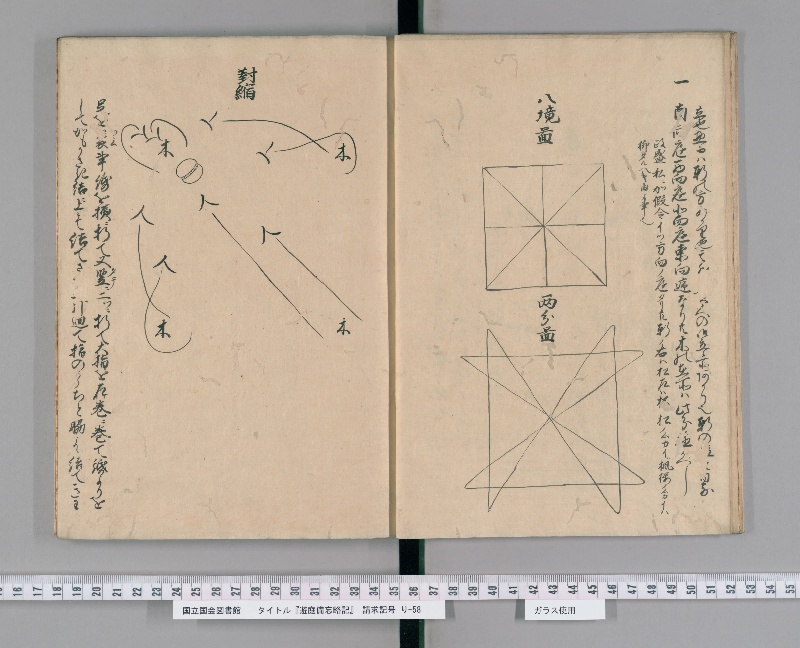
翻刻
立也惣而は軒の方あかり也其■■■人の御立候所あかり也軒の■■同前
一 南向庭西向庭北向庭東向庭なり共木の在所は此分植かへし
政盛私に加假令いつ方向の庭たり共軒の右は松左は橘松のむかいは楓桜のむかいは
栁たるへき由の事也
八境圖 両分圖
木 木
人 人
對縮
人
人
鞠
木 人 木
人
人 人
是を裹(つゝむ)事紙を横に折て又竪(たて)に二つに折て大指を左巻に巻て紙よりを
してかもかさき結に上も結てさ■■引廻て指のうちと脇も結てきわ
現代語訳
(前頁よりの続き)立つものである。総じて、軒の方が「あかり(明かり・上手)」となる。その■■■人の御立ちになる所が「あかり」となる。軒の■■も同前。
一、南向きの庭・西向きの庭・北向きの庭・東向きの庭であっても、木の在り所はこの通りに植え替えるべきこと。
政盛が私(しるし)に加えるに、仮令(たとえ)いずれの方向の庭であっても、軒の右は松、左は橘(たちばな)、松の向かいは楓、桜の向かいは柳、であるべき旨のことである。
【図:八境図(はちきょうず)および両分図(りょうぶんず)】
(八境図)
木
木
人 人
對縮(たいしゅく)
人
人
鞠
木 人 木
人
人 人
(両分図)
木
木
これ(=紙縒り?もしくは鞠?)を裹(つつむ)こと。紙を横に折って、また縦に二つに折って、大指(おおゆび=親指)を左巻きに巻いて、紙縒(こより)をして、「かもかさき結び」に上も結んで、さ■■引き回して、指の内と脇も結んで、きわ……
英語訳
(Continued from the previous page) …one stands accordingly. In general, the side toward the eaves (*noki*) is called *akari* (the "bright" or "upper" side). The place where that [certain] person stands is the *akari*. The ■■ of the eaves is likewise the same.
Item: Whether the garden faces south, west, north, or east, the placement of the trees should be replanted accordingly as follows.
[A note added personally by Masamori:] No matter which direction the garden faces, to the right of the eaves should be the pine (*matsu*), to the left should be the tachibana (橘, mandarin orange), facing the pine should be the maple (*kaede*), and facing the cherry (*sakura*) should be the willow (*yanagi*). This is the prescribed rule.
【Diagrams: "Hachi-kyō-zu" (Eight-Boundary Diagram) and "Ryōbun-zu" (Two-Division Diagram)】
*(Eight-Boundary Diagram)*
```
[Tree]
[Tree]
[Person] [Person]
Taishuku (對縮)
[Person]
[Person]
[Ball (鞠)]
[Tree] [Person] [Tree]
[Person]
[Person] [Person]
```
*(Two-Division Diagram)*
```
[Tree]
[Tree]
```
Concerning the wrapping of this [object — likely the kemari ball or paper cord]: Fold the paper horizontally, then fold it again vertically into two; wrap the thumb (*oyayubi*) in a left-handed roll (*hidarimaki*); twist it into a paper cord (*koyori*); tie it in a "*kamokasaki*-knot" (*かもかさき結び*), tying also the top; draw it around [through] ■■; tie also the inside of the fingers and the sides; and at the edge…