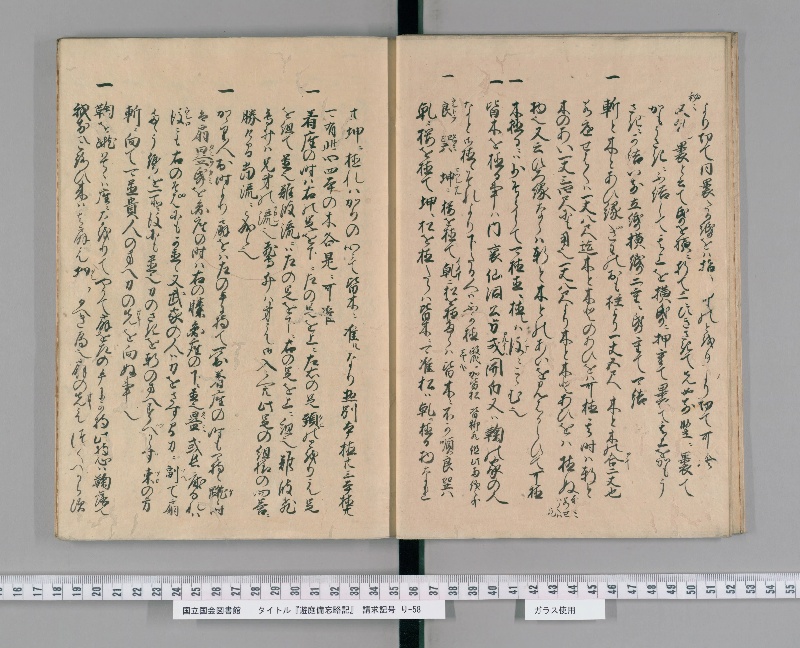
翻刻
より切て同裹たる紙をは指■■のとをりより切て可合
《割書:秘に|》又刻裹と云て帋を横に折て二にひきさきて先如前竪に裹て
かもうさきに不結して其上を横紙に押重て裹て其上をかもう
さきに可結い前立紙横紙二重に紙重て可結
一 軒と木とあひ縁ぎわのおも柱より一丈五尺 木と木の合(あい)二丈也
前庭せはくは一丈八尺迄木と木のあひをは可植其時は軒と
木のあい一丈三四尺にも用也一丈八尺より木と木とあひをは植ぬ 本■若せはくは歟
物也又云ひろ縁ならは軒と木とのあいを見はからひて可植
一 木植るには少そらして可植直に植れは後(のち)にこゝむ也
一 皆木を植る事は内裏仙洞公方 或(あるいは)関白又は鞠の家の人
なと御植候それより下たる人はい不可植《割書:政■に加皆松皆柳歟但此両儀之外|■歟》
一 艮(うしとら)巽(たつみ)坤(ひつじさる)梅を植て乾(いぬい)に松を植たらは皆木に不可順艮巽
乾に梅を植て坤に松を植たらは皆木に可准松は乾に植る物なれ
共坤に植れはかりの心にて皆木に准るなり惣別本植共三本植共
可有此心四本の木各是に可准
一 着座の時は右の足を下に左の足を上に左右の足 頸(くひ)のとをりにて足
を組て置也難波流には左の足を下に右の足を上に組也難波飛
鳥井は兄弟の流(なかれ)也飛鳥井は弟にて御入候へ共此足の組様の四善に
勝けり當流に被成候也
一 かゝり人出時より扇をは左の手に持て可_レ出着座の時も可持候 蹴(け)之時
は扇 畳(たゝみ)紙(かみ)を円座の時は右の膝円座の下に置也 畳(たゝみ)或長床なれは
後(うしろ)にも右のそばに可置候又武家の人は刀をさす間刀に副(そへ)て扇
たゝう紙を一所に後にも置也刀のさきを軒の方ヘすべからず束(つか)の方
軒に向て可置貴人の方へ刀の先(さき)を向ぬ事也
一 鞠を蹴はてゝは座になをりてやかて扇を左の手に可持此持心ハ鞠落て
我前へころひ来は其扇にて押(をし)■るへき為也扇の先(さき)にてつくへからす
現代語訳
〔前頁より続き〕より切って、同じく裹(つつ)んだる紙をば、指■■(判読不能)の通りより切って合わせるべし。
《割書:秘に》また「刻裹(きざみづつみ)」と云って、紙を横に折って二つに引き裂いて、先の如く竪(たて)に裹(つつ)んで、かもうさきに結ばずして、その上を横紙に押し重ねて裹んで、その上をかもうさきに結ぶべし。前立紙・横紙、二重に紙を重ねて結ぶべし。
一、軒と木との相(あい)縁際(えんぎわ)の表柱より一丈五尺、木と木の間(あい)二丈也。
前庭が狭き場合は一丈八尺までを木と木の間として植えるべし。その時は軒と木の間を一丈三・四尺に用いることも可也。一丈八尺より木と木の間を植えることはしない。本■(判読不能)若し狭き場合歟。
また云う、広縁(ひろえん)ならば軒と木との間を見計らいて植えるべし。
一、木を植えるには、少し(幹を)そらして植えるべし。直(まっすぐ)に植えれば、後に(木が)込む(倒れ込む・密集する)ことになるなり。
一、皆木(かいぼく)を植える事は、内裏・仙洞・公方(くぼう)、あるいは関白、または鞠の家の人などが御植えになること。それより下たる(身分の低い)人はい(て)植えてはいけない。《割書:政■(判読不能)に加える。皆松・皆柳歟。但しこの両儀の外■(判読不能)歟。》
一、艮(うしとら・北東)・巽(たつみ・東南)・坤(ひつじさる・南西)に梅を植えて、乾(いぬい・北西)に松を植えたならば、皆木(かいぼく)の順に従ってはいけない。艮・巽・乾に梅を植えて、坤に松を植えたならば、皆木の準(なぞらえ)に可(か)なう。松は乾(北西)に植えるものであるが、坤(南西)に植えた場合は、仮の心(便宜的な考え方)として皆木に準ずるなり。総じて、本植(もとうえ)であっても三本植であっても、この心(考え方)があるべし。四本の木はそれぞれこれに準ずべし。
一、着座の時は、右の足を下に、左の足を上にして、左右の足を頸(くび)の通りにて足を組んで置くなり。難波流(なにわりゅう)には、左の足を下に、右の足を上に組むなり。難波・飛鳥井(あすかい)は兄弟の流(なかれ)なり。飛鳥井は弟にておられるが、この足の組み様において四善(しぜん)に勝りけり。当流においてこのようにされるなり。
一、かかり人が出る時より、扇をば左の手に持って出るべし。着座の時も持つべし。蹴る時は、扇・畳紙(たたみがみ)を、円座(えんざ)の時は右の膝・円座の下に置くなり。畳(たたみ)あるいは長床ならば、後ろにも右のそばに置くべし。また、武家の人は刀を差す間(あいだ)、刀に添えて、扇・畳紙を一所に後ろにも置くなり。刀の先(さき)を軒の方へ向けるべからず。束(つか)の方を軒に向けて置くべし。貴人の方へ刀の先を向けぬ事なり。
一、鞠を蹴り果てては、座に直りて、やがて扇を左の手に持つべし。この持ち心は、鞠が落ちて我が前へ転がり来た時は、その扇にて押さえ■(判読不能)るべき為なり。扇の先にて突くべからず。
英語訳
[Continued from previous page] …cut from there, and likewise, the wrapped paper should be cut according to the same method as the finger ■■ (illegible) and joined together.
《Marginal note: Secret / Confidential》 Furthermore, what is called *kizamizutsumi* ("notch wrapping"): fold the paper horizontally, then tear it into two pieces, wrap it vertically as before, without tying it at the *kamōsaki* (tip knot), then press and layer another horizontal sheet of paper on top and wrap it, and upon that, tie it at the *kamōsaki*. The front paper and horizontal paper are to be layered doubly and then tied.
Item: The distance from the front column at the veranda edge (*engigawa*) between the eave (*noki*) and the tree is one *jō* five *shaku* (approx. 4.5 m); the distance between tree and tree is two *jō* (approx. 6 m).
If the front garden is narrow, the spacing between tree and tree may be reduced to as little as one *jō* eight *shaku* (approx. 5.4 m). In that case, the distance between the eave and the tree may also be used as one *jō* three or four *shaku* (approx. 3.9–4.2 m). One should not plant trees with a spacing between them of more than one *jō* eight *shaku*. The original ■ (illegible), perhaps if the space is narrow.
It is also said: if the veranda is wide (*hiroem*), one should judge the space between the eave and the tree accordingly and plant.
Item: When planting trees, they should be planted leaning slightly outward. If planted perfectly upright, they will crowd together (lean in toward each other) in later years.
Item: The planting of the *kaiboku* ("all-trees" / the complete set of trees) is carried out by the Imperial Court (*dairi*), the Retired Emperor's palace (*sentō*), the Shogun (*kubō*), or the Regent (*kanpaku*), or by people of the kemari households. Those of lower rank than these should not plant them. 《Marginal note (added by Masamori [?]): This applies to *kai-matsu* (all-pine) and *kai-yanagi* (all-willow) as well. However, outside these two cases, ■ (illegible) perhaps.》
Item: If plum trees are planted in the *ushitora* (northeast, *Gen*), *tatsumi* (southeast, *Son*), and *hitsujisaru* (southwest, *Kon*) directions, and a pine is planted in the *inui* (northwest, *Ken*) direction, this does not conform to the *kaiboku* order. If plum trees are planted in the *ushitora*, *tatsumi*, and *inui* directions, and a pine in the *hitsujisaru* direction, this conforms to the *kaiboku* standard. Although the pine is normally planted in the *inui* (northwest) position, when planted in the *kon* (southwest) position, it may be considered a provisional arrangement (*kari no kokoro*) that still conforms to the *kaiboku* standard. Whether it is a *motōe* (root/main planting) or a *sanbonue* (three-tree planting), this principle should be observed. The four trees are each to be assigned accordingly.
Item: When taking one's seat, the right foot is placed underneath and the left foot is placed on top, with both feet aligned at the level of the neck (*kubi no tōri*), and the legs are crossed and set in place. In the Naniwa school (*Naniwa-ryū*), the left foot is placed underneath and the right foot on top when crossing. The Naniwa and Asuka-i schools are schools of brothers (*kyōdai no nagare*). Although Asuka-i is the younger brother's school, in this matter of how to cross the legs it surpasses the four virtues (*shizen*). This method is adopted in our school (*tōryū*).
Item: From the moment a *kakari-nin* (a player who is "on," i.e., about to kick) steps out, they should hold the fan in the left hand. The fan should be held even when seated. When kicking, the fan and the *tatamigami* (folded paper) should be placed — when on a round mat (*enza*) — under the right knee and the round mat. If on a *tatami* floor or a long wooden floor (*nagayuka*), they should be placed to the rear and to the right. Furthermore, for those of the warrior class (*buke*) who carry a sword, the sword, together with the fan and folded paper, should all be placed together at the rear. The tip (*saki*) of the sword must not be directed toward the eave (*noki*) side. The hilt (*tsuka*) should face toward the eave when placed. This means one must not point the blade tip toward persons of high rank.
Item: After the ball-kicking is finished, one returns to one's seat and promptly takes the fan in the left hand. The reason for holding it in this manner is so that, should the ball fall and roll toward one's position, one may use the fan to hold it back ■ (illegible). One must not push the ball with the tip of the fan.