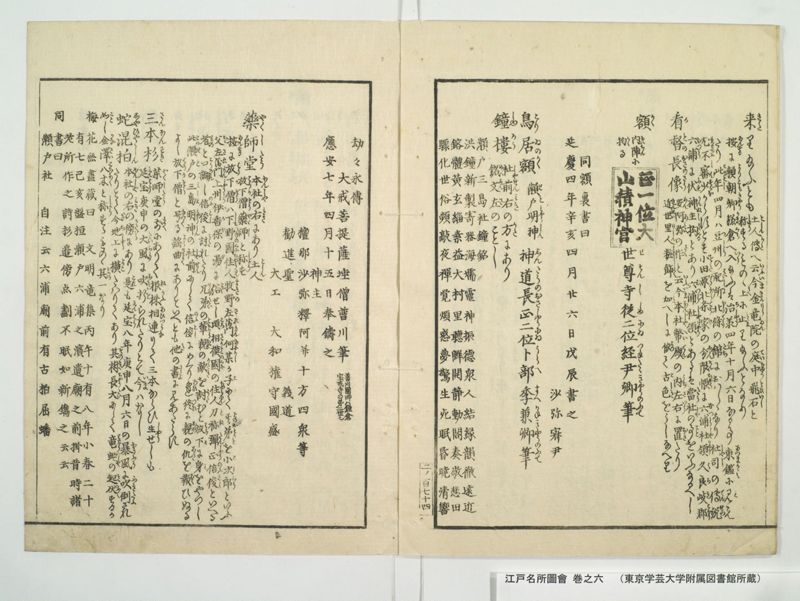
翻刻
【右丁】
来(きた)り給ふとも《割書:土人(としん)《振り仮名:傳|か#1た》へ云(いふ)今(いま)金竜院(きんりうゐん)の庭中(ていちゆう)飛石(とひいし)と|称(しよう)するものゝ上(うへ)に止(とゝま)り給ふとなり》
《割書:按(あんする)に頼朝卿(よりともきやう)鎌倉(かまくら)へ入(いり)給ふは治承(ちしやう)四年十月六日なる事 東鑑(あつまかゝみ)に見(み)え|たり此年(このとし)四月は豆州(つしう)の配所(はいしよ)北條(ほうてう)の舘(たち)におはしゝなり社司(しやし)の傳説(てんせつ)》
《割書:尤(もつとも)不審(ふしん)少(すくな)からすとす小田原北条家(をたはらほうてうけ)の分限帳(ふんけんちやう)に六浦社領(むつらしやりやう)久良岐郡(くらきこほり)|六浦(むつら)に伏(ふす)神主(かんぬし)抅(かゝくる)とあり六浦社領(むつらしやりやう)とあるは當社(たうしや)の事(こと)をいふなるへし》
看督長像(かとのおさのさう) 《割書:安阿弥(あんあみ)の作(さく)と云(いふ)今(いま)本社(ほんしや)幣殿(へいてん)の内(うち)左右(さいう)に置(おき)たり|近世(きんせい)里人(りしん)粧飾(しやうしよく)を加(くは)へしに依(よつ)て古色(こしき)をうしなへり》
額(かく)《割書:内陣(ないちん)に|拘(かく)る》【額の図・二重線囲い】世尊寺従二位経尹卿筆(せそんししゆにゐつねたゝきやうのふて)
【額字】
正一位大
山積神宮
同額裏書曰
延慶四年辛亥四月廿六日戊辰書之
沙弥𡨜尹#2
鳥居額(とりゐのかく)《割書:瀬戸明神(せとみやうしん)》神道長正二位卜部季兼卿筆(しんたうのおさしやうにゐうらへすへかねきやうのふて)
鐘樓(しゆろう)《割書:社前(しやせん)右(みき)の方(かた)にあり|銘文(めいふん)左(さ)のことし》
瀬戸三島社鐘銘
洪鐘新製寄器海壖靈神振德衆人結縁韻徹遠近
鎔體黄玄緇素益大村里聽鮮開静動閣奏敬悲田
驟化世俗頻敲夜禪覚煩惑夢驚生死眠昬暁清響
【左丁】
劫々永傳
大戒菩提薩埵僧普川筆《割書:普川國師は鎌倉|宝戒寺の弟二世也》
應安七年四月十五日奉鑄之
神主
檀那沙弥釋阿幷十方四衆等
勧進聖 義道
大工 大和権守國盛
藥師堂(やくしたう)《割書:本社(ほんしや)の右(みき)にあり土人(としん)|放下僧藥師(はうかそうやくし)と称(しよう)す》
《割書:按(あんする)に放下僧(はうかそう)は下野國(しもつけのくに)住人(ちゆうにん)牧野左衛門何某(まきのさゑもんなにかし)か子(こ)にて其弟(そのおとうと)を小次郎(こしらう)といふ|父(ちゝ)左衛門(さゑもん)上州(しやうしう)伊香保(いかほ)の湯(ゆ)に浴(よく)せし頃(ころ)相模國(さかみのくに)の住人(ちゆうにん)刀祢彈正信俊(とねたんしやうのふとし)といへる》
《割書:者(もの)と口論(こうろん)し信俊(のふとし)に討(うた)れたり兄弟(けうたい)の軰(ともから)親(おや)の歒(かたき)を討(うた)むと放下(はうか)に身(み)をやつし|此(この)瀬戸(せと)の三島明神(みしまみやうしん)の社前(しやせん)にして信俊(のふとし)にめくり逢(あひ)終(つひ)に親(おや)の仇(あた)を報(むく)ひぬる》
《割書:よし放下僧(はうかそう)と号(なつく)る謡曲(ようきよく)にありといへとも他(た)の書(しよ)に見あたらす|》
三本杉(さんほんすき)《割書:薬師堂(やくしたう)の前(まへ)にありて根株(ねかふ)相連(あひつらな)りて三本ならひ生(しやう)せしも|延宝(えんはう)庚申の大風(たいふう)に吹折(ふきを)られたりとて今(いま)はなし》
蛇混柏(しやひやくしん)《割書:本社(ほんしや)の右(みき)の傍(かたはら)にあり是(これ)も延宝(えんはう)八年庚申八月六日の暴風(ほうふう)に吹倒(ふきたふ)され|たりとて今(いま)地上(ちしやう)に横(よこ)たはりてあり其樹(そのき)長大(ちやうたい)にして竜蛇(りようしや)の起伏(きふく)するか》
《割書:如(こと)し金澤八木(かなさははちほく)と称(しよう)するものゝ其一(その )なり|》
梅花無盡蔵曰 文明竜集丙午十有八年小春二十
有七己亥盤桓瀬戸六浦之濵遺廟之前掛昔時諸
老所作之詩杉邉傍点劃不眠如新鐫之云云
同書曰
瀬戸社 自注云六浦廟前有古柏屈蟠
現代語訳
【右丁】
来られたともいう《割書:土地の人の伝承によると、今の金竜院の庭中で飛石と称するものの上に止まられたとのことである》
《割書:考えるに、頼朝卿が鎌倉へ入られたのは治承四年十月六日のことで、これは東鑑に見えている。この年の四月は豆州の配所、北条の館におられたのである。社司の伝説はもっとも疑わしい点が少なくない。小田原北条家の分限帳に「六浦社領 久良岐郡六浦に伏す神主」とある。六浦社領とあるのは当社のことを言うのであろう》
看督長像《割書:安阿弥の作と言う。今は本社幣殿の内の左右に置いてある。近世里人が装飾を加えたため古色を失ってしまった》
額《割書:内陣に掛かる》【額の図・二重線囲い】世尊寺従二位経尹卿筆
【額字】
正一位大
山積神宮
同額裏書に曰く
延慶四年辛亥四月廿六日戊辰これを書く
沙弥慈尹
鳥居額《割書:瀬戸明神》神道長正二位卜部季兼卿筆
鐘楼《割書:社前右の方にあり。銘文は左の通りである》
瀬戸三島社鐘銘
洪鐘新製寄器海壖靈神振德衆人結縁韻徹遠近
鎔體黄玄緇素益大村里聽鮮開静動閣奏敬悲田
驟化世俗頻敲夜禪覚煩惑夢驚生死眠昬暁清響
【左丁】
劫々永傳
大戒菩提薩埵僧普川筆《割書:普川国師は鎌倉宝戒寺の第二世である》
応安七年四月十五日これを鋳造し奉る
神主
檀那沙弥釈阿並びに十方四衆等
勧進聖 義道
大工 大和権守国盛
薬師堂《割書:本社の右にあり。土地の人は放下僧薬師と称する》
《割書:考えるに、放下僧は下野国住人牧野左衛門某の子で、その弟を小次郎という。父左衛門が上州伊香保の湯に入浴していた頃、相模国の住人刀祢弾正信俊という者と口論し、信俊に討たれた。兄弟の仲間が親の敵を討とうと放下に身をやつし、この瀬戸の三島明神の社前で信俊に巡り会い、ついに親の仇を報いたという。放下僧と号する謡曲があるというが、他の書には見当たらない》
三本杉《割書:薬師堂の前にあって根株が相連なって三本並んで生えていたが、延宝庚申の大風に吹き折られたとのことで、今はない》
蛇混柏《割書:本社の右の傍らにある。これも延宝八年庚申八月六日の暴風に吹き倒されたとのことで、今は地上に横たわってある。その樹は長大で竜蛇が起伏するようである。金沢八木と称するもののその一つである》
梅花無盡蔵に曰く 文明竜集丙午十有八年小春二十
有七己亥盤桓瀬戸六浦之濵遺廟之前掛昔時諸
老所作之詩杉邉傍点劃不眠如新鐫之云云
同書に曰く
瀬戸社 自注に云う、六浦廟前有古柏屈蟠
英語訳
【Right page】
came [to this place], it is also said《Small text: According to local tradition, [the deity] alighted upon what is now called the "flying stone" in the garden of Kinryu-in》
《Small text: Considering this, Lord Yoritomo entered Kamakura on the 6th day of the 10th month of Jisho 4, as recorded in the Azuma Kagami. In the 4th month of that year, he was at his place of exile in Izu Province, at the Hojo residence. The shrine priests' legends are quite questionable. In the Odawara Hojo family's division records, it states "Mutsuura shrine lands, chief priest prostrated in Mutsuura, Kuraki District." The reference to Mutsuura shrine lands likely refers to this shrine》
Statues of Kantoku-cho《Small text: Said to be the work of An'ami. They are now placed on the left and right inside the main shrine's offering hall. In recent times, local people added decorations, causing them to lose their ancient appearance}}
Plaque《Small text: Hanging in the inner sanctuary}}【Diagram of plaque with double-line border】Written by Lord Tsunetada, Junior Second Rank of Sesonji Temple
【Plaque text】
Senior First Rank Great
Yamazumi Shrine
The same plaque's reverse inscription says:
Written on the 26th day of the 4th month, Enkyo 4, year of the metal boar, day of earth-dragon
Monk Jin'in
Torii Gate Plaque《Small text: Seto Myojin}} Written by Lord Urabe Suekane, Head of Shinto, Junior Second Rank
Bell Tower《Small text: Located to the right in front of the shrine. The inscription text is as follows}}
Seto Mishima Shrine Bell Inscription
A great bell newly made, dedicated to the spiritual deity of the seashore, whose virtue resonates, people form connections, the sound reaches far and near
The molded form benefits yellow and black, monks and laypeople, the great village hears clearly, opens tranquility, movement and stillness play respectfully in the field of compassion
Rapidly transforming the secular world, frequently struck in night meditation, awakening delusive dreams, startling the sleep of life and death, the clear sound of dawn
【Left page】
Transmitted eternally through countless eons
Written by Great Precept Bodhisattva Monk Fusenkawa《Small text: Master Fusenkawa was the second generation of Kamakura's Hokai-ji Temple}}
Cast respectfully on the 15th day of the 4th month of Oan 7
Chief Priest
Patron Monk Shakua and the four groups of ten directions
Fundraising Monk Gido
Craftsman Yamato-gon-no-kami Kunimori
Yakushi Hall《Small text: Located to the right of the main shrine. Locals call it Hokaso Yakushi}}
《Small text: Considering this, Hokaso was the son of a certain Makino Saemon, a resident of Shimotsuke Province, whose younger brother was called Kojiro. When their father Saemon was bathing in the hot springs of Ikaho in Joshu, he quarreled with a man named Tone Tanjo Nobutoshi, a resident of Sagami Province, and was killed by Nobutoshi. The brothers' companions, seeking to avenge their father, disguised themselves as hokaso (street performers), met Nobutoshi in front of this Seto Mishima Myojin shrine, and finally avenged their father. Although there is said to be a Noh play titled "Hokaso," it is not found in other books}}
Three-trunk Cedar《Small text: Located in front of Yakushi Hall, with root stocks connected growing as three trunks side by side, but it was blown down in the great wind of Enpo Koshin and no longer exists}}
Serpentine Cypress{{Small text: Located beside the right side of the main shrine. This too was blown down in the storm on the 6th day of the 8th month of Enpo 8, Koshin year, and now lies horizontally on the ground. The tree is enormous and undulates like a dragon or serpent. It is one of what are called the Kanazawa Eight Trees}}
Baika Mujinzo states: In the 18th year of Bunmei, year of the fire horse, on the 27th day of the 10th month, year of earth boar, lingering at the shore of Seto Mutsuura, in front of the ancient shrine, hanging poems composed by various elders of old times, the marks beside the cedars remain clear as if newly carved, and so forth.
The same book states:
Seto Shrine A personal note says: In front of the Mutsuura shrine there is an ancient cypress, bent and coiled