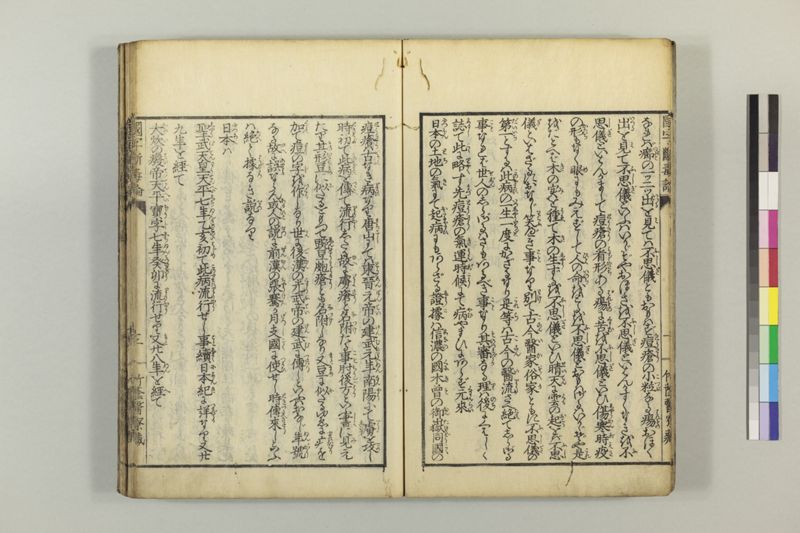
翻刻
【右頁】
なれば癤(ねぶと)の一ッ二ッ出(いつる)を見(み)ては不思儀(ふしぎ)ともおもはず痘瘡(とうさう)の小粒(こつぶ)なる瘍(はれもの)おほく
出(いつる)を見(み)て不思儀(ふしぎ)といふはいかゞぞやおほきを不思儀(ふしぎ)といはんかすくなきを不(ふ)
思儀(しぎ)といはんかまして痘瘡(とうさう)の看(みす〳〵)形(かたち)ある瘍(はれもの)に苦(くるしむ)を不思儀(ふしぎ)といひ傷寒時疫(しやうかんじえき)
の形(かたち)もなく眼(め)にもみえずして人(ひと)の命(いのち)をとるを不思儀(ふしぎ)とおもはざるはいかゞぞや是(これ)
をたとへば木(き)の実(み)を種(うゑ)て木(き)の生(しやう)ずるを不思儀(ふしぎ)といひ晴天(せいてん)に雲(くも)の起(おこる)をば不思(ふし)
儀(ぎ)といはざるにおなじ笑(わらふ)べき事(こと)なり別(わけ)て古今(ここん)醫家(いか)俗家(ぞくか)ともに不思儀(ふしぎ)の
第一(だいいち)とするは此病(このやまひ)の一生一度(いつしやういちど)にかぎるなり是等(これら)は古今(ここん)の醫流(いりう)さへ絶(たえ)てしらざる
事(こと)なれば世人(せじん)のしらざるはさもあるべき事(こと)なり其審(そのつまびらか)なる理(り)は後(のち)にくはしく
誌(しるし)て此(こゝ)に略(りやく)す先(まづ)痘瘡(とうさう)の氣運時候(きうんじこう)にて病(やむ)やまひにあらず元来(くわんらい)
日本(につほん)の土地(とち)の氣(き)にて起病(おこるやまひ)にもあらざる證據(しようこ)は信濃(しなの)の國(くに)木曽(きそ)の御嶽(おんたけ)同國(どうこく)の
【左頁】
痘瘡(とうさう)は古(いにしへ)なき病(やまひ)なり唐山(もろこし)にては東晉元帝(とうしんげんてい)の建武元年(けんむぐわんねん)南陽(なんやう)にて虜(りよ|ゑびす)を攻(せめ)し
時(とき)初(はじめ)て此病(このやまひ)を傅(つたへ)て流行(りうかう)したる故(ゆへ)に虜瘡(りよさう)と名附(なつけ)たる事(こと)肘後方(ちうごはう)といふ書(しよ)に見(み)え
たり其形(そのかたち)豆(まめ)に似(に)たるをもつて豌豆皰瘡(ゑんとうはうさう)とも名附(なつけ)しなり又(また)豆(まめ)に似(に)たるゆゑに疒(やまひかむり)を
加(くわへ)て痘(とう)の字(じ)を作(つくり)しなり世(よ)に後漢(ごかん)の光武帝(くわうぶてい)の建武(けんむ)に傅(つたはり)しといふはおなじ年號(ねんがう)
なる故(ゆへ)に誤(あやまる)ならん或人(あるひと)の説(せつ)に前漢(ぜんかん)の張騫(ちやうけん)か月支國(げつしこく)に使(つかひ)せし時(とき)傅來(つたへきたり)しといふ
は絶(たへ)て據(よりどころ)なき説(せつ)なり
日本(につほん)は
聖武天皇(しやうむてんわう)天平七年乙亥初(てんへいしちねんきのとのい)初(はじめ)て此病(このやまひ)流行(りうかう)せし事(こと)續日本紀(しよくにほんき)に詳(つまびらか)なりまた廿
九年を経(へ)て
大炊(おほい)の癈帝(はいてい)天平寶字七年癸卯(てんへいほうじしちねんみつのとのう)に流行(りうかう)せり又(また)廿八/年(ねん)を経(へ)て
現代語訳
【右頁】
それなのに癤(おでき)の一つ二つ出るのを見ては不思議とも思わず、痘瘡の小粒な腫れ物が多く出るのを見て不思議というのはどうだろうか。多いのを不思議というのか、少ないのを不思議というのか。まして痘瘡の見た目に形のある腫れ物に苦しむのを不思議といい、傷寒時疫の形もなく眼にも見えずして人の命を奪うのを不思議と思わないのはどうだろうか。これをたとえれば、木の実を種として植えて木が生えるのを不思議といい、晴天に雲が起こるのを不思議といわないのと同じで、笑うべきことである。特に古今の医家・俗家ともに不思議の第一とするのは、この病気が一生に一度に限ることである。これらは古今の医流さえ全く知らないことなので、世人が知らないのは当然のことである。その詳しい理由は後に詳細に記して、ここでは省略する。まず痘瘡が気運時候によって起こる病気ではなく、もともと日本の土地の気によって起こる病気でもないという証拠は、信濃国木曽の御嶽、同国の
【左頁】
痘瘡は昔はなかった病気である。中国では東晋元帝の建武元年に南陽で異民族を攻めた時、初めてこの病気が伝わって流行したため「虜瘡」と名付けたことが『肘後方』という書物に見える。その形が豆に似ているので「豌豆皰瘡」とも名付けた。また豆に似ているので、病垂れを加えて「痘」の字を作ったのである。世間で後漢の光武帝の建武年間に伝わったというのは、同じ年号であるため間違いだろう。ある人の説で前漢の張騫が月支国に使者として行った時に伝来したというのは、全く根拠のない説である。
日本では聖武天皇天平七年乙亥に初めてこの病気が流行したことが『続日本紀』に詳しい。また二十九年を経て、大炊廃帝天平宝字七年癸卯に流行した。また二十八年を経て
英語訳
【Right Page】
Yet while people do not find it strange when one or two boils appear, why do they call it mysterious when many small pustules of smallpox appear? Should we call the many mysterious or the few mysterious? Moreover, why do they call it mysterious to suffer from smallpox pustules that have visible form, yet not find it mysterious when typhoid epidemics, having no form and being invisible to the eye, take people's lives? To use an analogy, this is like calling it mysterious when trees grow from planted seeds, while not calling it mysterious when clouds form in clear skies—it is laughable. Particularly, what both medical professionals and laypeople throughout history consider most mysterious is that this disease occurs only once in a lifetime. Since even the medical schools of past and present are completely ignorant of these matters, it is natural that common people do not understand them. The detailed reasoning will be recorded thoroughly later, and I will omit it here. First, the evidence that smallpox is not a disease caused by seasonal atmospheric influences, nor originally a disease arising from the qi of Japanese soil, can be found in Mount Ontake in Kiso, Shinano Province, and in the same province...
【Left Page】
Smallpox is a disease that did not exist in ancient times. In China, it first spread and became epidemic when attacking barbarians in Nanyang during the first year of Jianwu under Emperor Yuan of Eastern Jin, hence it was named "barbarian pox" (ryōsō) as recorded in the book called "Elbow Reserve Emergency Prescriptions" (Chūgo-hō). Because its form resembled beans, it was also called "pea pustule pox" (entō-hōsō). Also because it resembled beans, the disease radical was added to create the character "tō" (痘). The common claim that it was transmitted during the Jianwu era of Emperor Guangwu of Later Han is probably an error due to the same era name. The theory by some that it was brought back when Zhang Qian of Former Han served as envoy to the Yuezhi Kingdom is a completely baseless claim.
In Japan, this disease first became epidemic in the seventh year of Tenpyō, year of the boar (735 CE), under Emperor Shōmu, as detailed in the "Continued Chronicles of Japan" (Shoku Nihongi). Twenty-nine years later, it became epidemic in the seventh year of Tenpyō-hōji, year of the rabbit (763 CE), under the deposed Emperor Ōi. Twenty-eight years later...