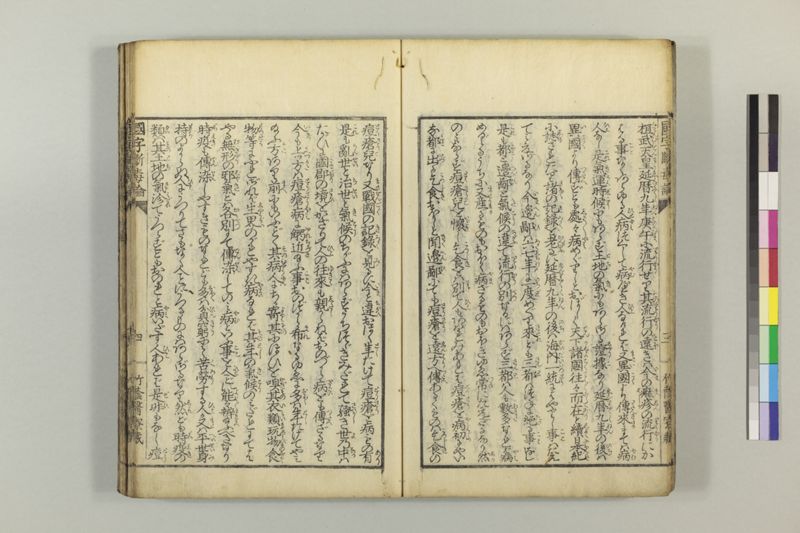
翻刻
【右頁】
桓武天皇(くわんむてんわう)延暦九年庚午(ゑんりやくくねんかのへむま)に流行(りうかう)せり其(その)流行(りうかう)の遠(とほ)きは今(いま)の痲疹(ましん|はしか)の流行(りうかう)にか
はる事(こと)なくあらゆる人(ひと)病(やみ)つくして病(やむ)べき人(ひと)なければ又(また)異國(いこく)より傅來(つたへきたる)まては病(やむ)
人(ひと)なし是(これ)氣運時候(きうんじこう)にもあらず土地(とち)の氣(き)にもあらざる證據(しやうこ)なり延暦九年(ゑんりやくくねん)の後(のち)は
異國(いこく)より傳(つたへ)ずとも處々(しよ〳〵)病(やみ)めぐりしとおぼしく天下諸國(てんかしよこく)往々而在(わう〳〵にしてあり)と續日本紀(しよくにほんき)
に誌(しる)されたり諸(もろ〳〵)の記録(きろく)を老(かんがふ)#1るに延暦九年(ゑんりやくくねん)の後(のち)は海内一統(かいだいいつとう)にはやりし事(こと)はたえ
てみえざるなり今(いま)邉鄙(へんひ)は六七年(ろくしちねん)に一度(いちど)めぐり來(きたれ)ども三都(さんと)はつねに絶(たゆ)る事(こと)なし
是(これ)も都(みやこ)と邉鄙(へんひ)と氣候(きこう)の違(ちがふ)て流行(りうかう)の別(べつ)なるにはあらず三都(さんと)は人も數多(あまた)なれば病(やみ)
めぐるうちに又(また)産(うまる)るものもおほく病(やま)ざるものもおほきゆゑ常(つね)にたえざるなり然(しか)
のみならず痘瘡児(とうさうご)を懷(いだき)し乞食(こつじき)をは別(わけ)て人(ひと)もあはれみあれば痘瘡(とうさう)を病初(やみはじめ)るやい
な都(みやこ)に出(いづ)る乞食(こつじき)おほしと聞(きく)邉鄙(へんひ)にても痘瘡(とうさう)を遠方(ゑんはう)へ傳(つたへ)あるくものは乞食(こつじき)の
【左頁】
痘瘡児(とうさうこ)なり又(また)戰國(せんごく)の記録(ころく)を見(み)るに今(いま)と違(ちがひ)おほく年(とし)たけて痘瘡(とうさう)を病もの有(あり)
是(これ)も亂世(らんせい)と治世(ちせい)と氣候(きこう)のちがふにはあらずうちつゞきみだれて騷(さはがし)き世(よ)の中(なか)は
たがひに國郡(くにこほり)の境(さかひ)をかぎりて人(ひと)の往來(ゆきゝ)も親(したし)からねばおのづから病(やまひ)をも傳(つたへ)ざるなり
今(いま)も《振り仮名:上ッ方|うへッかた》は痘瘡病(とうさうやみ)に觸近(ふれちかづき)給ふ事(こと)おのづから希(まれ)なるゆゑに多(おほく)は年(とし)たけてやみ
給ふ方(かた)あり前(まへ)にもいふごとく其(その)病人(ひやうにん)にちか寄(より)其(その)にほひを嗅(かぎ)其(その)衣類玩物食(いるいもてあそびものしよく)
物等(もつとう)にふれざれば生界(しやうがい)のがれやすき病(やまい)なれば其年(そのとし)の氣候(きこう)のみだれにては
やる無形(むきやう)の邪氣(じやき)とは各別(かくべつ)にて傅染(でんせん)してのみ病(やむ)といふ事(こと)を人(ひと)ごとに能々(よく〳〵)辨(わきまへ)給ふべきなり
時疫(じえき)も傅染(でんせん)しやすきものなれども多(おほく)は貧窮(ひんきう)にて苦勞(くろう)する人(ひと)か又(また)は平世(へいせい)身(み)
持(もち)のよからぬ人(ひと)にうつりてさもなく人ことにうつるものにはあらざるなり然(しかれ)ども時疫(じえき)の
類(るい)は其(その)土地(とち)の氣(き)沴(みだれ)てうつらずともおのれと病(やみ)いだす人(ひと)あれば是非(ぜひ)もなし痘(とう)
現代語訳
【右頁】
桓武天皇延暦九年庚午(790年)に流行した。その流行の間隔の長さは今の麻疹(はしか)の流行と変わることなく、すべての人が病気になり尽くして病気になるべき人がいなければ、また異国より伝来するまでは病気になる人はいない。これが気運時候によるものでもなく土地の気によるものでもない証拠である。延暦九年の後は、異国より伝えなくても各地で病気が回ったと思われ、天下諸国に広く存在すると『続日本紀』に記されている。諸々の記録を考えるに、延暦九年の後は海内統一して流行したことは全く見られない。今、辺鄙な地域は六、七年に一度回ってくるが、三都(京都・大阪・江戸)は常に絶えることがない。これも都と辺鄙な地域とで気候が違って流行が異なるのではなく、三都は人も数多いので病気が回っている間にまた生まれる者も多く、病気にならない者も多いため常に絶えないのである。それだけでなく、痘瘡児を抱いた乞食は特に人も憐れむので、痘瘡を病み始めるやいなや都に出る乞食が多いと聞く。辺鄙な地域でも痘瘡を遠方へ伝えて歩くものは乞食の
【左頁】
痘瘡児である。また戦国の記録を見ると、今と違って多く年を取ってから痘瘡を病む者がいる。これも乱世と治世とで気候が違うのではなく、打ち続き乱れて騒がしい世の中では、互いに国郡の境界を限って人の往来も親しくないので、自然と病気をも伝えないのである。今も上方は痘瘡病に接触することが自然と稀であるため、多くは年を取ってから病気になる方がある。前にも言うごとく、その病人に近寄り、その匂いを嗅ぎ、その衣類・玩具・食物等に触れなければ、生きている間は逃れやすい病気なので、その年の気候の乱れによって起こる無形の邪気とは全く別で、伝染してのみ病気になるということを人々はよくよく理解すべきである。時疫も伝染しやすいものであるが、多くは貧窮して苦労する人か、または平素身持ちの良くない人に移って、そうでなく誰彼となく移るものではない。しかしながら時疫の類はその土地の気が乱れて移らなくても自ずと病み出す人があるのでやむを得ない。痘瘡は
英語訳
【Right Page】
It became epidemic in the ninth year of Enryaku under Emperor Kammu, year of the metal horse (790 CE). The intervals between these epidemics are no different from today's measles epidemics—when all people have been afflicted and there are no more people who should fall ill, there are no more patients until it is transmitted again from foreign countries. This is evidence that it is caused neither by seasonal atmospheric influences nor by the qi of the land. After the ninth year of Enryaku, it seems the disease circulated in various places even without transmission from foreign countries, and it is recorded in the "Continued Chronicles of Japan" that it existed widely throughout all provinces of the realm. Considering various records, after the ninth year of Enryaku, there is no evidence of unified nationwide epidemics. Today, remote regions experience outbreaks once every six or seven years, but the three major cities (Kyoto, Osaka, Edo) never cease to have cases. This is not because the climate differs between cities and remote areas causing different epidemic patterns, but because the three cities have large populations, so while the disease circulates, many are also being born and many do not fall ill, hence it never ceases. Moreover, beggars carrying smallpox children are particularly pitied by people, so I hear that many beggars go to the cities as soon as they begin to suffer from smallpox. Even in remote areas, those who travel far spreading smallpox are beggars with
【Left Page】
smallpox children. Also, looking at records from the Warring States period, unlike today, many people fell ill with smallpox at advanced ages. This too is not because the climate differs between times of war and peace, but because in continuously turbulent and chaotic times, people limited themselves to the boundaries of their provinces and counties, with little friendly interaction, so naturally diseases were not transmitted either. Even today, people in the Kansai region naturally have rare contact with smallpox, so many fall ill at advanced ages. As mentioned before, if one does not approach the patients, smell their odor, or touch their clothing, toys, food, etc., it is a disease easily avoided during one's lifetime. Therefore, people should thoroughly understand that this is completely different from formless evil qi that arises from atmospheric disturbances of the year, and that one falls ill only through contagion. Epidemic diseases are also easily transmitted, but mostly they spread to people suffering in poverty or those with poor conduct in normal times, and do not spread indiscriminately to just anyone. However, with epidemic diseases of this type, some people naturally fall ill even when the local qi is not disturbed enough to cause transmission, so this cannot be helped. Smallpox...