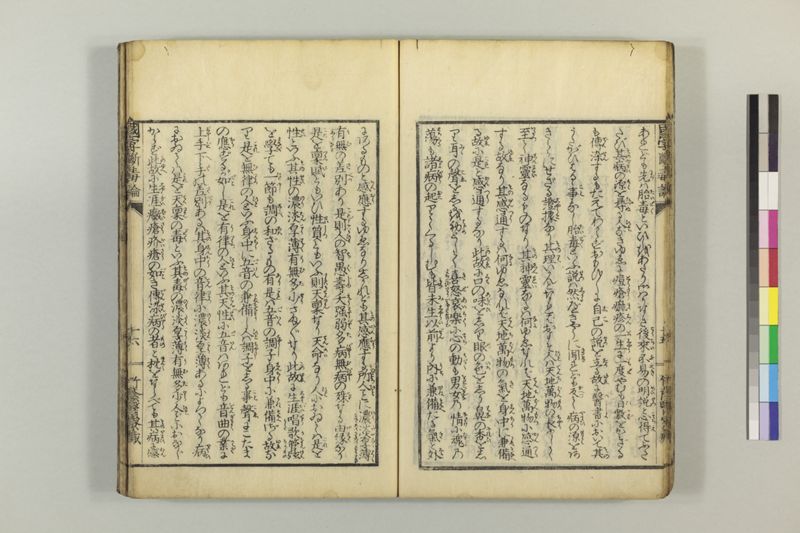
翻刻
【右頁】
あれども先(まづ)は胎毒(たいどく)といひしをあたり御はりなき後來(こうらい)不易(ふえき)の明説(めいせつ)と心得(こゝろえ)てふた
たび其病(そのやまひ)の源(もと)を尋(たづぬ)る人(ひと)なきゆゑに痘瘡(とうさう)痲疹(ましん)の一生(いつしやう)に一度(いちど)やむも日數(ひかず)をかぎる
も傳染(でんせん)するもたえてわからずおもひ〳〵に自己(じこ)の説(せつ)を立(たつ)る故(ゆゑ)に醫書(いしよ)において其(その)
うたがひはるゝ事(こと)なし胎毒(たいどく)といふ説(せつ)は然(しかる)べきやうに聞(きこゆ)れども反(かへつ)て病(やまひ)の源(もと)をあ
きらかにせざる證據(しやうこ)なり其理(そのり)いかんとなればおよそ人(ひと)は天地萬物(てんちばんもつ)の長(ちやう)にして
至(いたつ)て神靈(しんれい)なるものなり其(その)神靈(しんれい)なるは何(なに)ゆゑなれば天地萬物(てんちばんもつ)に感通(かんつう)
する故(ゆゑ)なり其(その)感通(かんつう)するは何(なに)ゆゑなれば天地萬物(てんちばんもつ)の氣(き)を身中(しんちう)に兼備(かねそなへ)
る故(ゆゑ)に是(これ)と感通(かんつう)するなり此故(このゆゑ)に口(くち)の味(あじはひ)をしり眼(め)の色(いろ)をしり鼻(はな)の香(にほひ)をし
り耳(みゝ)の聲(こゑ)をしるを初(はじめ)として喜怒(きど|よろこびいかり) 哀楽(あいらく|かなしみたのしむ)に心(こゝろ)の動(うごく)も男女(をとこをんな)の情(なさけ)に魂(たましい)の
蕩(とろくる)も諸病(しよびやう)の起(おこ)りてくるしむも皆(みな)未生以前(みしやういぜん)より内(うち)に兼備(かねそなへ)たる氣(き)と外(ほか)
【左頁】
にあるものと感應(かんおう)するゆゑなりしかれども其(その)感應(かんおう)する所(ところ)人(ひと)ことに濃淡(のうたん|こきあはき) 厚薄(こうはく|あつきうすき)
有無(うむ|あるなき)の差別(さべつ)あり是則(これすなはち)人(ひと)の智愚(ちぐ)寿夭(じゆえう)强弱(きやうじやく)多病無病(たびやうむびやう)の殊(こと)なる由縁(ゆえん)なり
是(これ)を稟賦(りんふ)ともいひ性質(せいしつ)ともいふ則(すなはち)天稟(てんりん)なり天命(てんめい)なり人(ひと)におゐては是(これ)を
性(せい)といふ其性(そのせい)の濃淡(のうたん)厚薄(こうはく)有無(うむ)多少(たせう)さま〴〵なり此故(このゆゑ)に生涯(しやうがい)唱歌(せうか|うた)管弦(くわんけん|なりもの)
を學(まなび)ても一節(ひとふし)も調(しらへ)の和(あは)ざるもの有(あり)是(これ)は五音(ごいん)の調子(ちやうし)身中(しんちう)に兼備(かねそなへ)ざる故(ゆゑ)な
り是(これ)を無律(むりつ)の人(ひと)といふ身中(しんちう)に五音(ごいん)の兼備(かねそなへ)し人(ひと)は調子(ちやうし)をしる事(こと)聲(こゑ)にこたま
の應(おう)ずるが如(ごと)し是(これ)を有律(うりつ)の人(ひと)といふ其(その)天性(てんせい)に五音(ごいん)はあれども音曲(をんぎよく)の業(わざ)に
上手下手(じやうずへた)の差別(さべつ)あるは其(その)身中(しんちう)の音律(をんりつ)に濃淡(のうたん)厚薄(こうはく)あるによつてなり病(やまひ)
におゐては是(これ)を天稟(てんりん)の毒(どく)といふ其毒(そのどく)の濃淡(のうたん)厚薄(こうはく)有無(うむ)多少(たせう)人(ひと)ごとにおなじ
からず此故(このゆへ)に生涯(しやうがい)黴瘡(ばいさう)疥瘡(かいさう)の如(ごと)き傳染病(でんせんびやう)の者(もの)と枕(まくら)をならべても其病(そのやまひ)に感(かん)
現代語訳
【右頁】
あれども、まず胎毒説を当たり前で反駁しがたい後来不変の明説と心得て、再びその病の源を尋ねる人がないため、痘瘡や麻疹が一生に一度患うのも、日数が限られるのも、伝染するのも、全く分からず、思い思いに自分の説を立てる。そのため医書においてその疑いが晴れることはない。胎毒という説はもっともらしく聞こえるが、かえって病の源を明らかにしない証拠である。その理由はどうかといえば、およそ人は天地万物の長であって、至って神霊なるものである。その神霊なる理由は何かといえば、天地万物に感通するからである。その感通する理由は何かといえば、天地万物の気を身中に兼ね備えるゆえに、これと感通するのである。この故に、口で味を知り、眼で色を知り、鼻で匂いを知り、耳で声を知ることを初めとして、喜怒哀楽に心が動くのも、男女の情に魂が蕩けるのも、諸病が起こって苦しむのも、皆未生以前より内に兼ね備えた気と外にあるものとが感応するからである。
【左頁】
しかしながら、その感応する所は、人ごとに濃淡、厚薄、有無の差別がある。これすなわち人の智愚、寿夭、強弱、多病無病の異なる理由である。これを稟賦ともいい性質ともいう。すなわち天稟であり、天命である。人においてはこれを性という。その性の濃淡、厚薄、有無、多少は様々である。この故に、生涯歌や管弦を学んでも、一節も調子の合わない者がある。これは五音の調子が身中に兼ね備わっていないためである。これを無律の人という。身中に五音の兼ね備わった人は、調子を知ることが声にこだまが応ずるようである。これを有律の人という。その天性に五音はあっても、音曲の技に上手下手の差別があるのは、その身中の音律に濃淡厚薄があることによる。病においては、これを天稟の毒という。その毒の濃淡、厚薄、有無、多少は人ごとに同じではない。この故に、生涯梅毒や疥癬のような伝染病の者と枕を並べても、その病に感
英語訳
【Right Page】
However, since people first accepted the theory of fetal poison as a natural, irrefutable, and eternally unchanging clear explanation, and no one thereafter sought to investigate the source of these diseases again, they completely failed to understand why smallpox and measles occur once in a lifetime, why their duration is limited, and why they are contagious. Each person established their own theory based on their own ideas, so the doubts in medical texts were never resolved. The theory of fetal poison sounds plausible, but it is actually evidence that fails to clarify the source of disease. The reason for this is that humans are the leaders of all things between heaven and earth and are supremely spiritual beings. They are spiritual because they can commune with all things between heaven and earth. They can commune because they possess within their bodies the qi of all things between heaven and earth, and thus they commune with these things. Therefore, beginning with knowing taste through the mouth, color through the eyes, fragrance through the nose, and sound through the ears, the heart's movement in joy, anger, sorrow and pleasure, the soul's stirring with passion between men and women, and the suffering that arises from various diseases - all of these occur because the qi possessed within since before birth responds to things outside.
【Left Page】
However, the degree of this responsiveness varies among individuals in terms of concentration, thickness, presence or absence. This is precisely the reason for differences in human intelligence and foolishness, longevity and short life, strength and weakness, and tendency toward illness or health. This is called natural endowment or constitution - that is, heavenly endowment and heavenly mandate. In humans, this is called nature. The concentration, thickness, presence or absence, and quantity of this nature varies greatly. Therefore, some people who study singing and instrumental music throughout their lives cannot harmonize even a single phrase. This is because the harmony of the five tones is not possessed within their bodies. Such people are called "those without rhythm." People who possess the five tones within their bodies know harmony as naturally as an echo responds to a voice. These are called "people with rhythm." Even though the five tones exist in their natural constitution, differences in skill level in musical arts arise because there are variations in the concentration and thickness of the musical temperament within their bodies. In terms of disease, this is called innate poison. The concentration, thickness, presence or absence, and quantity of this poison differs for each person. Therefore, even if one shares a pillow with someone suffering from contagious diseases like syphilis or scabies throughout life, one may not contract