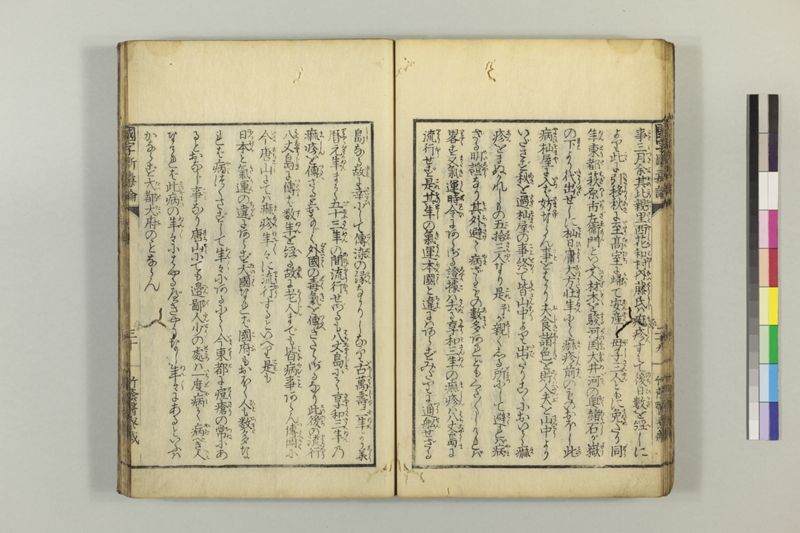
翻刻
【右頁】
事(こと)三月余(みつきよ)其比(そのころ)親里(おやさと)西花和村(にしはなわむら)内藤氏(ないとううじ)は痲疹(ましん)すみて後(のち)日數(ひかず)を經(へ)しに
より此(こゝ)に引移(ひきうつり)秋(あき)に至(いたり)高室(たかむろ)に㱕(かへり)て安産(あんざん)し母子三人(ぼしさんにん)ともに免(まぬかれ)たり同(どう)
年(ねん)東都(とうと)萩原市左衛門(はぎはらいちざゑもん)といふ人(ひと)材木(ざいもく)を駿河国(するがのくに)大井河(おほゐがわ)の奥(おく)《振り仮名:赭石が嶽|あかいし だけ》
の下(もと)より代出(きりいだ)#1せしに杣日庸(そまひよう)大方(おほかた)壮年(さうねん)にて痲疹前(なしんまへ)のものおほし此(この)
病(やまひ)杣屋(そまや)に入(いら)ば妨(さまたげ)ならん事(こと)をはかり夫食(ぶじき)諸色(しよしき)を貯(たくはへ)人夫(にんぶ)を山中(さんちう)より
いださず秋(あき)を過(すぎ)杣屋(そまや)の事(こと)終(をはり)て皆(みな)山中(さんちう)より出(いで)たりこゝにおいて痲(ま)
疹(しん)をまぬかれしもの五拾三人(ごじふさんにん)なり是(これ)《割書:予(よ)》が親(したし)くしる所(ところ)にして避(さく)れば病(やま)
ざる明證(めいしやう)なり其外(そのほか)避(さけ)て病(やま)ざるもの數多(あまた)あれどもくだ〳〵しければ
畧(りやく)す又(また)氣運(きうん)時令(じれい)にあらざる證據(しやうこ)は去(さんぬ)る享和三年(きやうわさんねん)の痲疹(ましん)は八丈島(はちじやうじま)に
流行(りうかう)せず是(これ)其年(そのとし)の氣運(きうん)本國(ほんこく)と違(ちかふ)にはあらずみだりに通舩(つうせん)せざる
【左頁】
島(しま)なる故(ゆゑ)に幸(さいわひ)にして傳染(でんせん)の縁(えん)なかりしなり古(いにしへ)萬壽二年(ばんじゆにねん)より承(しよう)
歴元年(りやくぐわんねん)まて五十三年(ごじふさんねん)の間(あいだ)流行(りうかう)せざるも八丈島(はちじやうじま)にて享和三年(きやうわさんねん)の
痲疹(ましん)を傳(つたへ)さるとおなじく外國(ぐわいこく)の毒氣(どくき)を傳(つたへ)きたらざるなり此後(こののち)の流行(りうかう)
八丈島(はちじやうじま)に傳(つたはら)ば数年(すねん)を經(へ)る故(ゆゑ)に老人(らうじん)までも皆(みな)病事(やむこと)あらん傳聞(つたへきく)に
今(いま)唐山(もろこし)にては痲疹(ましん)年々(ねん〳〵)に流行(りやかう)するといへり是(これ)も
日本(につぽん)と氣運(きうん)の違(ちがふ)にあらず大國(たいこく)なれば國府(こふ)もおほく人(ひと)も数多(あまた)な
れば病(やみ)つくさずして年々(ねん〳〵)にあるにて今(いま)東都(とうと)に痘瘡(とうさう)の常(つね)にあ
るとおなじ事(こと)なり唐山(もろこし)にても邉鄙(へんぴ)人少(にんせう)の處(ところ)は一度(いちど)病(やみ)て病(やむ)べき人(ひと)
なければ此病(このやまひ)の年々(ねん〳〵)にはやるべきやうなし年々(ねん〳〵)にあるといふは
かならず大都(たいと)大府(たいふ)のことならん
現代語訳
【右頁】
こと三ヶ月余り。その頃、親里の西花和村の内藤氏は麻疹が済んでから日数を経ていたので、ここに引き移り、秋に至って高室に帰って安産し、母子三人ともに免れた。同年、江戸の萩原市左衛門という人が材木を駿河国大井川の奥の赤石ヶ嶽の下から切り出したが、杣人夫の大方は壮年で麻疹未経験の者が多かった。この病気が杣屋に入れば妨げになることを考慮し、夫食や諸色を蓄え、人夫を山中から出さず、秋を過ごして杣屋の仕事を終えてから皆山中より出た。ここにおいて麻疹を免れた者は五十三人である。これは私が親しく知るところであって、避ければ病まない明証である。その他避けて病まない者は数多いが、詳細に述べれば煩雑なので省略する。また気運・時令によるものではない証拠は、去る享和三年の麻疹は八丈島に流行しなかったことである。これはその年の気運が本国と違うのではなく、みだりに通船しない
【左頁】
島であるゆえに幸いにして伝染の縁がなかったのである。古く万寿二年から承暦元年まで五十三年の間流行しなかったのも、八丈島で享和三年の麻疹を伝えなかったのと同じく、外国の毒気を伝え来たらなかったのである。この後の流行が八丈島に伝わったならば、数年を経るゆえに老人までも皆病むことがあろう。伝聞によると、今中国では麻疹が年々流行するという。これも日本と気運が違うのではなく、大国であれば国府も多く人も数多いので、病み尽くすことなく年々あるのであって、今江戸に痘瘡が常にあるのと同じことである。中国でも辺鄙で人少ない所は、一度病んで病むべき人がなければ、この病気が年々流行するはずがない。年々あるというのは、必ず大都・大府のことであろう。
英語訳
【Right Page】
for about three months. Around that time, since the Naitō family of Nishihanawa Village, her parents' home, had experienced measles and many days had passed since its conclusion, she moved there. In autumn she returned to Takamuro and gave birth safely, with mother and three children all being spared. In the same year, a person from Edo named Hagiwara Ichizaemon was cutting timber from beneath Akaishi-ga-take in the depths of the Ōi River in Suruga Province. Most of the lumberjack workers were young men who had not previously had measles. Considering that if this disease entered the lumber camp it would be disruptive, he stored food and various supplies and did not let the workers leave the mountains. After passing the autumn and finishing the lumber work, everyone came out from the mountains. At this point, fifty-three people had avoided measles. This is something I know intimately, and it is clear proof that avoidance prevents illness. There are many others who avoided it and did not fall ill, but I omit the details as they would be tedious. Further evidence that it is not due to cosmic influence or seasonal timing is that the measles of Kyōwa 3 did not spread to Hachijō Island. This was not because that year's cosmic influence differed from the mainland, but because it was an island that did not allow indiscriminate ship traffic,
【Left Page】
and was thus fortunately without opportunities for contagion. Similarly, the fact that there was no epidemic for fifty-three years from Manju 2 to Shōryaku 1 was not due to different foreign toxic qi being transmitted, just as Hachijō Island did not transmit the Kyōwa 3 measles. If future epidemics were to reach Hachijō Island, since years would have passed, even the elderly would all fall ill. According to reports, measles now occurs annually in China. This too is not because the cosmic influence differs from Japan, but because it is a large country with many provinces and numerous people, so without everyone falling ill, it occurs yearly—the same as how smallpox is constantly present in Edo now. Even in China, in remote places with few people, once people have been ill and there are no more who should fall ill, there is no way for this disease to spread annually. The claim that it occurs yearly must necessarily refer to large cities and major administrative centers.