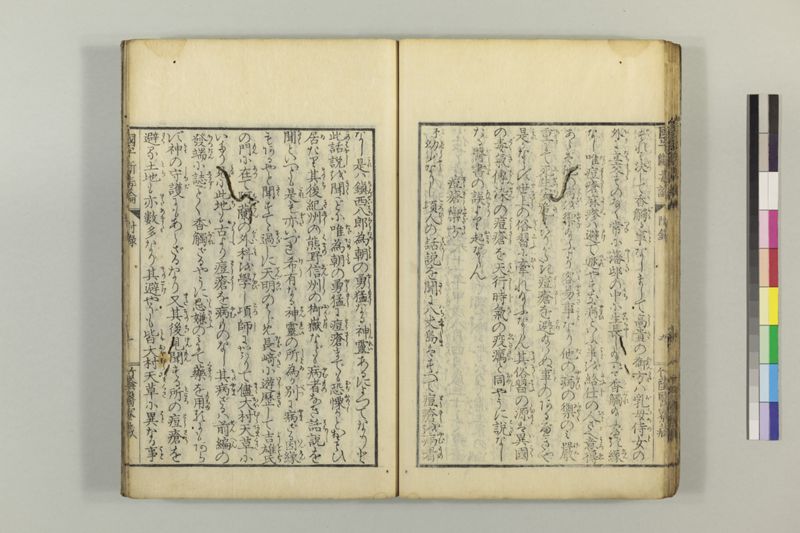
翻刻
【右頁】
ずれば決(けつ)して香觸(かぶる)る事(こと)なしまして高貴(こうき)の御方(おんかた)は乳母侍女(おちめのと)の
外(ほか)に立交(たちまじる)ものなく常(つね)に藩邸(やしき)の中(うち)に生長(せいちやう)し給へば香觸(かぶれ)給ふべき緣(ゑん)
なし唯(たゞ)痘瘡(とうさう)麻疹(ましん)は避(さけ)て遯(のがれ)やすき病(やまひ)といふ事(こと)を給仕(きふじ)の人(ひと)さへ意得(こゝろゑ)
あらば他(た)の病(やまひ)を禦(ふえぎ)給ふより容易事(いとやすきこと)なり他(た)の病(やまひ)の禦(ふせく)のみ嚴(げん)
重(ぢう)にて死生安危(しせいあんき)はかりがたき痘瘡(とうさう)を避(さけ)給はぬ事(こと)のあるべきや
是(これ)かならず世上(せじやう)の俗習(ぞくしふ)に牽(ひか)れ給ふならん其俗習(そのぞくしふ)の源(みなもと)は異國(いこく)
の毒氣傳染(どくきでんせん)の痘瘡(とうさう)を天行時氣(てんかうじき)の疫癘(ゑきれい)と同(おなじ)やうに說(とき)なし
たる醫書(いしよ)の誤(あやまり)より起(おこる)ならん
痘瘡禦方(とうさうふせぎかた)
《割書:予(よ)》幼少(ゑうせう)なりし頃(ころ)人(ひと)の話説(はなし)を聞(きく)に八丈島(はちじやうしま)はすべて痘瘡(とうさう)を病者(やむもの)
【左頁】
なし是(これ)は鎮西八郎為朝(ちんぜいはちらうためとも)の勇猛(ゆうもう)なる神靈(しんれい)あるによつてなりと
此話説(このはなし)を聞(きく)ごとに唯(たゞ)為朝(ためとも)の勇猛(ゆうもう)に痘瘡(とうさう)までも恐慄(おぢおのゝく)かとおもひ
居(ゐ)たり其後(そのゝち)紀州(きしう)の熊野(くまの)信州(しんしう)の御嶽(おんたけ)なども病者(やむもの)なき話說(はなし)を
聞(きく)といへども是(これ)も亦(また)いづれ希有(けう)なる神靈(しんれい)の所為(しよゐ)か別(べつ)に病(やま)ざる因緣(いんえん)
もあるやと聞(きゝ)すてゝ過(すぎ)しに天明(てんめい)のはじめ長﨑(ながさき)に遊歷(いうれき)して吉雄氏(よしをうぢ)
の門(もん)に在(あつ)て阿蘭(をらん)の外科(ぐわいくわ)を學(まなび)し頃(ころ)師(し)にかはりて儘(まゝ)大村(おほむら)天草(あまくさ)に
いたり見(みる)に《振り仮名:此地|□□ち#1》も古(いにしへ)より痘瘡(とうさう)を病(やむ)ものなし其(その)病(やま)ざるは前編(ぜんへん)の
發端(ほつたん)に誌(しるす)ごとく香觸(かぶれ)ざるやうに忌嫌(いみきらふ)のみにて薬(くすり)を用(もちゆ)るにもあら
ず神(かみ)の守護(しゆご)にもあらざるなり又(また)其後(そのゝち)見聞(けんもん)する所(ところ)の痘瘡(とうさう)を
避(さく)る土地(とち)も亦(また)數多(あまた)なり其(その)避(さけ)やうも皆(みな)大村(おほむら)天草(あまくさ)に異(こと)なる事(こと)
現代語訳
【右頁】
すれば決して感染することはない。まして高貴な御方は乳母や侍女の他に交わる者もなく、常に藩邸の中で成長されるので感染される縁もない。ただ痘瘡や麻疹は避けて逃れやすい病気であるということを給仕の人さえ理解していれば、他の病気を防ぐよりもずっと容易なことである。他の病気の予防のみ厳重にして、死生安危の計りがたい痘瘡を避けないということがあってよいだろうか。
これは必ず世上の俗習に引かれているのであろう。その俗習の源は、外国の毒気伝染である痘瘡を天行時気の疫癘と同じように説明した医書の誤りから起こったのであろう。
痘瘡の防ぎ方
私が幼少であった頃、人の話を聞くに、八丈島はすべて痘瘡を病む者が
【左頁】
いない。これは鎮西八郎為朝の勇猛なる神霊があるためであると。
この話を聞くたびに、ただ為朝の勇猛さに痘瘡までも恐れ震えるのかと思っていた。その後、紀州の熊野や信州の御嶽なども病む者がないという話を聞いたけれども、これもまたいずれかの稀有なる神霊の所業か、別に病まない因縁もあるのかと聞き流して過ごしていた。天明の初めに長崎に遊学して吉雄氏の門に在ってオランダの外科を学んでいた頃、師に代わってしばしば大村や天草に至り見ると、この地も古来より痘瘡を病む者がない。その病まないのは前編の発端に記したように感染しないように忌み嫌うのみで、薬を用いるのでもなく神の守護でもないのである。またその後見聞するところの痘瘡を避ける土地もまた数多くある。その避け方もみな大村・天草と異なることが
英語訳
【Right Page】
then one will definitely not be infected. Moreover, noble persons have no contact with anyone other than wet nurses and ladies-in-waiting, and since they constantly grow up within the domain residence, there is no opportunity for them to be infected. If even the attendants understand that smallpox and measles are diseases that can be easily avoided and escaped, it would be much easier than preventing other diseases. When prevention of other diseases alone is conducted strictly, how could there be any reason not to avoid smallpox, whose life-and-death dangers are incalculable?
This must be due to being influenced by worldly customs. The source of those customs probably arose from the error in medical texts that explained foreign toxic contagion smallpox in the same way as epidemic pestilence of heavenly seasonal qi.
Methods of Preventing Smallpox
When I was young, I heard people say that on Hachijō Island, there were absolutely no people who suffered from
【Left Page】
smallpox. This was said to be due to the valiant divine spirit of Chinzei Hachirō Tametomo.
Every time I heard this story, I simply thought that even smallpox feared and trembled before Tametomo's valor. Later, I heard stories that places like Kumano in Kishū and Ontake in Shinshū also had no sufferers, but I dismissed these as well, thinking they might be the work of some rare divine spirits or that there might be other reasons for not falling ill. In the early Tenmei period (1781-1789), when I traveled to Nagasaki and studied Dutch surgery under Master Yoshio, I often went to Ōmura and Amakusa in place of my teacher. When I observed these places, I found that this region too had no people who suffered from smallpox since ancient times. Their freedom from the disease was, as recorded in the beginning of the previous volume, simply through avoiding and detesting infection, not through the use of medicine nor divine protection. Moreover, I have since observed many other regions that avoid smallpox. Their methods of avoidance are all different from those of Ōmura and Amakusa.