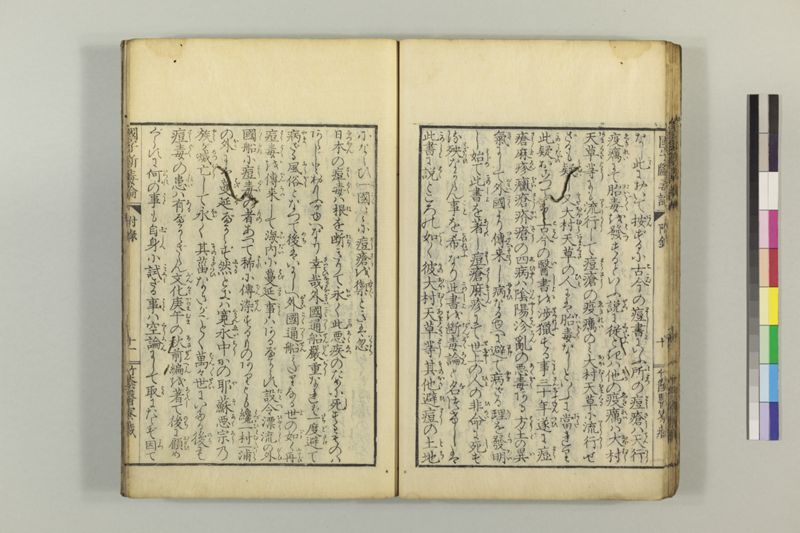
翻刻
【右頁】
なし此(こゝ)において按(あん)ずるに古今(ここん)の痘書(とうしよ)にいふ所(ところ)の痘瘡(とうさう)は天行(てんかう)
疫癘(ゑきれい)にて胎毒(たいどく)を發(はつ)するといふ説(せつ)に従(したがふ)ときは他(ほか)の疫癘(ゑきれい)は大村(おほむら)
天草等(あまくさとう)にも流行(りうかう)して痘瘡(とうさう)の疫癘(ゑきれい)のみ大村(おほむら)天草(あまくさ)に流行(りうかう)せ
ざるも疑(うたがは)し又(また)大村(おほむら)天草(あまくさ)の人(ひと)には胎毒(たいどく)なしといふに當(あた)れり
此疑(このうたがひ)おこつて□□#1古今(ここん)の醫書(いしよ)を《振り仮名:渉獵|せつ#2れふ》する事(こと)三十年(さんじふねん)遂(つひ)に痘(とう)
瘡(さう)麻疹(ましん)黴瘡(ばいさう)疥瘡(かいさう)の四病(しびやう)は陰陽(いんやう)沴亂(てんらん)の悪毒(あくどく)ある方土(はうど)の異(い)
氣(き)にして外國(ぐわいこく)より傳来(つたへきたり)し病(やまひ)なるゆへに避(さけ)て病(やま)ざる理(り)を發明(はつめい)
し始(はじめ)て此書(このしよ)を著(あらは)し痘瘡(とうさう)麻疹(ましん)にて世上(せじやう)の人(ひと)の非命(ひめい)に死(し)す
る殃(わざはひ)なからん事(こと)を希(こひねがふ)なり此書(このしよ)を断毒論(だんどくろん)と名(な)つけしは
此書(このしよ)に説(とく)ところの如(ごと)く彼(かの)大村天草等(おほむらあまくさとう)其他(そのほか)避痘(ひとう)の土地(とち)
【左頁】
にならひ一國(いつこく)々々に痘瘡(とうさう)を禦(ふせぐ)ときは忽(たちまち)
日本(につほん)の痘毒(とうどく)は根(ね)を断(たち)きりて永(なが)く此悪疾(このあくしつ)のために死(し)するものは
あらじとおもふがゆへなり幸哉(さいはひなるかな)外國(ぐわいこく)通船(つうせん)嚴重(げんぢう)なれば一度(いちど)避(さけ)て
病(やま)ざる風俗(ふうぞく)となつて後(のち)はいにしへ外國(ぐわひこく)通船(つうせん)みだりなる世(よ)の如(ごと)く再(ふたゝび)
痘毒(とうどく)を傳来(でんらい)して海内(かいだい)に蔓延(はびこる)事(こと)はあるべからす設令(たとへ)漂流(ひやうりう)の外(ぐわひ)
國船(こくふね)に痘毒(とうどく)の者(もの)あつて稀(まれ)に傳染(でんせん)するものありとも纔(わづか)一村(ひとむら)一浦(ひとうら)
の外(ほか)には蔓延(はびこる)べからず然(しかる)ときは寛永中(くわんゑいちう)かの耶蘇悪宗(やそあくしう)の
族(やから)が㓕亡(めつぼう)して永(なが)く其菑(そのわざはひ)なきがごとく萬々世(ばん〳〵せい )にいたる後(のち)も
痘毒(とうどく)の患(うれい)は有(ある)べからざらん文化庚午(ぶんくわかのえむま)の秋(あき)前編(ぜんへん)を著(あらはし)て後(のち)に顧(おもひ)め
ぐらすに何(いつれ)の事(こと)も自身(じしん)に試(こゝろみ)ざる事(こと)は空論(くうろん)にして取(とる)にたらず因(よつ)て
現代語訳
【右頁】
ない。ここにおいて考えるに、古今の痘瘡に関する医書にいうところの痘瘡は天行疫癘であって胎毒を発するという説に従うときは、他の疫癘は大村・天草等にも流行しているのに、痘瘡の疫癘のみが大村・天草に流行しないのも疑わしい。また大村・天草の人には胎毒がないということになってしまう。
この疑問が起こって以来、古今の医書を調査研究すること三十年、ついに痘瘡・麻疹・梅毒・疥癬の四病は陰陽混乱の悪毒ある異国の異気であって、外国より伝来した病気であるがゆえに避けて病まない理を発明し、初めてこの書を著した。痘瘡・麻疹によって世上の人が非業の死を遂げる災いがなくなることを希望するのである。この書を断毒論と名付けたのは、この書に説くところのように、かの大村・天草等その他の痘瘡回避の土地
【左頁】
にならい、一国々々に痘瘡を防ぐときは、たちまち
日本の痘毒は根を断ち切って永くこの悪疾のために死する者はいないであろうと思うためである。幸いなことに外国との通船は厳重であるから、一度避けて病まない風俗となった後は、昔外国との通船がみだりであった世のように再び痘毒を伝来して国内に蔓延することはないであろう。たとえ漂流の外国船に痘毒の者があって稀に伝染する者があったとしても、わずか一村一浦の外には蔓延しないであろう。そうであるならば、寛永中にかのキリシタン悪宗の族が滅亡して永くその災いがないように、万々世に至る後も痘毒の患いはないであろう。文化七年(1810)秋に前編を著してのちに振り返ってみるに、いずれのことも自身に試さない事は空論であって取るに足らない。よって
英語訳
【Right Page】
There are none. Considering this matter, according to the theory stated in ancient and modern smallpox medical texts that smallpox is a heavenly epidemic pestilence that manifests fetal poison, it is suspicious that while other epidemic pestilences also spread to places like Ōmura and Amakusa, only the smallpox pestilence does not spread to Ōmura and Amakusa. This would also mean that people in Ōmura and Amakusa have no fetal poison.
Since this doubt arose, I have investigated and researched ancient and modern medical texts for thirty years, and finally discovered the principle that the four diseases of smallpox, measles, syphilis, and scabies are foreign miasmas with malevolent poison from the disorder of yin and yang, and because they are diseases transmitted from foreign countries, they can be avoided and one need not fall ill. I wrote this book for the first time with the hope that the disaster of people in the world dying unnatural deaths from smallpox and measles would cease. I named this book "Treatise on Cutting Off Poison" because, as explained in this book, following the example of those regions like Ōmura and Amakusa and other smallpox-avoiding lands
【Left Page】
when each province prevents smallpox, immediately
the smallpox poison in Japan would be cut off at its roots and there would be no one who dies from this evil disease for a long time. Fortunately, since foreign shipping is strictly controlled, once customs are established to avoid and not fall ill, there will be no recurrence of smallpox poison transmission and spread throughout the country as in the old days when foreign shipping was unrestricted. Even if there were people with smallpox poison on drifting foreign ships and rare cases of transmission occurred, it would not spread beyond a single village or bay. If this were the case, just as the Christian heretical sect was destroyed during the Kan'ei period (1624-1644) and there has been no such disaster since, even after countless generations, there should be no suffering from smallpox poison. In the autumn of Bunka 7 (1810), after writing the previous volume and reflecting on it, I realized that anything not tested by oneself is mere empty theory and not worth considering. Therefore