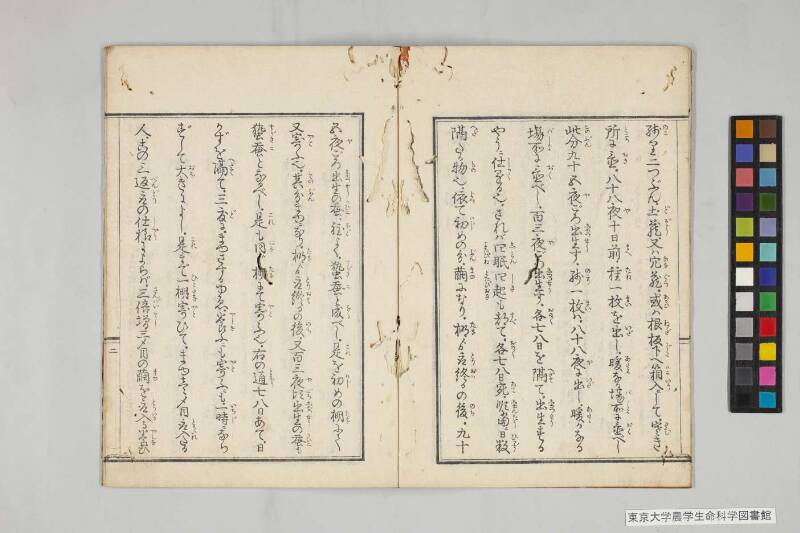
翻刻
【右丁】
残(のこ)り二つぶん.土蔵(どぞう).又は穴蔵(あなぐら).或(あるひ)は根板下(ねだじた)へ箱入(はこいり)にして.寒(さむ)き
所(ところ)に置(おき).八十八 夜(や)十日 前(まへ).種(たね)一 枚(まい)を出(いだ)し.暖(あたゝか)なる場所(ばしよ)に置(おく)べし
此分(このぶん)九十五 夜(や)ごろ出生(しゆつせう)す.残(のこり)一 枚(まい)は.八十八 夜(や)に出(いだ)し.暖(あたゝ)かなる
場所(ばしよ)に置(おく)べし.百三 夜(や)ごろ出生(しゆつせう)す.各(おの〳〵)七八日を隔(へだて)て.出生(しゆつせう)する
やうに仕懸(しかく)る也.されば《振り仮名:四眠四起|しみんしき|よたびねよたびおき》も都(すべ)て.各(おの〳〵)七八日 宛(あて).順当(しゆんたう)に日数(ひかず)
隔(へだ)たる物(もの)也.依(よつ)て初(はじ)めの分(ぶん).繭(まゆ)になり.棚(たな)より取終(とりおは)るの後(のち).九十
【左丁】
五 夜(や)ごろ出生(しゆつせう)の蚕(かひこ).程(ほど)よく.蟄蚕(すがきこ)と成(なる)べし.是(これ)を初(はじ)めの棚(たな)にて
又 寄(やと)ふ也.其分(そのぶん)まゆになり.棚(たな)より取終(とりおは)るの後(のち).又百三 夜頃(やごろ)出生(しゆつせう)の蚕(かひこ)も
蟄蚕(すがきこ)となるべし.是(これ)も同(おな)じ棚(たな)にて寄(やと)ふ也.右の通(とほり)七八日あて.日
かずを隔(へだて)て.三 度(ど)に.まゆさするゆゑ.養(やしな)ふにも寄(やと)ふにも.一時(いちじ)になら
ずして大(おほ)きによし.是(これ)まで一棚(ひとたな)寄(やと)ひて.まゆ壱乄#1目 取入(とりいれ)たる
人.この三 返取(べんどり)の仕様(しやう)によらば.三倍増(さんばいまし)三乄目の繭(まゆ)を取入(とりいる)る養(やしな)ひ
現代語訳
【右丁】
残り二つ分は、土蔵、または穴蔵、あるいは根太板の下へ箱に入れて、寒い場所に置き、八十八夜の十日前に種紙一枚を取り出して、暖かな場所に置くべきである。この分は九十五夜頃に孵化する。残り一枚は、八十八夜に取り出して、暖かな場所に置くべきである。百三夜頃に孵化する。それぞれ七〜八日を間隔として孵化するように仕掛けるのである。そうすれば、四眠四起(よたびねよたびおき)も、すべてそれぞれ七〜八日ずつ、順当に日数が隔たるものである。よって、最初の分が繭になり、棚から取り終えた後、九十
【左丁】
五夜頃に孵化した蚕が、ほどよく蟄蚕(すがきこ)となるはずである。これを最初の棚で再び飼い上げる。その分が繭になり、棚から取り終えた後、また百三夜頃に孵化した蚕も蟄蚕となるはずである。これも同じ棚で飼い上げる。上記の通り、七〜八日ずつ日数を隔てて、三度に繭を作らせるので、育てるにも飼い上げるにも、一度に重なることなく、大変都合がよい。これまで一棚で飼い上げて繭一〆目を取り入れていた人が、この三返取の仕様によるならば、三倍増の三〆目の繭を取り入れることができる養い方
英語訳
【Right page】
The remaining two portions should be placed in boxes in a cold location such as a storehouse, underground cellar, or beneath the floor joists. Ten days before the 88th night, one sheet of seed paper should be taken out and placed in a warm location. This portion will hatch around the 95th night. The remaining one sheet should be taken out on the 88th night and placed in a warm location. It will hatch around the 103rd night. The timing is arranged so that hatching occurs at intervals of seven to eight days respectively. Accordingly, the four sleeps and four wakings (the four molting cycles) will all occur at proper intervals of seven to eight days in sequence. Therefore, after the first batch has formed cocoons and been cleared from the shelf, around the ninety-
【Left page】
fifth night, the silkworms that hatched will have conveniently become cocooning silkworms (sugakiko). These are then raised again on the first shelf. After that batch has formed cocoons and been cleared from the shelf, the silkworms that hatched around the 103rd night will also have become cocooning silkworms. These too are raised on the same shelf. Since cocoons are produced three times at intervals of seven to eight days as described above, it is greatly advantageous that the raising and shelf-work do not all coincide at once. For those who have previously harvested one *meme* of cocoons from one shelf, by following this three-harvest method, they will be able to bring in three times as much — three *meme* of cocoons — as a method of rearing.