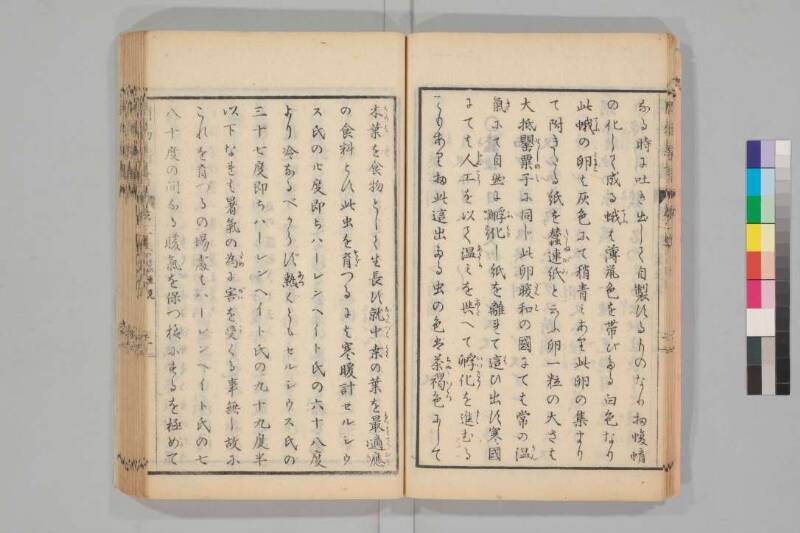
翻刻
なる時に吐き出して自製するものなり扨蝮蜟
の化して成る蛾(てふ)は薄鼠色を帯びたる白色なり
此 蛾(てふ)の卵(たまこ)は灰色にて稍青みあり此卵の集まり
て附きたる紙を蚕連紙(たねがみ)と云ふ卵一粒の大さは
大抵 罌粟子(けしのみ)に同じ此卵 暖和(だんわ)の国にては常の温(うん)
気(き)にて自然に《振り仮名:孵化|ふくわ|かいわり》し紙を離れて這(は)ひ出す寒国
にては人工(じんこう)を以て温(あたゝか)みを与(あた)へて孵化(かいわり)を進(すゝ)むる
こともあり扨此這出たる虫の色は茶褐色(ちやいろ)にして
木葉(きのは)を食物として生長す就中(なかんづく)桑(くわ)の葉を最(もつとも)《振り仮名:適応|てきおう|よき》
の食料とす此虫を育(そだ)つるには寒暖計セルシウ
ス氏の廿度即りハーレンヘイト氏の六十八度
より冷なるべからず熱(あつ)くともせルシウス氏の
三十七度即ちハーレンヘイト氏の九十九度半
以下なれは暑気の為(ため)に害(がい)を受(う)くる事無し故に
これを育つるの場処はハーレンヘイト氏の七
八十度の間なる暖気を保つ様にするを極めて
現代語訳
なる時に吐き出して自ら製造するものである。さて蛹が化して成る蛾は薄鼠色を帯びた白色である。この蛾の卵は灰色で少し青みがある。この卵が集まって付着している紙を蚕種紙と言う。卵一粒の大きさは大体ケシの実と同じである。この卵は、温暖な国では普通の温度で自然に孵化し、紙を離れて這い出す。寒い国では人工的に温かさを与えて孵化を促進することもある。さて、この這い出した虫の色は茶褐色で、
木の葉を食物として成長する。中でも桑の葉を最も適した食料とする。この虫を育てるには、セルシウス温度計の20度、すなわちファーレンハイト温度計の68度より冷たくてはならない。暑くてもセルシウス温度計の37度、すなわちファーレンハイト温度計の99.5度以下であれば、暑さのために害を受けることはない。したがって、これを育てる場所はファーレンハイト温度計の70-80度の間の暖かさを保つようにするのが極めて
英語訳
when it spits out and manufactures itself. Now, the moth that emerges from the transformed pupa is white with a pale gray tinge. The eggs of this moth are gray with a slight bluish color. The paper on which these eggs are clustered and attached is called silkworm egg paper (tanegami). The size of one egg is roughly the same as a poppy seed. In warm countries, these eggs naturally hatch at normal temperatures and crawl out from the paper. In cold countries, artificial warmth is sometimes applied to promote hatching. The color of these newly hatched insects is brown,
and they grow by eating tree leaves as food. Among these, mulberry leaves are the most suitable food. To raise these insects, the temperature must not be colder than 20 degrees Celsius, which is 68 degrees Fahrenheit. Even if hot, as long as it is below 37 degrees Celsius, which is 99.5 degrees Fahrenheit, they will not be harmed by the heat. Therefore, the place for raising them should be kept at a warmth between 70-80 degrees Fahrenheit, which is extremely