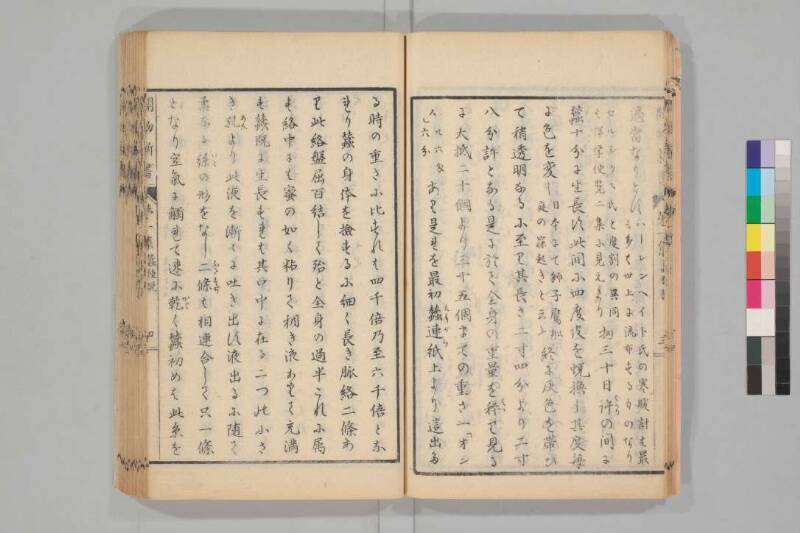
翻刻
適当なりとす《割書:ハーレンヘイト氏の寒暖計は最|も多く世上に流布するものなり》
《割書:セルシウス氏と度割の異同|は洋学便覧二集に見えたり》扨三十日 許(ばかり)の間に
蚕十分に生長す此間に四度皮を蜕換し其度毎
に色を変し《割書:日本にて獅子鷹船|庭の寐起きと云ふ》終に灰色を帯び
て稍透明なるに至り其長さ二寸四分より二寸
八分許となる是に於て全身の重量を秤(はか)り見る
に大抵二十個より三十五個まての重さ一「オン
ス」《割書:廿六匁|六分》あり是れを最初 蚕連紙(たねがみ)上より這出た
る時の重さに比すれは四千倍乃至六千倍とな
れり蚕の身体を撿するに細く長き脈絡二条あ
り此絡盤屈百結して殆と全身の過半これに属
す絡中には蜜の如く粘りて稠き液ありて充満
す蚕既に生長すれは其口中に在る二つの小さ
き孔(あな)より此液を漸々に吐き出す液出るに随て
柔なる糸(いと)の形をなし二条(ふたすぢ)は相連合して只一条
となり空気に触れて速に乾(かわ)く蚕初めは此糸を
現代語訳
適当である。(ファーレンハイト氏の温度計は最も多く世間に流布しているものである。セルシウス氏との度数の違いについては洋学便覧二集に記載されている。)さて30日ほどの間に蚕は十分に成長する。この間に4度皮を脱ぎ換え、その度ごとに色を変える(日本では獅子鷹船庭の寝起きと言う)。最終的に灰色を帯びてやや透明になり、その長さは2寸4分から2寸8分ほどとなる。ここで全身の重量を測ってみると、大体20個から35個までの重さが1オンス(26匁6分)ある。これを最初に蚕種紙上から這い出した
時の重さと比べると4千倍から6千倍となっている。蚕の身体を調べると、細く長い脈絡が2条あり、この絡は盤屈百結してほとんど全身の過半がこれに属している。絡の中には蜜のように粘りがあって濃い液で充満している。蚕が既に成長すると、その口中にある2つの小さな孔からこの液を徐々に吐き出す。液が出るに従って柔らかい糸の形をなし、2条は相連合してただ1条となり、空気に触れて速やかに乾く。蚕は初めはこの糸を
英語訳
appropriate. (Fahrenheit's thermometer is the most widely circulated in the world. The differences in degree divisions between Celsius and Fahrenheit are described in Yōgaku Benran, Second Collection.) Now, in about thirty days, the silkworm grows sufficiently. During this time, it molts four times, changing color each time (in Japan, this is called "shishi-taka-funaba no neoki" - the sleeping and waking of lion-hawk-boat-garden). Finally, it becomes grayish and somewhat transparent, reaching a length of about 2 sun 4 bu to 2 sun 8 bu. When the total body weight is measured at this point, approximately 20 to 35 individuals weigh one ounce (26 monme 6 bu). Compared to the initial weight when they first crawled out from the silkworm egg paper,
this represents a 4,000 to 6,000-fold increase. Upon examining the silkworm's body, there are two fine, long vessels. These vessels are coiled and twisted throughout, comprising nearly more than half of the entire body. The vessels are filled with a viscous, thick liquid like honey. Once the silkworm has fully grown, it gradually expels this liquid through two small holes in its mouth. As the liquid emerges, it forms soft threads, and the two strands combine to become just one strand, which quickly dries upon contact with air. The silkworm initially uses this thread to