翻刻
【右丁 白紙】
【資料整理ラベル】
09
ヨ
12
【左丁】
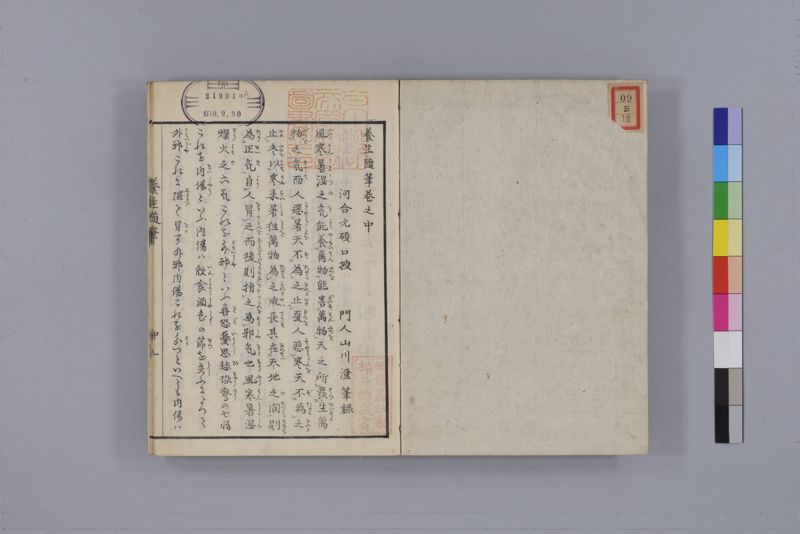
養生隨筆巻之中 【蔵書印】西備州松永
松井館蔵書
河合元碩口授 門人山川 澄 筆録
風寒(ふうかん)暑湿(しよしつ)之(の)気(き)能(よく)養(やしない)_二万物(はんふつを)_一能 害(がいす)_二万物(はんふつを)_一 天之所_レ発(はつ)_二-生(せいする)万
物(ぶつ)_一之 気(きにして)而人 悪(にくめとも)_レ暑(しよを)天 不(す)_二為(ために)_レ之止(これかやめ)_一_レ夏(なつを)人 悪(にくめとも)_レ寒(かんを)天 不(ず)_二為(ために)_レ之(これか)
止(やめ)_一_レ冬(ふゆを)以(もつて)_二寒来暑往(かんらいしよわうを)_一万物 為(ために)_レ之成長(これかせいてうす)其 在(あつては)_二 天-地 之(の)間(あいたに)_一則(すなはち)
為(たり)_二世気(せいき)_一自(より)_レ 人 冒(をかして)_レ之(これを)而後則(しかうしてのちにすなはち)指(さして)_レ之(これを)為(する)_レ邪気(しやきと)也(なり)風寒暑湿(ふうかんしよしつ)
燥火(さうくわ)之(の)六気これを外邪(くわいしや)といふ喜(き)怒(ど)憂(いう)思(し)悲(ひ)恐(きやう)驚(けう)の七情
これを内傷(ないしやう)といふ内傷は飲食酒色(いんしよくしゆしよく)の節(せつ)を失(うし)ふによつて
外邪(くわいじや)これに随(したかつ)て冒(をか)す外邪内傷これを分(わか)つといへとも内傷は
現代語訳
【右丁 白紙】
【資料整理ラベル】
09
ヨ
12
【左丁】
養生随筆巻之中 【蔵書印】西備州松永
松井館蔵書
河合元碩口授 門人山川 澄 筆録
風・寒・暑・湿の気は、よく万物を養い、また万物を害する。これは天が万物を発生させる気であって、人が暑さを嫌っても、天はそのために夏をやめることはない。人が寒さを嫌っても、天はそのために冬をやめることはない。寒さが来て暑さが去ることによって、万物はそのために成長する。それが天地の間にあるときは、正気となる。人がこれを犯してから後に、これを指して邪気というのである。
風・寒・暑・湿・燥・火の六気、これを外邪という。喜・怒・憂・思・悲・恐・驚の七情、これを内傷という。内傷は飲食や酒色の節度を失うことによって起こり、外邪がこれに従って侵入する。外邪と内傷をこのように分けて言うけれども、内傷は
英語訳
[Right page: blank]
[Archival label]
09
Yo
12
[Left page]
Essays on Health Cultivation, Volume Two 【Library seal】Western Bizen Province Matsunaga
Matsui Hall Collection
Oral instruction by Kawai Genseki Recorded by disciple Yamakawa Sumi
The qi of wind, cold, heat, and dampness can both nourish all things and harm all things. This is the qi by which Heaven generates all things. Even though people dislike heat, Heaven does not stop summer for their sake. Even though people dislike cold, Heaven does not stop winter for their sake. Through the coming of cold and the departure of heat, all things grow and develop. When this exists between Heaven and Earth, it becomes righteous qi. Only after people violate this does it become what we point to and call pathogenic qi.
The six qi of wind, cold, heat, dampness, dryness, and fire—these are called external pathogens. The seven emotions of joy, anger, worry, pensiveness, grief, fear, and fright—these are called internal damage. Internal damage occurs through losing moderation in food, drink, and sensual pleasures, and external pathogens follow this and invade. Although we distinguish between external pathogens and internal damage in this way, internal damage is...