翻刻
【右丁】
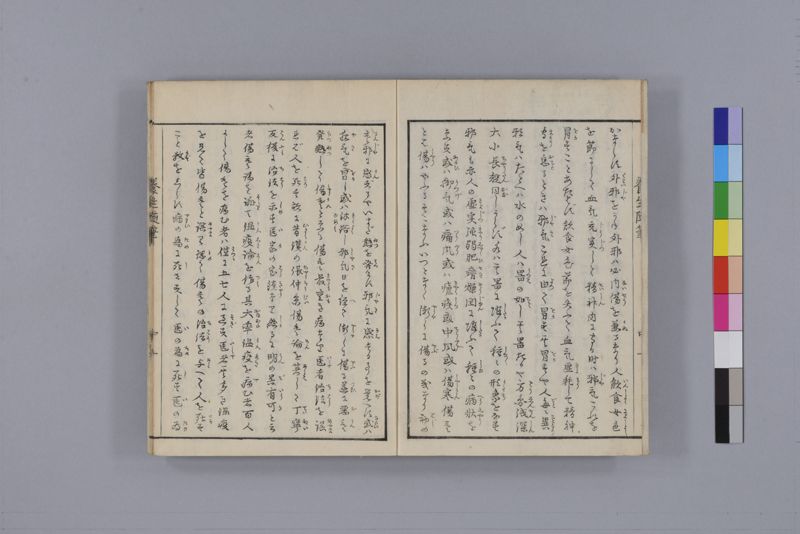
かならす外邪(くわいじや)をかね外邪は必 内傷(ないしやう)を兼(かぬ)るなり人 飲食(いんしよく)女色(によしよく)
を節にして血気 充実(じうじつ)して精神(せいしん)内に守る時は邪(じや)気これを
冒(をか)すことあたはず飲食女色節を失ふて血気 虚耗(きよもう)して精神
守(まもり)を怠(おこた)るときは邪気(じやき)これに由(よつ)て冒(をか)す其 冒(をか)すや人 毎(ごと)に異(ことなり)
邪気はたとへは水の如し人は器(うつは)の如(こと)し其器たるや方円(はうゑん)浅深(せんしん)
大小 長短(ちやうたん)同(おな)しからず水は其器に随(したか)ふて種々(しゆ〳〵)の形象(かたち)をなす
邪気も亦人の虚実(きよじつ)強弱(きやうしやく)肥瘠(ひせき)燥潤(そうじゆん)に随(したか)ふて種(しゆ)々の病状(へうしやう)を
なす或(あるひ)は脚気(かつけ)或は痛風(つうふう)或は瘧疾(きやくしつ)或中風(ちうふう)ある傷寒(しやうかん)傷寒
とは傷(しやう)はやふるそこなふいつとなく漸(やうや)く傷(やぶ)るの義なり初(はじ)め
【左丁】
寒邪(かんじや)に感(かん)ずるやいまだ熱(ねつ)を発せす邪気(じやき)に感(かん)する事を覚(おぼ)へす或(あるい)は
夜気(やき)を冒(をか)し或は《振り仮名:沐浴|もくよく|ゆあみ》し邪気(しやき)日を経(へ)て漸(やうや)くに傷(やふ)る遂(つひ)に悪寒(おかん)
発熱(ほつねつ)して傷寒(しやうかん)となる傷寒 最(もつとも)重(おも)き病なり医(いしや)者 治法(ちはう)を誤(あやま)
れば人を死(ころ)す故に昔(むかし)漢(かん)の張仲景(ちやうちうけい)傷寒 論(ろん)を著(あらは)して丁寧(ていねい)
反復(はんふく)に治法(ちほう)を示(しめ)す医家(いか)の宝鑑(はうきやう)なり然(しか)るに明(みん)の呉有可(ごいうか)と云
者傷寒論を誹(そしり)て温疫論(うんゑきろん)を作(つく)る其 大率(おほむね)温疫(うんゑき)を病(や)む者百人
にして傷寒を病む者は僅(わつか)に五七人 過(すぎ)す医者(いしや)其多き温疫
を見て皆傷寒と誤(あやま)り認(とめ)て傷寒の治法(ちはう)を与(あた)へて人を死(ころ)す
こと数(かず)をしらす病(やまひ)の為(ため)に死(し)せすして医(い)の為(ため)に死(し)す医(い)の為(ため)
現代語訳
【右丁】
必ず外邪を兼ね、外邪は必ず内傷を兼ねるのである。人が飲食や女色を節制して血気が充実し、精神が内を守っている時は、邪気がこれを侵すことはできない。飲食や女色の節度を失って血気が虚耗し、精神が守りを怠る時は、邪気がこれによって侵入する。その侵し方は人によって異なる。
邪気はたとえば水のようなもので、人は器のようなものである。その器というものは、方形・円形、浅い・深い、大小、長短が同じではない。水はその器に従って種々の形をなす。邪気もまた人の虚実、強弱、肥瘦、燥潤に従って種々の病状をなす。あるものは脚気、あるものは痛風、あるものは瘧疾、あるものは中風、あるものは傷寒である。傷寒とは「傷」は破る・損なうという意味で、いつとなく徐々に傷つけるという意味である。初めは
【左丁】
寒邪に感じてもまだ熱を発せず、邪気に感じることを自覚しない。あるいは夜気を侵し、あるいは入浴し、邪気が日を経て徐々に傷つけ、ついに悪寒・発熱して傷寒となる。傷寒は最も重い病である。医者が治法を誤れば人を死なせる。故に昔、漢の張仲景が傷寒論を著して丁寧かつ反復して治法を示した。これは医家の宝鑑である。
しかし明の呉有可という者が傷寒論を批判して温疫論を作った。その大要は、温疫を病む者が百人いて、傷寒を病む者はわずかに五、七人に過ぎない。医者はその多い温疫を見て皆傷寒と誤って認識し、傷寒の治法を与えて人を死なせることは数知れない。病のために死ぬのではなく医のために死ぬ。医のために
英語訳
[Right page]
Internal damage necessarily accompanies external pathogens, and external pathogens necessarily accompany internal damage. When a person moderates food, drink, and sexual pleasures so that blood and qi are abundant and the spirit guards the interior, pathogenic qi cannot invade. When one loses moderation in food, drink, and sexual pleasures so that blood and qi become depleted and the spirit neglects its guard, pathogenic qi invades through this opening. The way it invades differs from person to person.
Pathogenic qi is like water, and people are like vessels. These vessels differ in being square or round, shallow or deep, large or small, long or short. Water takes various forms according to its vessel. Pathogenic qi also creates various disease conditions according to people's deficiency or excess, strength or weakness, obesity or thinness, dryness or moisture. Some develop beriberi, some gout, some malaria, some stroke, some cold damage (shanghan). "Cold damage" means "injury"—to break or harm—meaning to gradually injure imperceptibly. Initially,
[Left page]
when one is affected by cold pathogens, fever has not yet developed and one is unaware of being affected by pathogenic qi. Perhaps one is exposed to night air, or takes a bath, and the pathogenic qi gradually causes injury over days, finally resulting in aversion to cold and fever, becoming cold damage disease. Cold damage is the most serious illness. If doctors err in their treatment methods, they kill people. Therefore, long ago Zhang Zhongjing of the Han dynasty wrote the "Treatise on Cold Damage," carefully and repeatedly demonstrating treatment methods. This is a treasure mirror for medical practitioners.
However, Wu Youke of the Ming dynasty criticized the Treatise on Cold Damage and created the "Treatise on Warm Epidemics." His main point was that among a hundred people suffering from warm epidemics, only about five to seven suffer from true cold damage. Doctors see these numerous warm epidemic cases and mistakenly identify them all as cold damage, applying cold damage treatments and killing countless people. They die not from the disease but from the medicine—from the medicine...