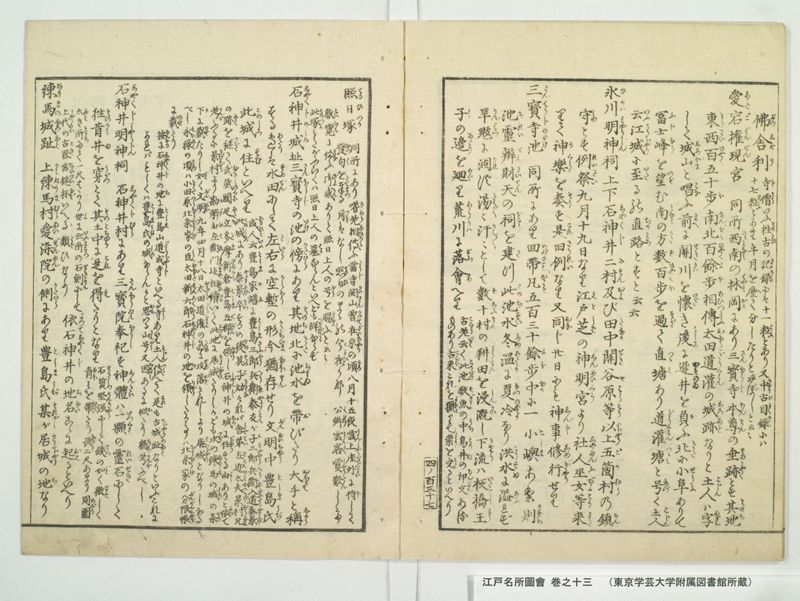
翻刻
【右丁】
仏舎利(ぶつしやり)《割書:寺僧(じそう)いふ往古(そのかみ)の記録(きろく)には十一粒( りふ)とあり又 中古(ちゆうひ)目録(もくろく)には|十七粒( りふ)とあり年月を歴(へ)て分したりとおぼしと云々》
愛宕権現宮(あたごごんげん ) 同所 西南(にしみなみ)の林岡(はやしおか)にあり三宝寺(さんほうじ)本尊(ほんそん)の垂跡(すゐしやく)とす其地(そのち)
東西(とうさい)百五十歩(ひやく ほ )南北(なんぼく)百余歩(ひやくよほ)相伝(あひつたふ)太田道潅(おほただうくわん)の城跡(しろあと)なりと土人(とじん)は字(あざな)
して城山(しろやま)と唱(とな)ふ前(まへ)に関川(せきかは)を懐(いだ)き後(うしろ)に遅井(おそのゐ)を負(お)ふ北(きた)に小阜(せうふ)ありて
冨士峰(ふじほう)を望(のぞ)む南(みなみ)の方(かた)数百歩(すひやくほ)を過(すぎ)て直塘(つゝみ)あり道潅塘(だうくわんつゝみ)と号(なづ)く土人(とじん)
云(いふ)江城(こうじやう)に至(いた)るの直路(ちかみち)とすと云々
氷川明神祠(ひかはみやうしん )上下 石神井(しやくじ)二村(にそん)及(およ)び田中(たなか)関(せき)谷原(やはら)等(とう)以上(いじやう)五箇村(ごかむら)の鎮(ちん)
守(しゆ)とす例祭(れいさい)九月十九日なり江戸(えと)芝(しば)の神明宮(しんめいくう)より社人(しやにん)巫女(ふぢよ)等(とう)来(きた)
りて神楽(かくら)を奏(そう)す是(これ)旧例(きうれい)なり又 同(おな)じ廿日にも神事(しんじ)修行(しゆぎやう)せり
三宝寺池(さんはうじのいけ) 同所にあり回帯(めぐること)凡(およそ)五百三十余歩( よほ)中(なか)に一 小嶼(こしま)あり則(すなはち)
池霊弁財天(ちれいべんさいてん)の祠(ほこら)を建(た)つ此(この)池水(ちすい)冬(ふゆ)温(あたゝか)に夏(なつ)冷(ひやゝか)なり洪水(こうすゐ)に溢(あふ)れず
旱魃(かんはつ)に涸(かれ)ず湯々(たう〳〵)汗々(かん〳〵)として数十村(すしふそん)の耕田(こうてん)を浸漑(しんかい)し下流(かりう)は板橋(いたはし)王(わう)
子(し)の辺(あたり)を廻(めぐ)り荒川(あらかは)に落会(おちあ)へり《割書:古老(こらう)云(いは)く此池(このいけ)数魚(すぎよ)の中(うち)鳥井(とりゐ)の印文(ゐんぶん)ある|ものあり古来(こらい)これを猟(すなと)りて祟(たゝり)を受(うく)るといへり》
【左丁】
照日塚(てるひつか) 《割書:同所にあり嗜老(きらう)相伝(あひつた)ふ当寺(たうじ)開山(かいさん)曽(かつて)在京(ざいきやう)の頃(ころ)八月十五日夜 雲上(うんしゆう)座外(ざぐわい)に侍(じ)して|発句(ほつく)を奉(たてまつ)る月(つき)はなし照日(てるひ)のまゝの今夜(こよひ)かな 公卿(くけう)雲客(うんかく)賞歎(しやうたん)して》
《割書:叡覧(えいらん)に備(そな)ふ御感(ぎよかん)ありて照日上人の号(がう)を賜(たま)ふと云々|此塚(このつか)うたがふらくは照日上人の墓(はか)ならんといへども詳(つまびらか)ならず》
石神井城址(しやくじのしろ ) 三宝寺(さんほうじ)の池(いけ)の傍(かたはら)にあり其地(そのち)北(きた)に池水(ちすゐ)を帯(お)びたり大手(おほて)と称(しよう)
する辺(あたり)は水田(すゐでん)にして左右(さいう)に空塹(からほり)の形(かたち)今猶(いまなほ)存(そん)せり文明中(ぶんめいちゆう)豊島氏(としまうぢ)
此城(このしろ)に住(すむ)といへり《割書:或人云(あるひといふ)豊島家譜(としまかふ)に豊島三郎兵衛泰友(としまさふらうへうゑやすとも)が子(こ)三郎兵衛入道泰景(さふらうへうゑにふたうすかげ)|此城(このしろ)にあり泰景(やすかげ)卒(そつ)するの後(のち)其子(そのこ)幼(をさな)ければ舎弟(しやてい)左近太夫景村(さこんのいふかげむら)兄(あに) 》
《割書:の跡(あと)を継(つぎ)て武蔵国(むさしのくに)足立(あたち)多摩(たま)新倉(にゐくら)豊島(としま)五郡(ごぐん)を領(りやう)し石神井(しやくじ)の城(しろ)に住(ぢゆう)する由(よし)ありと依(よつ)て|考(かんが)ふるに景村(かげむら)より勘解由左衛門(かげゆさゑもん)迄(まで)相続(あひつゞ)いて此地(このち)に居城(きよじやう)たりしかども次(つぎ)の練馬(ねりま)の城(しろ)の条(でう) 》
《割書:下(か)に載(のせ)たりし如(ごと)く文明(ぶんめい)九年四月十八日 太田道潅(おほただうくわん)の為(ため)に攻落(せめおと)されしより廃城(はいじやう)となりしなる|べし永禄(えいろく)の頃(ころ)は小田原北条家(をたはらほうでうけ)の臣(しん)太田新六郎(おほたしんろくらう)石神井(しやくじ)の地(ち)を領(りやう)したる事は北条家(ほうでうけ)の分限帳(ぶんげんちやう)》
《割書:に載(のせ)たり|》
《割書:按(あんする)に石神井(しやくじ)の地(ち)に豊島山(としま )道成寺(だうじやうじ)といへる寺(てら)あり土人(とじん)伝(つた)へて是(これ)も古城趾(こじやうのあと)なりといふこれに|よればもしくは豊島氏(としまうぢ)の城(しろ)ならんかと思(おも)はる山号(さんがう)又 因(ちなみ)あるに似(に)たり猶(なほ)考(かんが)ふべし》
石神井明神祠(しやくじいみやうじん ) 石神井村(しやくじむら)にあり三宝院(さんほうゐん)奉祀(ほうし)す神体(しんたい)は一顆(いつくわ)の霊石(れいせき)にして
往昔(そのかみ)井(ゐ)を穿(うがつ)とて其(その)土中(とちゆう)に是(これ)を得(え)たりとなり《割書:石質(せきしつ)堅強(けんきやう)にして銕(てつ)の如(ごと)く微(すこ)しく|青(あほ)みを帯(おび)たり長(ながさ)二尺あまり周圍(めぐり)》
《割書:太(ふと)き所(ところ)にて一尺はかり世(よ)に云所(いふところ)の石剣(せきけん)にして|上代(しやうたい)の古器(こき)雷槌(らいつい)抔(など)いへる類(たぐ)ひなり》依(よつて)石神井(しやくじ)の地名(ちめい)こゝに起(おこ)るといへり
練馬城趾(ねりまのしろあと) 上練馬村(かみねりまむら)愛染院(あいぜんゐん)の側(かたはら)にあり豊島氏(としまうぢ)某(それがし)が居城(きよじやう)の地(ち)なり
現代語訳
## 【右丁】
**仏舎利**
《割書:寺の僧侶が言うには、往古の記録には十一粒とあり、また中古の目録には十七粒とある。年月を経て分かれたものと思われる、とのことである。》
**愛宕権現宮**
同所(石神井)の西南の林岡(林の丘)にある。三宝寺の本尊の垂迹(権現としての現れ)とする。その地は東西百五十歩、南北百余歩。言い伝えによれば、太田道灌の城跡であるといい、土地の人々はその字を「城山」と呼んでいる。前方に関川を抱き、後方に遅井(おそのい)を負う。北に小さな丘があり、富士の峰が望める。南の方、数百歩を過ぎると堤があり、「道灌堤」と呼ばれている。土地の人々が言うには、江城(江戸城)へ至る近道であった、とのことである。
**氷川明神祠**
上・下石神井の二村および田中・関・谷原など、合わせて五箇村の鎮守とする。例祭は九月十九日である。江戸・芝の神明宮より社人・巫女などが来て神楽を奏でる。これが旧来の例である。また同じく二十日にも神事が行われる。
**三宝寺池**
同所にある。周囲はおよそ五百三十余歩。中に一つの小島があり、そこに池霊弁財天の祠を建てている。この池の水は冬は温かく、夏は冷たい。洪水に際しても溢れず、旱魃のときも涸れない。滔々と豊かに流れ、数十村の耕作地を潤し、下流は板橋・王子あたりを廻り、荒川に合流する。
《割書:古老が言うには、この池に棲む魚の中に、鳥居の印文(紋様)があるものがいる。古来これを獲ると祟りを受けるといわれている。》
---
## 【左丁】
**照日塚**
《割書:同所にある。古老の言い伝えによれば、当寺の開山(初代住職)がかつて在京のころ、八月十五日の夜、雲上(宮中・公卿の世界)の座の外に侍して発句を奉った。「月はなし 照日のまゝの 今夜かな」。公卿・雲客たちが賞賛し、叡覧(天覧)に供えられ、御感があって「照日上人」の号を賜ったとのことである。この塚はおそらく照日上人の墓であろうと思われるが、詳しいことは定かでない。》
**石神井城址**
三宝寺池のほとりにある。その地は北に池水を帯びている。「大手」と称される辺りは水田となっており、左右に空堀の形が今もなお残っている。文明年間(1469〜1487)に豊島氏がこの城に住んでいたといわれる。
《割書:ある人が言うには、豊島家譜によれば、豊島三郎兵衛泰友の子・三郎兵衛入道泰景がこの城にいた。泰景が亡くなった後、その子が幼かったため、舎弟(弟)の左近太夫景村が兄の跡を継いで、武蔵国の足立・多摩・新倉・豊島の五郡を領し、石神井の城に住んでいたとのことである。これを考えると、景村より勘解由左衛門まで代々この地に居城を構えていたが、次の練馬の城の条に後述するように、文明九年(1477年)四月十八日に太田道灌によって攻め落とされ、廃城となったのであろう。永禄年間(1558〜1570)には小田原北条家の臣・太田新六郎が石神井の地を領したことは、北条家の分限帳に記載されている。》
《按ずるに:石神井の地に「豊島山道成寺」という寺がある。土地の人々が伝えて、これも古城の跡であるという。これによれば、もしかすると豊島氏の城であったかとも思われる。山号(寺の号)もまた(豊島氏と)縁があるようであり、なお考察すべきである。》
**石神井明神祠**
石神井村にある。三宝院が奉祀する。神体は一個の霊石で、往昔、井戸を掘ろうとしたところ、その土中からこれを得たという。
《割書:石質は堅強で鉄のようであり、わずかに青みを帯びている。長さ二尺あまり、周囲の最も太いところで一尺ほどである。世にいうところの「石剣」であり、上代の古器、「雷槌(らいつい)」などと呼ばれる類のものである。》
よって「石神井」という地名はここに起こるといわれている。
**練馬城址**
上練馬村の愛染院のほとりにある。豊島氏某(某人)の居城の地である。
英語訳
## [Right Page]
**Buddha's Relics (Busshari)**
*[Interlinear note: According to the temple monks, ancient records state there were eleven grains; a later catalogue records seventeen grains. It is thought that they divided and multiplied over the years, so it is said.]*
**Atago Gongen Shrine**
Located on a wooded hill to the southwest of the same location (Shakujii). It is considered the *suijaku* (manifestation in the form of a Shinto deity) of the principal Buddha image of Sanpō-ji Temple. The grounds measure approximately 150 paces east to west and over 100 paces north to south. According to tradition, this is the site of a castle belonging to Ōta Dōkan, and the local people call this area *Shiroyama* (Castle Hill). Before it embraces the Sekikawa River, and behind it backs onto the Osono-i (a well). To the north there is a small hill from which Mount Fuji can be seen. Several hundred paces to the south there is an embankment known as the "Dōkan Embankment." The local people say it served as a shortcut to *Kōjō* (Edo Castle).
**Hikawa Myōjin Shrine**
This serves as the guardian shrine (*chinju*) of five villages combined: the upper and lower villages of Shakujii, Tanaka, Seki, and Yahara. The annual festival (*reisai*) is held on the nineteenth day of the ninth month. Shrine attendants (*shajin*) and shrine maidens (*miko*) come from the Shinmei-gū Shrine in Shiba, Edo, to perform *kagura* (sacred music and dance). This is the long-established custom. Sacred rites are also performed on the twentieth day of the same month.
**Sanpō-ji Pond**
Located at the same place. The circumference is approximately 530-odd paces. In the middle there is a small islet, upon which a shrine to the Pond-Spirit Benzaiten has been erected. The waters of this pond are warm in winter and cool in summer. It does not overflow in floods, nor does it dry up in droughts. It flows abundantly and irrigates the farmland of several dozen villages; the downstream flow winds around the area of Itabashi and Ōji, and eventually merges with the Arakawa River.
*[Interlinear note: According to village elders, among the many fish in this pond, there are some bearing the imprint of a torii (shrine gate) upon them. It has been said from ancient times that to catch such fish will bring divine punishment.]*
---
## [Left Page]
**Teruhi Mound (Teruhi-zuka)**
*[Interlinear note: Located at the same place. According to the tradition passed down by village elders, the founder (kaisan) of this temple, once during his time in the capital, sat in attendance outside the seats of the nobility on the night of the fifteenth day of the eighth month, and offered this hokku (opening verse): "There is no moon — just as the sun shines, such is this night." The court nobles and attendants praised it greatly; it was presented for imperial inspection, and His Majesty was deeply moved, bestowing upon the monk the title "Teruhi Shōnin" (Saint Teruhi). This mound is likely the grave of Teruhi Shōnin, though this is not entirely certain.]*
**Site of Shakujii Castle (Shakuji no Shiro-ato)**
Located beside the Sanpō-ji Pond. The northern side of its grounds is bordered by the pond waters. The area called the *ōte* (main gate approach) has become paddy fields, but the shapes of the dry moats (*karabori*) on both sides still remain to this day. It is said that during the Bunmei era (1469–1487), the Toshima clan inhabited this castle.
*[Interlinear note: According to one person, the Toshima family genealogy states that Toshima Saburōhyōe Nyūdō Yasukage — son of Toshima Saburōhyōe Yasutomo — resided in this castle. After Yasukage's death, as his son was still young, his younger brother Sakon-no-tayū Kagemura succeeded to his elder brother's position, ruling over five districts of Musashi Province — Adachi, Tama, Niikura, and Toshima — and resided in Shakujii Castle. Based on this account, it appears that from Kagemura down to Kageyū-zaemon, successive generations held this place as their castle seat; however, as detailed below in the entry on Nerima Castle, on the eighteenth day of the fourth month of Bunmei 9 (1477), the castle was attacked and overthrown by Ōta Dōkan, after which it fell into ruin. During the Eiroku era (1558–1570), it is recorded in the Hōjō clan's *bungenchō* (register of retainers' stipends) that Ōta Shinrokurou, a retainer of the Odawara Hōjō clan, held the land of Shakujii.]*
*[Editorial note: Upon reflection, there is a temple in Shakujii called "Toshimayama Dōjō-ji," and the local people say that this too is the site of an ancient castle. Based on this, one might think it could have been a castle of the Toshima clan. The temple's mountain name (*sangō*) also seems to suggest a connection. This warrants further investigation.]*
**Shakujii Myōjin Shrine**
Located in Shakujii Village. It is maintained and worshipped by Sanpō-in. The divine object (*shintai*) of worship is a single sacred stone, which, according to tradition, was discovered in the ground when a well was being dug long ago.
*[Interlinear note: The stone is extremely hard like iron, and bears a faint bluish tint. It measures over two shaku in length, and about one shaku in circumference at its widest point. It is what is known as a "stone sword" (sekken), belonging to the category of ancient artifacts from antiquity called "thunder hammers" (raidzui) and the like.]*
Thus it is said that the place name "Shakujii" originated from this stone.
**Site of Nerima Castle (Nerima no Shiro-ato)**
Located beside Aizen-in in Kami-Nerima Village. It was the castle seat of a certain member of the Toshima clan.