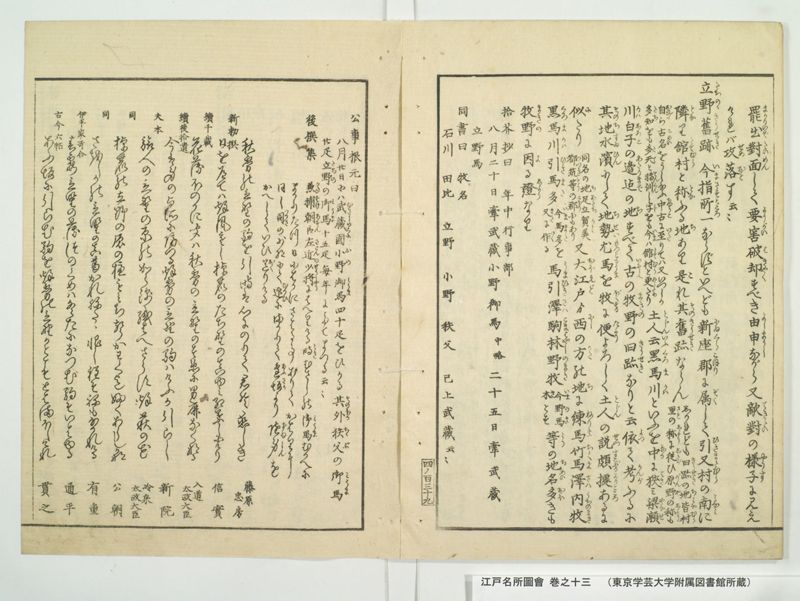
翻刻
【右丁】
罷出(まかりいで)対面(たいめん)して要害(ようがい)破却(はきやく)すべき由(よし)申(まうし)ながら又 敵対(てきたい)の様子(やうす)に見え
ければ攻落(せめおと)す云々
立野旧跡(たちのゝきうせき) 今(いま)指所(さすところ)一ならずといへども新座郡(にゐくらこほり)に属(ぞく)して引又村(ひきまたむら)の南(みなみ)に
隣(とな)り舘村(たてむら)と称(とな)ふる地(ち)あり是(こ)れ其(その)旧跡(きうせき)ならん《割書:しかれども旧跡(きうせき)の地(ち)皆(みな)村(むら)|里(さと)の称(しよう)に従(したが)ひ原野(げんや)の称(しよう)も》
《割書:自(おのづか)ら古名(こめい)をうしなふ中古(ちゆうこ)に至(いた)りては又いつしか|多知(たち)をも多天(たて)と転訓(てんくん)し字(じ)をも今(いま)は舘村(たてむら)と更(あらため)たり》土人云(とじんいふ)黒馬川(くろまかは)といふを中(なか)に挾(はさ)み梁瀬(やなせ)
川(かは)白子(しろこ)の辺(あたり)迄(まで)の地(ち)すべて古(いにしへ)の牧野(まきの)の旧跡(きうせき)なりと云 依(よつ)て考(かんが)ふるに
其地(そのち)水浜(すゐひん)にして地勢(ちせい)尤(もつとも)馬(うま)を牧(ぼくする)に便(たより)よろしく土人(とじん)の説(せつ)頗(すこぶる)拠(よりところ)あるに
似(に)たり《割書:同名の地(ち)足立(あたち)賀美(かみ)|都筑(つつき)等(とう)の郡(こほり)にもあり》又 大江戸(おほえど)より西(にし)の方(かた)の地(ち)に練馬(ねりま)竹馬沢(ちくまさわ)内牧(うちのまき)
黒馬川(くろまかは)引馬多(ひきまた)《割書:今(いま)馬多(また)を|又(また)に作(つく)る》馬引沢(うまひきさは)駒林(こまはやし)野牧(のまき)《割書:今(いま)野馬(のま)|木(き)とす》等(とう)の地名(ちめい)多(おほ)きも
牧野(まきの)に因(よ)る証(しよう)なり
拾芥抄曰 年中行事部
八月二十日牽武蔵小野御馬《割書:中略》二十五日牽武蔵
立野馬
同書曰 牧名
石川 田比 立野 小野 秩父 已上武蔵云々
【左丁】
公事根元曰
八月廿日には武蔵国(むさしのくに)小野(おの)御馬(みうま)四十疋をひかる其外(そのほか)秩父(ちゝぶ)の御馬(みうま)
廿疋 立野(たちの)の御馬(みうま)十五疋毎年にたてまつる云々
後撰集 兼輔朝臣左近少将(かねすけあそんさこんのせうしやう)にはへりける時(とき)むさしの御馬(みうま)むかへに
まかりたつ日にはかにさはる事ありてかはりに
同し司(つかさ)の少将にて迎(むかひ)にまかりて逢坂(あふさか)より随身(ずゐしん)を
かへしていひ送(おく)りける
秋霧の立野の駒を引時は心にのりて君そ恋しき 藤原忠房
新勅撰
日をへては秋風寒し棹鹿のたち野のまゆみ紅葉しにけり 信実
続千載
花薄ほのかに聞は秋霧の立野のすゑに男鹿なくなる 入道太政大臣
続後拾遺
今は身のよそに隔つる秋霧の立野の駒はけふか引らし 新院
夫本
旅人の立野の原のから錦織はへさらす秋萩の花 冷泉太政大臣
同
棹鹿の立野の原の橋もみち声かわく迄ふくあらしかな 公朝
同
さをしかの立野の真葛かれねたゝ恨し程そねもなかれける 有重
伊平家哥合
春霞立野の薄つのくめは冬たになつむ駒そいはゆる 通平
古今六帖
あふ坂に引らむ駒を秋霧の立野かとこそとはまほしけれ 貫之
現代語訳
## 【右丁】
……(城から)打って出て対面し、要害(城砦)を破却する旨を申し出ながら、また敵対する様子が見えたので、攻め落とした、とのことである。
---
### 立野旧跡
今日、「立野」と指す場所は一つではないが、新座郡に属し、引又村の南に隣接する「舘村」と称する地がある。これがその旧跡であろう。
《割書:とはいえ、旧跡の地はすべて村・里の名称に従ってしまい、原野としての名称も自然と古い名を失ってしまう。中古(平安・鎌倉時代ごろ)に至っては、いつしか「タチ(多知)」を「タテ(多天)」と読み替え、表記も今では「舘村」と改められてしまった。》
土地の人々は言う——黒馬川を中に挟み、梁瀬川・白子のあたりまでの地は、すべて古代の牧野(馬の牧場)の旧跡である、と。これを考えてみると、その地は水辺に近く、地形が馬を放牧するのに大変都合よく、土地の人々の説にはかなりの根拠があるように思われる。
《割書:同名の地は足立・賀美・都筑などの郡にもある。》
また、大江戸(江戸)より西の方の地に、練馬・竹馬沢・内牧・黒馬川・引馬多(引又)《割書:今は「馬多(また)」を「又(また)」と書く》・馬引沢・駒林・野牧《割書:今は「野馬木(のまき)」とする》などの地名が多いことも、牧野に由来する証拠である。
---
**『拾芥抄』に曰く(年中行事部)**
> 八月二十日、武蔵の小野の御馬を牽く。《中略》二十五日、武蔵の立野の馬を牽く。
**同書に曰く(牧名)**
> 石川・田比・立野・小野・秩父——以上、武蔵……とのことである。
---
## 【左丁】
**『公事根元』に曰く**
> 八月二十日には、武蔵国の小野の御馬四十疋(ひき)を牽かれる。そのほか秩父の御馬二十疋、立野の御馬十五疋を、毎年献上する……とのことである。
---
**『後撰集』**
(詞書)兼輔朝臣が左近少将であった時、武蔵野の御馬を迎えに(行幸・使いとして)出発する日に、にわかに差し障りが生じて、代わりに同じ官職の少将が迎えに行き、逢坂(から)随身を帰して(兼輔のもとへ)送り届けた(歌)——
> 秋霧の立野の駒を引く時は 心に乗りて君ぞ恋しき 藤原忠房
---
**『新勅撰集』**
> 日を経ては秋風寒し棹鹿の 立野の檀(まゆみ)紅葉しにけり 信実
---
**『続千載集』**
> 花薄ほのかに聞けば秋霧の 立野の末に男鹿鳴くなる 入道太政大臣
---
**『続後拾遺集』**
> 今は身のよそに隔つる秋霧の 立野の駒は今日か引くらし 新院
---
**『夫木(和歌)抄』**
> 旅人の立野の原のから錦 織り延へさらす秋萩の花 冷泉太政大臣
同
> 棹鹿の立野の原の橋紅葉 声かわくまで吹く嵐かな 公朝
同
> さをしかの立野の真葛(まくず)枯れねただ 恨しほどぞ音も鳴かれける 有重
---
**『伊平家歌合』**
> 春霞立野の薄つのぐめば 冬だに夏む駒ぞいはゆる 通平
---
**『古今六帖』**
> 逢坂に引くらむ駒を秋霧の 立野かとこそ問はまほしけれ 貫之
英語訳
## [Right Page]
…came forth to meet (the attackers) and declared their intention to demolish the fortifications, yet when they again showed signs of resistance, (Dōkan's forces) stormed and took the castle, and so it goes.
---
### The Historic Site of Tachino (立野)
Although there are several places referred to as "Tachino" today, there is a place called Tatemura (舘村), belonging to Niikura District and neighboring the south of Hikimata Village, which is likely to be the original site.
*[Interlinear note: However, the lands of former sites all tend to follow the names of the villages and hamlets that replaced them, and the names denoting open fields and moorlands naturally lose their ancient names. By the medieval period, "Tachi" (多知) had imperceptibly shifted in reading to "Tate" (多天), and the written form has now likewise been changed to "Tatemura" (舘村).]*
The local people say that all the land from either side of the Kuromakawa River to the area of the Yanasegawa River and Shiroko was in ancient times the site of a horse pasture (*makino*). Considering this claim, the land is indeed close to the water's edge and the terrain is most convenient for grazing horses; the local people's account would seem to have considerable foundation.
*[Interlinear note: Places with the same name are also found in Adachi, Kami, and Tsuzuki districts.]*
Furthermore, to the west of Edo, there are many place names connected to horse pastures: Nerima, Chikumasawa, Uchinomaki, Kuromakawa, Hikimata (Hikimata) *[Interlinear note: nowadays "mata" (馬多) is written simply as "mata" (又)]*, Umahikisawa, Komabayashi, Nomaki *[Interlinear note: now written "Nomaki" (野馬木)]*, and others — all of which serve as evidence of their connection to the ancient horse pastures.
---
**From the *Shūgaishō* (年中行事部 / Section on Annual Observances):**
> On the twentieth day of the eighth month, the horses of Musashi no Ono are led forth. *(Abbreviated.)* On the twenty-fifth day, the horses of Musashi Tachino are led forth.
**From the same work (牧名 / List of Pasture Names):**
> Ishikawa, Tabi, Tachino, Ono, Chichibu — the above are (the pastures) of Musashi…and so it goes.
---
## [Left Page]
**From the *Kuji Kongen* (公事根元):**
> On the twentieth day of the eighth month, forty horses from the Ono pasture of Musashi Province are led forth. In addition, twenty horses from Chichibu and fifteen horses from Tachino are presented every year…and so it goes.
---
**From the *Gosen(waka)shū* (後撰集):**
*(Preface)* When Kanesuké Ason was serving as a lesser captain of the Left Palace Guards (*Sakon no Shōshō*), on the day he was to depart to receive the horses of Musashino, an unexpected matter arose, and in his place another lesser captain of the same office went to receive them; from Ōsaka Barrier he sent back the attendants (*zuishin*) and sent this poem (to Kanesuké):
> *Aki-giri no / Tachino no koma wo / hiku toki wa / kokoro ni norite / kimi zo koishiki*
> (When leading the colts of Tachino through the autumn mist, my heart rides forth, and how I long for you.)
> — Fujiwara no Tadafusa
---
**From the *Shin Chokusenshū* (新勅撰集):**
> *Hi wo hete wa / akikaze samushi / saoshika no / Tachino no mayumi / momiji shi ni keri*
> (As the days pass, the autumn wind grows cold; the spindle tree of Tachino, where the stags roam, has turned to red.)
> — Nobuzane
---
**From the *Zoku Senzaishū* (続千載集):**
> *Hana susuki / honoka ni kikeba / aki-giri no / Tachino no sue ni / shika naku naru*
> (Faintly, through the flowering pampas grass, I hear — at the far end of misty Tachino, a stag is calling.)
> — The Nyūdō Chancellor (入道太政大臣)
---
**From the *Zoku Gosenshū* (続後拾遺集):**
> *Ima wa mi no / yoso ni hedatsuru / aki-giri no / Tachino no koma wa / kyō ka hiku rashi*
> (Now separated as if by autumn mist, as a stranger — the colts of Tachino are being led, perhaps today.)
> — The Retired Emperor (新院)
---
**From the *Fuboku (Wakashō)* (夫木和歌抄):**
> *Tabibito no / Tachino no hara no / kara nishiki / orihae sarasu / aki hagi no hana*
> (In the fields of Tachino where travelers pass, the Chinese brocade — the blossoms of autumn bush clover spread out to bleach in the sun.)
> — The Reizei Chancellor (冷泉太政大臣)
*(Same work)*
> *Saoshika no / Tachino no hara no / hashi momiji / koe kawaku made / fuku arashi kana*
> (On the bridge-maple of Tachino's fields where the stags roam, the storm blows until the cries run dry.)
> — Kimitomo (公朝)
*(Same work)*
> *Saoshika no / Tachino no makuzu / kare ne tada / urami shi hodo zo / ne mo nakarekeru*
> (The kudzu roots of Tachino where the stags tread have withered — just as deep as my resentment, so deeply do I weep.)
> — Arushige (有重)
---
**From the *I-Heike Utaawase* (伊平家歌合):**
> *Harugasumi / Tachino no susuki / tsuno gumeba / fuyu da ni natsumu / koma zo iwa yuru*
> (When the pampas grass of Tachino sprouts its shoots through the spring haze, even in winter, the colts that graze there are, it is said, the finest.)
> — Michihira (通平)
---
**From the *Kokin Rokujō* (古今六帖):**
> *Ōsaka ni / hikuramu koma wo / aki-giri no / Tachino ka to koso / towamahoshikere*
> (Those colts being led at Ōsaka — I wish I could ask: is this the mist-wrapped Tachino?)
> — Ki no Tsurayuki (貫之)