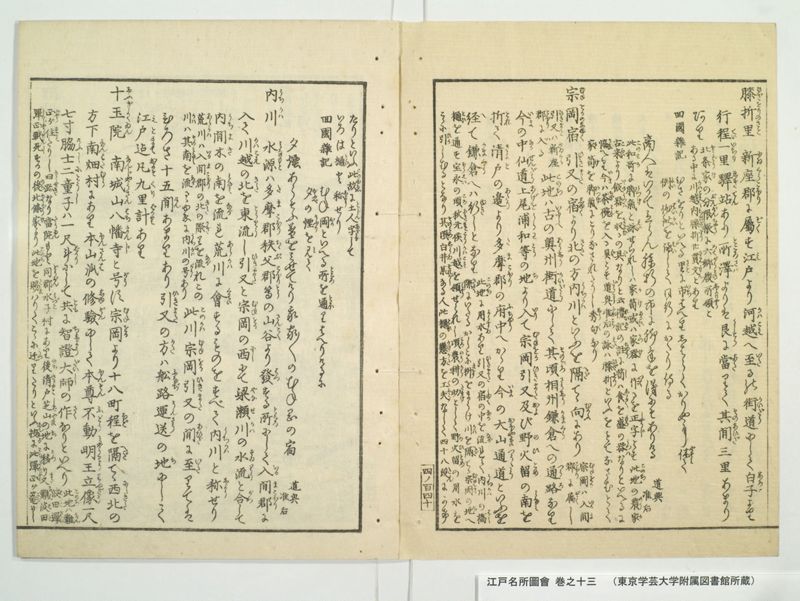
翻刻
【右丁】
膝折里(ひざをりのさと) 新座郡(にゐくらこほり)に属(ぞく)す江戸(え )より河越(かはこえ)へ至(いた)るの街道(かいだう)にして白子(しろこ)より
行程( てい)一里(いちり)駅站(ゑきてん)あり所沢(ところさは)よりは艮(うしとら)に当(あた)りて其間(そのあいだ)三里あまり
あり《割書:北条家(ほうでうけ)の分限帳(ぶんげんちやう)に六郷殿(ろくがうとの)所領(しよりやう)と|ある中に川越内(かはこえうち)膝折(ひざをり)廿貫文( くわんもん)とあり》
《割書:回国雑記 ひさをりといへる里(さと)に市(いち)はへりしはらくかりやに休(やすみ)て| 例(れい)の俳諧(はいかい)を詠(えい)して同行にかたり侍る》
商人はいかて立らん膝折の市に脚気を得にそありける 道興准后
《割書:此(この)和哥(わか)に脚気(かつけ)と詠(えい)せられしは家笥(かけ)或(あるひ)は家器(かつけ)に作(つく)るを正字(しやうじ)とす此地(このち)の農家(のうか)|古来(こらい)より食器(いゝのうつは)を収(をさむ)るの具(ぐ)なりと云 礼記(れいき)の註(ちゆう)に笥(し)は食(しよく)を盛(もる)の器(うつは)なりといへるに》
《割書:恊(かな)へり今(いま)は茶碗(ちやわん)を入る具(ぐ)とす道興准后(どうこうじゆこう)の詠(えい)は膝折(ひざをり)といふをもてなさむとて|家笥(かけ)を脚気(かつけ)にとりなされたりし秀句(しうく)なり》
宗岡宿(むねをかのしゆく) 引又(ひきまた)の宿(しゆく)より北(きた)の方 内川(うちかは)といふを隔(へだ)てゝ向(むかふ)にあり《割書:宗岡(むねをか)は入間(いるま)|郡(こほり)に属(ぞく)し》
《割書:引又(ひきまた)は新座(にゐくら)|郡(こほり)に入(い)る》此地(このち)は古(いにしへ)の奥州街道(あうしうかいだう)にして其頃(そのころ)相州(さうしう)鎌倉(かまくら)への通路(つうろ)なり
今(いま)の中仙道(なかせんだう)上尾(あげを)浦和(うらわ)等(とう)の地(ち)より入(いり)て宗岡(むねをか)引又(ひきまた)及(およ)び野火留(のひとめ)の南(みなみ)を
折(をれ)て清戸(きよと)の辺(あたり)より多摩郡(たまこほり)の府中(ふちゆう)へかゝり今(いま)の大山通道(おほやまつうたう)といふを
経(へ)て鎌倉(かまくら)へは行(ゆき)しとなり《割書:此地(このち)に用水(ようすゐ)あり引又(ひきまた)の宿(しゆく)の中(なか)を流(なが)れて内川(うちかは)の橋(はし)|際(きは)にいたるかしこに枡(ます)をまうけ川(かは)を隔(へだ)てゝ宗岡(むねをか)の地(ち)へ》
《割書:樋(とひ)を通す宝永(ほうえい)の頃(ころ)秋元侯(あきもとこう)川越(かはこえ)を領(りやう)せられし頃(ころ)農耕(のうかう)の助(たすけ)として野火留(のひとめ)の用水を|こゝに引(ひか)しむるとなり其頃(そのころ)白井(しらゐ)某(それがし)なる人此 樋(とひ)の懸方(かけかた)を工夫(くふう)なして四十八段( たん)にかけ》
【左丁】
《割書:たりといふ此故(このゆゑ)に土人(とじん)字(あざな)して|いろは樋(とひ)と称(しよう)せり》
《割書:回国雑記 むね岡(おか)といへる所(ところ)を通(とほ)りはへりけるに| 夕(ゆふべ)の煙(けふり)を見(み)て》
夕煙あらそふ暮をみせてけり我家〳〵のむね岡の宿 道興准后
内川(うちかは) 水源(みなもと)は多摩郡(たまこほり)秩父郡(ちゝぶこほり)等(とう)の山谷(さんこく)より発(はつ)する所(ところ)にして入間郡(いるまこほり)に
入て川越(かはこえ)の北(きた)を東流(とうりう)し引又(ひきまた)と宗岡(むねをか)の西(にし)にて梁瀬川(やなせかは)の水流(すゐりう)と合(がつ)して
内間木(うちまき)の南(みなみ)を流(なが)れ荒川(あらかは)に会(くわい)するものをすべて内川(うちかは)と称(しよう)せり
《割書:荒川(あらかは)は入間郡(いるまこほり)の北(きた)の際(かぎ)りを流(なが)れこの|川(かは)は其南(そのみなみ)を流(なが)るゝゆゑに内川(うちかは)の号(がう)あり》此川(このかは)宗岡(むねをか)引又(ひきまた)の間(あひだ)に至(いた)りては
ひろさ十五間( けん)あまりあり引又(ひきまた)の方(かた)は船路(ふなぢ)運送(うんさう)の地(ち)にして
江戸(えと)迄(まて)凡(およそ)九里(くり)計(ばかり)あり
十玉院(しふぎよくゐん) 南城山(なんじやうさん)八幡寺(はちまんじ)と号(がう)す宗岡(むねをか)より十八町 程(ほど)を隔(へだ)てゝ西北(にしきた)の
方 下南畑村( なんはたむら)にあり本山派(ほんさんは)の修験(しゆげん)にして本尊(ほんそん)不動明王立像(ふどうみやうわうりふざう)一尺
七寸 脇士(けふし)二童子(にとうし)は一尺 斗(ばかり)にして共(とも)に智証大師(ちしようだいし)の作(さく)なりといへり《割書:此地(このち)は難(なん)|波田弾(はただん)》
《割書:正(じやう)が住(すみ)たりし旧跡(きうせき)なり当院(たうゐん)もと同郡(どうぐん)水子村(みづこ )にあり後(のち)清戸(きよと)芝山(しばやま)の地(ち)に移(うつ)り又(また)難波田(なんはた)|弾正(たんじやう)戦死(せんし)するの後(のち)北条家(ほうでうけ)より此地(このち)を賜(たま)はりてこゝに遷(うつ)りたりといふ按(あんする)に此(この)弾正(たんじやう)が篭(こも)りし》
現代語訳
## 【右丁】
### 膝折里(ひざおりのさと)
新座郡に属す。江戸より河越(川越)へ至る街道にあたり、白子より一里の行程に駅站(宿場)がある。所沢からは北東の方角にあたり、その間三里あまりある。
《割書:北条家の分限帳に「六郷殿所領」とある中に、「川越内 膝折 二十貫文」とある。》
《割書:『回国雑記』に——「ひざをり」という里に市が立っていたので、しばらく仮屋に休んで、いつものように俳諧を詠んで、同行の者に語りました——とある。》
> 商人はいかで立たらん 膝折の市に脚気(かけ)を得にぞありける 道興准后
《割書:この和歌に「脚気(かつけ)」と詠まれているのは、「家笥(かけ)」あるいは「家器(かつけ)」と書くのが正字とされるものである。この地の農家では、古来より食器を収める道具のことをそう呼ぶという。『礼記』の注に「笥(し)は食を盛る器なり」とあるのと一致する。今は茶碗を入れる道具のこととされる。道興准后の詠は、「膝折」というのをもてなそうとして、「家笥(かけ)」を「脚気(かつけ)」に言いかけられた秀句(洒落た句)である。》
---
### 宗岡宿(むねおかのしゅく)
引又の宿より北の方、内川というものを隔てて向かいにある。《割書:宗岡は入間郡に属し、引又は新座郡に入る。》この地は古代の奥州街道にあたり、そのころ相州鎌倉への通路であった。今の中仙道の上尾・浦和などの地より入って、宗岡・引又および野火留の南を折れ、清戸のあたりから多摩郡の府中へかかり、今の大山通道というものを経て鎌倉へ行ったとのことである。
《割書:この地に用水がある。引又の宿の中を流れて内川の橋のたもとに至る。そこに枡(ます)を設け、川を隔てて宗岡の地へ樋(とい)を通している。宝永のころ、秋元侯が川越を領されたころ、農耕の助けとして野火留の用水をここに引かせたとのことである。そのころ白井某という人が、この樋のかけ方を工夫して、四十八段にかけ》
## 【左丁】
《割書:たりという。このゆえに土地の人々はこれを「いろは樋」と称している。》
《割書:『回国雑記』に——「むね岡」という所を通りましたところ、夕べの煙を見て——とある。》
> 夕煙あらそふ暮れをみせてけり 我が家々の宗岡の宿 道興准后
---
### 内川(うちかわ)
水源は多摩郡・秩父郡などの山谷より発するところにして、入間郡に入って川越の北を東へ流れ、引又と宗岡の西にて梁瀬川の水流と合流して、内間木の南を流れ荒川に合流するものを、すべて内川と称する。
《割書:荒川は入間郡の北の端を流れ、この川はその南を流れるゆえに「内川」の名がある。》
この川は宗岡と引又の間に至っては、幅十五間あまりある。引又の方は船路・運送の地であって、江戸まで凡そ九里ほどある。
---
### 十玉院(じゅうぎょくいん)
南城山(なんじょうさん)八幡寺と号す。宗岡より十八町ほど隔てて西北の方、下南畑村(しもなんばたむら)にある。本山派の修験であって、本尊は不動明王立像(高さ一尺七寸)、脇士の二童子は一尺ばかりにして、ともに智証大師(ちしょうだいし)の作であるといわれている。
《割書:この地は難波田弾正(なんばただんじょう)が住んでいた旧跡である。当院はもともと同郡の水子村(みずこむら)にあり、後に清戸・芝山の地に移り、また難波田弾正が戦死した後、北条家よりこの地を賜ってここに遷ったという。考えてみると、この弾正が籠もりし……》
(以下次ページへ続く)
英語訳
## [Right Page]
### Hizaori Village (膝折里)
This belongs to Niikura District. It lies on the highway from Edo to Kawagoe (Kōshi), one *ri* (league) from Shiroko, where there is a post station. From Tokorozawa it lies to the northeast, a distance of over three *ri*.
*[Interlinear note: In the Hōjō clan's register of stipends (*bungencho*), among the lands listed as belonging to Lord Rokugō, there is an entry reading "Within Kawagoe: Hizaori, twenty *kanmon*."]*
*[Interlinear note: The* Kaikoku Zakki *(Miscellaneous Notes on Traveling the Provinces) states: "In the village called Hizaori there was a market in session, so I rested for a while in a temporary shelter and, as was my custom, composed a verse and recited it to my traveling companions."]*
> *Akinbito wa / ikade tataramn / Hizaori no / ichi ni kakke wo / e ni zo arikeru*
> (How could a merchant stand [at market]? At the market of Hizaori, one has surely come down with "kake"!)
> — The Cloistered Imperial Prince Dōkō (道興准后)
*[Interlinear note: The word "kakke" (脚気) as used in this poem is properly written as "kake" (家笥) or "katske" (家器), meaning the vessel used to store tableware — a utensil used by farming households in this area since ancient times to hold food containers. This accords with the commentary in the* Liji *(Record of Rites), which states: "The 'si' (笥) is a vessel for holding food." Today it is used to hold tea bowls. The verse by Dōkō is a clever *shūku* (witty wordplay) in which he plays on the name "Hizaori" ("knee-fold") by substituting "kakke" (脚気, lit. "leg affliction") for "kake" (家笥, "food-basket"), honoring the name of the place.]*
---
### Muneoka Post Station (宗岡宿)
This lies to the north of the Hikimata post station, on the opposite side of the waterway called the Uchikawa.
*[Interlinear note: Muneoka belongs to Iruma District; Hikimata falls within Niikura District.]*
This place was the ancient Ōshū Kaidō (the highway to the northeastern provinces) and was, in those days, the route to Kamakura in Sagami Province. Travelers would enter from places along today's Nakasendō such as Ageo and Urawa, then turn south of Muneoka, Hikimata, and Nohitome, pass through the Kiyoto area, proceed toward Fuchū in Tama District, and travel along what is now called the Ōyama Tsūdō before reaching Kamakura.
*[Interlinear note: There is an irrigation channel in this area. It flows through the center of Hikimata post station and reaches the bridgehead of the Uchikawa. There a sluice box (*masu*) has been constructed, and a wooden conduit (*toi*) carries water across the river to the district of Muneoka. Around the Hōei era, when Lord Akimoto held the domain of Kawagoe, he had the Nohitome irrigation water drawn here to assist agriculture. At that time, a certain man named Shirai devised the method of hanging this conduit in forty-eight sections,]*
## [Left Page]
*it is said. For this reason, the local people nicknamed it the "Iroha Conduit" (いろは樋), after the forty-eight syllables of the Japanese syllabary.*
*[Interlinear note: The* Kaikoku Zakki *states: "As I was passing through the place called Muneoka, I saw the evening cooking smoke and (composed the following):"]*
> *Yūkemuri / arasou kure wo / mise te keri / wagaya wagaya no / Muneoka no yado*
> (The evening smoke rises in rivalry as dusk falls — from each and every home at Muneoka post station.)
> — The Cloistered Imperial Prince Dōkō (道興准后)
---
### Uchikawa River (内川)
Its headwaters rise from the mountain valleys of Tama District, Chichibu District, and others; it enters Iruma District, flows eastward to the north of Kawagoe, and at a point to the west of Hikimata and Muneoka it joins with the flow of the Yanasegawa River. It then flows along the south of Uchimaki and joins the Arakawa River — this entire waterway is called the Uchikawa.
*[Interlinear note: The Arakawa flows along the northern edge of Iruma District; this river flows to its south, hence the name "Uchikawa" (Inner River).]*
At the point where the river reaches the stretch between Muneoka and Hikimata, it is more than fifteen *ken* (approximately 27 meters) in width. On the Hikimata side it serves as a waterway for boat transport, the distance to Edo being approximately nine *ri* (about 35 kilometers).
---
### Jūgyokuin Temple (十玉院)
Also known as Nanjōzan Hachimanjī (南城山八幡寺). It stands to the west-northwest of Muneoka, about eighteen *chō* (roughly two kilometers) distant, in the village of Shimo-Nambata (下南畑村). It is a temple of the Honzan branch of Shugendo mountain asceticism. The principal image is a standing statue of Fudō Myōō (Acala), measuring one *shaku* seven *sun* (approximately 51 cm) in height; the flanking attendants — two boy figures (*dōji*) — stand about one *shaku* (approximately 30 cm) tall. All three are said to be works of the Great Master Chishō (智証大師).
*[Interlinear note: This place is the historic site where Nambata Danjō (難波田弾正) once resided. The temple was originally located in Mizuko Village in the same district, later moved to the area of Kiyoto and Shibayama, and then — after the death in battle of Nambata Danjō — was granted this land by the Hōjō clan and relocated here, it is said. Upon reflection, the castle in which this Danjō took refuge…]*
*(Continues on the next page.)*