翻刻
【右丁】
《割書: より此塚をのひとめと名つけはへるよし国の人まうし| 侍けれは》
若草のつまもこもらぬ冬されにやかてもかるゝ野火とめの塚 道興准后
《割書:これを過てひさをりといへる里に市はへり 下略》
《割書:按(あんする)に昔(むかし)は火田といひて原野に火(ひ)を放(はな)ち草(くさ)を焼(やき)て肥(こやし)とし種(たね)を下(おろ)すを焼畑(やきはた)|ともいひしなり今(いま)秩父郡(ちゝぶこほり)および信州(しんしう)等(とう)に焼苅蕎麦(やきかりそば)といふものあるは則(すなはち)是(これ)》
《割書:なりされど其火(そのひ)の盛(さかん)なるに至(いた)りて人家(じんか)におよぼさん事の恐(おそれ)あれば堤(つゝみ)又は塚(つか)|などを築(きづ)きて其(その)野火(のひ)を遮(さへぎ)り止(とむ)る料(りやう)とする故(ゆゑ)に野火止(のひとめ)の名(な)あるならん今 平(へい) 》
《割書:林寺(りんじ)境内(けいだい)に九十九塚(つくもつか)業平塚(なりひらつか)など称(しよう)するものあるも同(おな)したぐひなるべし|かゝる号(がう)を唱(とな)ふるは伊勢物語(いせものかたり)に因(よ)りて後人(こうじん)のまうけたりしにやあらん》
金鳳山(きんほうさん)平林禅寺(へいりんぜんじ) 養心院(やうしんゐん)と号(がうす)野火留街道(のひとめかいだう)より八町 程(ほど)東(ひがし)にあり花洛(くわらく)
妙心寺派(めうしんじは)の禅林(ぜんりん)なり《割書:古(いにしへ)は大徳寺(たいとくじ) |派(は)なりと云》開山(かいさん)は石室善玖大和尚(せきしつぜんきうたいおしやう)《割書:石碑(せきひ)に唐国(もろこし)保(ほう)|寧(ねい)#1古林茂和尚(こりんもおしやう)》
《割書:の法嗣(はふし)康応(かうおう)元年己巳|九月二十五日 尓寂(じしやくす)云》中興(ちゆうこう)は雪堂大和尚(せつだうたいおしやう)と号(がう)す《割書:元和九年|九月二日 寂(じやくす)》其先(そのせん)同国
足立郡(あたちこほり)岩附(いはつき)にありしを寛文(くわんぶん)三年《割書:石院和尚(せきゐんおしやう)|住山(ちゆうさん)の時(とき) 》此地(このち)に移(うつ)すと云
《割書:旧地(きうち)は岩附(いはつき)にあり今(いま)金重村(かなしげむら)及(およ)び|平林寺邑(へいりんじむら)抔(など)唱(とな)ふる地(ち)これなり》寮舎(りやうしや)四宇( う)あり
仏殿(ぶつでん) 本尊(ほんそん)釈迦如来(しやかによらい)《割書:此(この)仏殿(ぶつてん)は岩附(いはつき)より|迁(うつ)し建(たつ)るといふ》
山門(さんもん)《割書:仏殿(ぶつでん)の前(まへ)にあり樓上(ろうしやう)に十六阿羅漢(しふろくあらかん)の木像(もくさう)を置(おき)たり|此(この)山門(さんもん)は岩附(いはつき)にありしを其侭(そのまゝ)に迁(うつ)し建(たつ)ると云(いふ)》
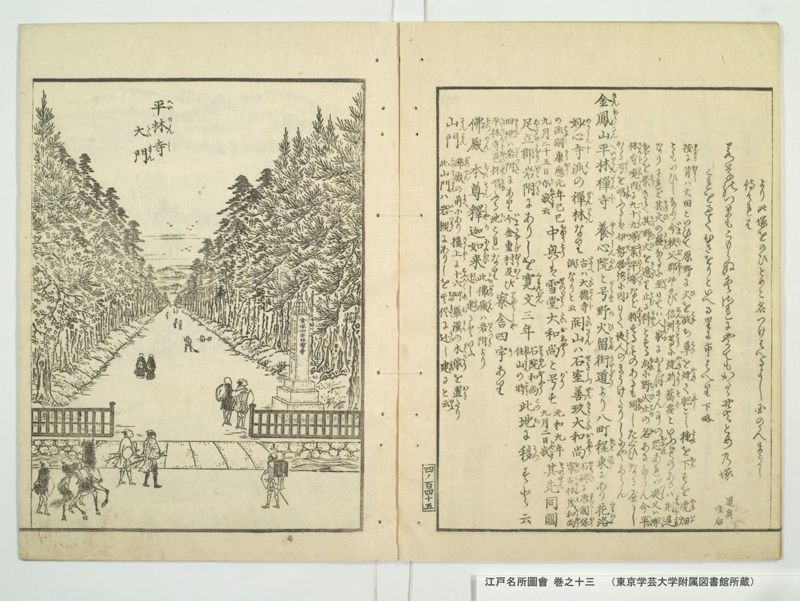
【左丁 絵図】
平林寺(へいりんし)
大門(たいもん)
現代語訳
## 【右丁】
(割注の続き:……より、この塚を「野火留(のびとめ)」と名付けたのであるという旨を、地元の人々が申しておりましたので、)
> 若草の 妻もこもらぬ 冬されに やかてもかるる 野火とめの塚 道興准后
(割注:これを過ぎて、膝折という里に市が立っている。 〔以下略〕)
(割注:按ずるに、昔は「火田(ひた)」といって、原野に火を放ち、草を焼いて肥料とし、種を蒔くことを「焼畑(やきはた)」とも言ったものである。今日、秩父郡および信州などで「焼刈蕎麦(やきかりそば)」というものがあるのは、すなわちこれのことである。しかしながら、その火が盛んになって人家に及ぶおそれがあるため、堤や塚などを築いて、その野火を遮り止める備えとしたことから、「野火止」の名があるのであろう。今、平林寺の境内に「九十九塚」「業平塚」などと称するものがあるのも、同じ類いであろう。このような名称が唱えられるのは、『伊勢物語』に因んで後世の人々が設けたものであろうか。)
---
## 金鳳山 平林禅寺
養心院と号する。野火留街道より八町ほど東にある。京都妙心寺派の禅林である。
(割注:古くは大徳寺派であったという。)
開山は石室善玖大和尚である。
(割注:石碑に「唐国(中国)・保寧の古林茂和尚の法嗣、康応元年己巳九月二十五日に示寂す」とある。)
中興は雪堂大和尚と号する。
(割注:元和九年九月二日に示寂。)
もともとは同国・足立郡の岩付(いわつき)にあったが、寛文三年、
(割注:石院和尚が住山の時に、)
この地に移したという。
(割注:旧地は岩付にあり、今日「金重村(かなしげむら)」および「平林寺村」などと称する地がそれである。)
境内には寮舎が四棟ある。
**仏殿** ―― 本尊は釈迦如来。
(割注:この仏殿は岩付より移し建てたという。)
**山門** ――
(割注:仏殿の前にある。楼上に十六羅漢の木像が安置されている。この山門は岩付にあったものをそのまま移し建てたという。)
## 【左丁 絵図】
**平林寺 大門**
英語訳
## [Right Page]
*(Continuation of the interlinear note from the previous page: …it is for this reason that this mound came to be called "Nobidomé," as the local people told me.)*
> *Wakakusa no / tsuma mo komoaranu / fuyu sare ni / yakate mo karuru / Nobidomé no tsuka*
>
> (In the winter when not even a young wife hides in the young grass, the Nobidomé Mound too shall soon wither away in the burning fields.)
>
> — *Dōkō Jugo* [the Retired Archbishop Dōkō]
*(Interlinear note: Passing this place, there is a market held in the village called Hizaori. [The rest is omitted.]*
*(Interlinear note: It may be noted that in ancient times, the practice of setting fire to open fields, burning the grass to use as fertilizer, and then sowing seeds was called "yakihata" (slash-and-burn agriculture), or "hita" (fire-field). The practice known today in Chichibu district and Shinshū province as "yakikari soba" [buckwheat grown by slash-and-burn method] is precisely this. However, because there was danger of such fires, when they burned strongly, spreading to people's dwellings, embankments and mounds were built to intercept and stop the wild fires — and it is from this practice that the name "Nobidomé" [fire-stop] likely derives. The mounds within the precincts of Heirinzi today, referred to by names such as "Tsukumo-zuka" and "Narihira-zuka," are probably of the same kind. It may be that such names were assigned by later generations under the influence of the Tales of Ise.)*
---
## Kinhōzan Heirin Zen Temple
Also known as Yōshin'in. It is located approximately eight chō [~870 meters] to the east of the Nobidomé highway. It is a Zen temple belonging to the Myōshinji school of Kyoto.
*(Interlinear note: It is said that in ancient times it belonged to the Daitokuji school.)*
The founding abbot was the Great Monk Sekishitsu Zenkyū.
*(Interlinear note: A stone monument records: "Dharma heir of the Monk Kobayashi [Korin Mō] of Hōning [Baoning], Tang China; passed away on the twenty-fifth day of the ninth month of Kōō 1 [1389].")*
The restorer of the temple was known as the Great Monk Settō.
*(Interlinear note: He passed away on the second day of the ninth month of Genna 9 [1623].)*
The temple was originally located in Iwatsuki, in Adachi district of the same province [Musashi], but was relocated to its present site in Kanbun 3 [1663].
*(Interlinear note: At the time when the monk Sekiin was serving as abbot.)*
*(Interlinear note: The former site is in Iwatsuki, which today corresponds to the areas called "Kanashige Village" and "Heirinzi Village.")*
There are four subsidiary buildings within the temple precinct.
**Buddha Hall (Butsuden)** — The principal image of worship is Śākyamuni Tathāgata.
*(Interlinear note: This Buddha Hall is said to have been moved and rebuilt from Iwatsuki.)*
**Mountain Gate (Sanmon)** —
*(Interlinear note: Located in front of the Buddha Hall. Wooden images of the Sixteen Arhats are enshrined in the upper story. This mountain gate is said to have been moved as it was from Iwatsuki and rebuilt here.)*
## [Left Page — Illustration]
**Heirinzi Temple — Great Gate (Daimon)**