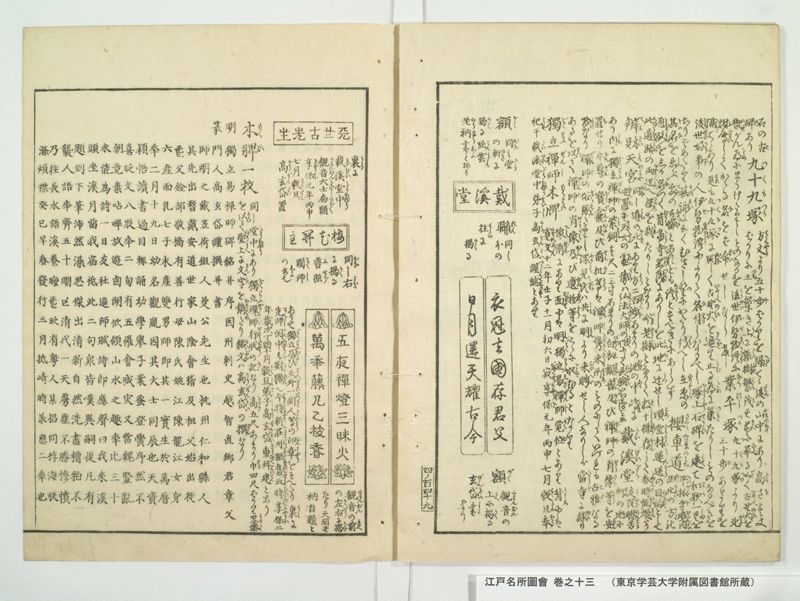
翻刻
【右丁】
《割書:石の古(こ)|碑(ひ)あり》九十九塚(つくもつか)《割書:方丈(はうちやう)より五十歩( ほ)ばかりを隔(へだ)てゝ後(うしろ)の山中(やまのなか)にあり高(たか)さ壱丈|ばかりに土(つち)を築(つ)き上(うへ)に雑樹(ざふじゆ)繁茂(はんも)す前(まへ)に挙(あぐ)る如(ごと)く古(いにしへ)野火(のひ)を》
《割書:禦(ふせ)がん為(ため)にまうけたりしものなるを後世(こうせい)伊勢物語(いせものかたり)に|附会(ふくわい)してかゝる名(な)をば命(めい)せしならむ》業平塚(なりひらつか)《割書:九十九塚(つくもつか)より北(きた) |三十歩( ほ)あまりを》
《割書:隔(へだ)てゝあり是(これ)も九十九塚(つくもつか)に同(おな)しく古(いにしへ)野火(のひ)を遮(さへぎ)り止(とむ)る為(ため)に築(つき)たりしものなるべきを|後世(こうせい)好事(かうず)の人 伊勢物語(いせものかたり)によりて名付(なつけ)しなるべし塚上(ちようしやう)石碑(せきひ)を建(たて)て和歌(わか)一首( しゆ)を》
《割書:ちりばめたり其詠(そのえい)に云くむさし野(の)にかたり伝(つた)へし在原(ありはら)の|其名(そのな)を忍(しの)ぶ露(つゆ)の古塚(ふるつか)とあれども証(しよう)とすべきにあらず》桜車道(さくらくるまのみち)《割書:平林寺(へいりんじ)境内(けいだい)|西北(にしきた)の方(かた)の》
《割書:通路(とほりみち)をしか名(な)つく昔(むかし)当寺(たうじ)岩附(いはつき)にありしを此地(このち)に迁(うつ)せし頃(ころ)堂材(たうさい)運送(うんそう)の目的(めあて)として|此(この)通路(とほりみち)の両辺(りやうへん)へ桜(さくら)を栽(うゑ)たりしとなり今(いま)老樹(らうじゆ)となりて数十株(すしうちゆう)存(そん)して春時(しゆんじ)爛漫(らんまん)たり》
弁財天宮(べんさいてんのみや)《割書:同(おな)し道(みち)の北(きた)にあり方(はう)二百歩( ひやくほ)あまりの池(いけ)の中嶋(なかしま)に|安置(あんち)す天女(てんによ)の霊像(れいざう)は弘法大師(こうはふだいし)の作(さく)にして霊験(れいけん)いちしるしと云》戴渓堂(たいけいだう)《割書:支院(しゐん)聯芳(れんはう)|軒(けん)の地(ち)に》
《割書:あり内(うち)に独立禅師(どくりふぜんじ)の紫銅(しとう)壱尺二三寸あまりの白衣観音(びやくえくわんおん)及(およ)び禅師(ぜんじ)の肖像(せうさう)等(とう)を安(あん)|置(ち)せり本尊(ほんそん)の宝龕(ほうがん)及(およ)び前机(ぜんき)等(とう)は禅師(ぜんし)携来(たづさへきたる)所(ところ)のものにしていづれも古雅(こが)なる》
《割書:物(もの)なり禅師(ぜんじ)の俗縁(ぞくえん)たりし深見氏(ふかみふぢ)は共(とも)に明(みん)より来聘(らいへい)せし人なりしが当寺(たうじ)に縁(ゆか)り|あるを以(もつ)て禅師(ぜんじ)の肖像(せうざう)及(およ)び遺物(ゆゐもつ)等(とう)をこゝに収(をさ)むるとなり》
独立禅師木牌(どくりつぜんしもくはい) 《割書:像前(ざうぜん)にあり面(おもて)には明独立易禅師覚位(みんどくりつえきぜんじかくゐ)とあり背(うしろ)には|寛文(くわんぶん)十二年壬子十一月初六日 寂(ぢやくす)享保(きやうほ)元年丙申七月 穀旦(こくたん)奉(ほう)》
《割書:祀(しす)干《振り仮名:載渓堂|たいけいだう》#4中(ちゆう)弟子(ていし)高玄岱(かうげんたい)謹(つゝしんて)誌(しるす)とあり》
額(がく)《割書:同(おな)し堂(たう)|の軒(のき)に》
《割書:掲(かく)る点雲(てんうん)|老納(らうなう)書(しよ)とあり》
《箱:戴渓堂》【一字一行書は縦書き表示】
聯(れん)《割書:同く|外の》
《割書:柱(はしら)に|掲(かく)る》
《箱:衣冠去国存君父》
《箱:日月還天耀古今》
額(がく)《割書:観音(くわんおん)の|上(うへ)に掲(かく)る》
《割書:玄岱(げんたい)書(しよ)| なり》
【左丁】
《箱:天竺古先生》
裏(うら)に
《振り仮名:載渓堂中|たいけいたうちゆう》#4
観音大士扁額(くわんおんたいしのがく)
享保(きやうほ)元年丙申
七月 穀旦(こくたん)
高玄岱(かうげんたい)置
《箱:梅花関主》
同(おな)し右(みぎ)
に掲(かく)る
普照(ふせう)
国師(こくし)
の書(しよ)也
《箱:五夜禅灯三昧火》
《箱:萬秊藤凡乙枝香》
《割書:観音(くわんおん)の前(まえ)の|左右(さいう)に掲(かけ)》
《割書:たり天間野|衲自題と》
《割書:ありて独立(どくりふ)及(およ)び天外一間人(てんぐわいいつかんじん)等(とう)の印章(ゐんしやう)をそへたり裏(うら)に|先師(せんし)関中(かんちゆう)之(の)対聯(たいれん)也 今特新荘用照旧云(いまことにしんさうしてもつてふるきをてらすといふ)時(とき)享保(きやうほ)二|年歳次丁酉十月 穀旦(こくたん)弟子(ていし)高玄岱(かうげんたい)重(かさねて)拝建(はいこん)とあり》
木牌(もくひ)一枚《割書:同(おな)し堂中(たうちゆう)にあり独立禅師(どくりふぜんじ)行状(ぎやうぢやう)の記(き)なり高(たかさ)五尺あまり巾(はゞ)四尺ばかり黒漆(うるし)|を以(もつ)て塗(ぬり)上(うへ)に文字(もんじ)を鐫(ちりはめ)たり銘文(めいぶん)は高玄岱(かうげんたい)の撰(せん)なり》
明独立易禅師碑銘幷序因州刺史越智直郷君章父
篆門人高玄岱謹撰幷書
師明之戴笠荷鉏人曼公先生也杭州仁和県人
其先出晋戴安道世家山陰会稽及祖父始出徒
焉#1父銓部敬橋有善行母陳氏姚江陳竜江女身
六産而乳七子末産雙男師即其一実生於万暦
秊#2二月十九日幼名観胤因其大士同辰也天資
頴悟読書過目輒誦幼学挙子業𤼭登黌序然不
喜𣆅文八股秊二旬有五罹会城灾又当魏豎乱
朝竟棄呫嗶放遊卥湖欣頜山水之趣秊比三十
未能為詩一日友社逼師賦詩即応声曰我来渓
頭坐渓月畱我宿祇此二句衆皆嘆異嗣後凡有
題到下筆沛然藻思傑出清新自然洗尽糟粕不
襲人語秊斉五十明亡清代一天虜塵不勝惨憤
乃往長水語渓養#3晦焉𣆅有粤人某招同桴海快
滌煩襟癸巳早春発行三月抵崎時承応二秊也
現代語訳
## 【右丁】
### 九十九塚(つくもづか)
方丈より五十歩ほど離れた後ろの山中にある。高さ一丈ほどに土を築き上げ、上に雑木が繁茂している。前に述べたように、もとは野火(野原の火事)を防ぐために設けられたものであるが、後世の人が『伊勢物語』にこじつけて、このような名を付けたのであろう。
---
### 業平塚(なりひらづか)
九十九塚より北へ三十歩あまりを隔ててある。これも九十九塚と同様に、古く野火を遮り止めるために築いたものであろうが、後世の好事家が『伊勢物語』にちなんで名付けたのであろう。塚の上に石碑を建て、和歌一首を刻み込んでいる。その詠に云う、
> 武蔵野に 語り伝へし 在原の
> その名を忍ぶ 露の古塚
とあるが、これを証拠とするには足りない。
---
### 桜車道(さくらくるまのみち)
平林寺境内の西北の方の通路をそのように名付ける。昔、当寺が岩付(いわつき)にあった頃、この地に移転した際、堂の建材を運搬する目的として、この通路の両辺に桜を植えたとのことである。今は老木となり、数十株が残っており、春には爛漫と咲き誇る。
---
### 弁財天宮(べんざいてんのみや)
同じ道の北にある。四方二百歩あまりの池の中島に安置する。天女の霊像は弘法大師の作にして、霊験いちじるしと云う。
---
### 戴渓堂(たいけいどう)
支院・聯芳軒(れんぽうけん)の地にある。内に独立禅師の紫銅製・一尺二、三寸あまりの白衣観音、および禅師の肖像等を安置している。本尊の宝龕(ほうがん)および前机等は禅師が携えてきたものであり、いずれも古雅な品である。禅師の俗縁であった深見氏は、ともに明(みん)から招聘されて来た人であったが、当寺に縁があることにより、禅師の肖像および遺物等をここに収めるとのことである。
---
### 独立禅師木牌(どくりつぜんじもくはい)
像の前にある。表には「明独立易禅師覚位」とあり、裏には「寛文十二年壬子(1672年)十一月初六日 寂す 享保元年丙申(1716年)七月 穀旦(こくたん) 奉祀 戴渓堂中 弟子 高玄岱(こうげんたい) 謹んで誌す」とある。
---
### 額(がく)
同じ堂の軒に掲げる。「点雲(てんうん)老納(ろうのう)書」とある。
**【戴渓堂】**(縦書き一字一行)
### 聯(れん)
同じく外の柱に掲げる。
> **衣冠去国存君父**
> **日月還天耀古今**
---
### 額(がく)【観音の上に掲げる】
玄岱(げんたい)の書である。
## 【左丁】
**【天竺古先生】**
裏には、
戴渓堂中 観音大士扁額
享保元年丙申
七月 穀旦(こくたん)
高玄岱(こうげんたい) 置く
---
**【梅花関主】**
同じく右に掲げる。普照国師の書である。
---
**【五夜禅灯三昧火】**
**【萬年藤凡乙枝香】**
観音の前の左右に掲げてある。「天間野衲(てんかんやのう)自題」とあり、独立及び「天外一間人(てんがいいっかんじん)」等の印章を添えてある。裏には「先師関中の対聯なり。今特に新装して以て旧きを照らすと云う。時に享保二年(1717年)歳次丁酉(ひのととり)十月 穀旦 弟子 高玄岱 重ねて拝建(はいこん)」とある。
---
### 木牌(もくはい)一枚
同じ堂中にある。独立禅師の行状(ぎょうじょう)の記である。高さ五尺あまり、幅四尺ばかり、黒漆を以て塗り、上に文字を刻み込んである。銘文は高玄岱の撰(せん)である。
---
### 明独立易禅師碑銘幷序
因州刺史 越智直郷君章父 篆
門人 高玄岱 謹撰幷書
禅師は明の「戴笠荷鉏(たいりゅうかしょ)の人」、曼公(まんこう)先生とも呼ばれる方である。杭州仁和県の人で、その先祖は晋(しん)の戴安道(たいあんどう)より出で、代々山陰・会稽(かいけい)を本拠とする家柄であったが、祖父の代に始めてそこを出て移住した。父は銓部敬橋(せんぶけいきょう)といい、善行の人であった。母は陳氏(ちんし)、姚江(ようこう)の陳竜江(ちんりゅうこう)の娘であり、六度の出産で七人の子(男の双子あり)をもうけた。禅師はその最後の産の一人で、実は万暦年間の二月十九日に生まれた。幼名を観胤(かんいん)といい、その大士(観音菩薩)と同じ日の辰(生まれ)であることによる。天資は明敏で、書を読めば一目でたちまち諳んじた。幼くして挙子業(科挙の学業)を学び、学校(黌序)に入ったが、時文(科挙文)・八股文(はっこぶん)を好まなかった。二十五歳の頃、会城(かいじょう)の災いに遭い、また魏忠賢(ぎちゅうけん)が朝廷を乱す世に当たり、ついに科挙の勉強を捨て、卥湖(ろこ)のあたりを放遊して、山水の趣に楽しんだ。三十歳近くになっても詩を作ることができなかったが、ある日、友社(詩の仲間)が禅師に詩を賦することを促すと、即座に応じて曰く、
> 我来渓頭坐 渓月畱我宿
ただこの二句に、衆みな嘆き異しんだ。以後は凡そ題が与えられると、筆を下せばたちまち思いが溢れ出て、詩才は傑出し、清新自然、糟粕(そうはく)を洗い尽くし、人の語を踏襲しなかった。五十歳の頃、明が滅んで清の代となり、天下が虜塵(りょじん)に覆われ、惨憤に耐えぬとして、長水(ちょうすい)の渓(たに)に赴き、世を避けて隠遁した。後に粤(えつ、広東)の人のある者が招いて、ともに海を渡ることを勧め、憂いを爽快に払い去ろうと言うので、癸巳(みずのとみ、1653年)の早春に発ち、三月に(長崎の)崎に着いた。時に承応二年(1653年)のことである。
英語訳
## [Right Page]
### Tsukumo-zuka (Nine-and-Ninety Mound)
This mound is located in the hills behind the main abbot's quarters (hōjō), about fifty paces away. Earth has been piled up to a height of roughly one jō (approximately 3 meters), and various trees grow thickly on top. As noted above, this was originally constructed to serve as a firebreak against wild-field fires (nōbi); however, later generations, associating it with *The Tales of Ise*, gave it this poetic name.
---
### Narihira-zuka (Narihira's Mound)
This mound stands more than thirty paces north of Tsukumo-zuka. Like the Tsukumo-zuka, it was most likely originally built to block and stop wild-field fires, but in later ages, a person of romantic fancy named it after *The Tales of Ise*. A stone monument has been erected on top of the mound, with the following waka poem inscribed upon it:
> *Musashino ni — kagatari tsutaeshi — Arihara no*
> *Sono na wo shinobu — tsuyu no furuzuka*
> ("On Musashino, a mound of ancient dew, where the name of Arihara, handed down in legend, is fondly recalled")
However, this cannot be taken as definitive proof of an association with Narihira.
---
### Sakura Kuruma no Michi (Cherry Blossom Carriage Road)
This is the name given to the path running to the northwest of Heirinji Temple's precincts. Long ago, when the temple was relocated from Iwatsuki to its present site, cherry trees were planted on both sides of this road for the purpose of transporting construction timber for the halls. These trees have now grown old, and several dozen specimens remain, bursting into full bloom each spring.
---
### Benzaiten-gū (Shrine of Benzaiten)
This shrine stands to the north of the same road. The deity is enshrined on an islet in a pond measuring roughly two hundred paces on each side. The sacred image of the heavenly maiden (tennyo) is said to be the work of Kōbō Daishi (Kūkai), and is renowned for its miraculous efficacy.
---
### Taikeidō (戴渓堂, the Hall of the Stream-Bearer)
This hall is situated on the grounds of the sub-temple Renpōken (聯芳軒). Inside, it enshrines a purple-bronze (shidō) image of the White-Robed Kannon (Byakue Kannon), over one shaku two or three sun in height (approximately 37–40 cm), made for the Venerable Dokuryu (独立禅師), as well as a portrait of the Master himself. The sacred canopy (hōgan) housing the main image and the altar table before it were all items the Master brought with him, and each is a piece of refined antique elegance. The Fukami family, who were connected to the Master through secular ties, came to Japan from Ming China together with him; and it is because of their connection to this temple that the Master's portrait and personal belongings are preserved here.
---
### Wooden Memorial Tablet of the Venerable Dokuryu (独立禅師木牌)
This tablet stands before the image. The front bears the inscription: "Meidokuryu Eki Zenji Kakui" (明独立易禅師覚位, "The enlightened position of the Venerable Dokuryu-Eki of the Ming Dynasty"). On the reverse: "Passed away on the sixth day of the eleventh month of Kanbun 12, year of Mizunoe-Ne (壬子, 1672). On an auspicious day (kokudan) in the seventh month of Kyōhō 1, year of Hinoe-Saru (丙申, 1716), this tablet was reverently enshrined within the Taikeidō. Recorded with reverence by the disciple Kō Gentai (高玄岱)."
---
### Hanging Placard (額)
Hung from the eaves of the same hall. It reads: "Written by Ten'un (点雲) Rōnō (老納, 'old monk')."
**[TAIKEIDŌ 戴渓堂]** (displayed vertically, one character per line)
### Couplet (聯)
Hung on the outer pillars of the same hall:
> **衣冠去国存君父**
> *(Though garments and cap leave the homeland, the lord and father are not forgotten)*
> **日月還天耀古今**
> *(Sun and moon return to heaven, shining bright through past and present)*
---
### Hanging Placard (額) [hung above the Kannon image]
In the calligraphy of Gentai (玄岱).
## [Left Page]
**[天竺古先生 TENJIKU KOSHINSEI]** (Venerable Ancient Master of India [i.e., Kannon])
On the reverse:
Plaque of the Great Being Kannon, within the Taikeidō
Kyōhō 1, year of Hinoe-Saru (丙申)
Seventh month, auspicious day (kokudan)
Placed by Kō Gentai (高玄岱)
---
**[梅花関主 BAIKA KAN-SHU]** (Master of the Plum Blossom Barrier)
Hung to the right of the above. In the calligraphy of Fushō Kokushi (普照国師).
---
**[五夜禅灯三昧火]** *(In the five watches of the night, the Zen lamp burns with the fire of samādhi)*
**[萬年藤凡乙枝香]** *(For ten thousand years, the wisteria and its branches carry their fragrance)*
These are hung to the left and right before the Kannon image. They are inscribed "Self-composed by Tenkanyanō (天間野衲)," with the seals of Dokuryu and "Tengai Ikkanmin (天外一間人)" and others affixed. On the reverse: "This is the couplet composed by our late master during his time in the Guan (関中, i.e., during his passage). Now, specially refurbished, to illuminate the old with the new, so it is said. In the tenth month of the second year of Kyōhō (1717), year of Hinoto-Tori (丁酉), the disciple Kō Gentai once again reverently re-erected this."
---
### A Single Wooden Memorial Board (木牌)
This is also kept within the same hall. It is a record of the life and conduct (gyōjō) of the Venerable Dokuryu. It measures over five shaku in height (approx. 1.5 m) and about four shaku in width (approx. 1.2 m), coated with black lacquer, with characters carved into the surface. The inscription text was composed by Kō Gentai.
---
### Inscription and Preface for the Venerable Dokuryu-Eki of Ming, Together with Its Foreword
Seal-script written by Ochi Naosato Kunjōfu (越智直郷君章父), Magistrate of Inshū (因州)
Reverently composed and written by the disciple Kō Gentai (高玄岱)
The Master was a man of the "rainhat and hoe" of the Ming dynasty—one known as Master Mankō (曼公). He was a native of Jinhe County (仁和県), Hangzhou (杭州). His ancestors traced their lineage to Dai Andō (戴安道) of the Jin dynasty, and for generations the family was settled in Shanyin and Kuaiji (山陰会稽); but from his grandfather's generation they departed and settled elsewhere. His father, Senbu Kyōkyō (銓部敬橋), was a man of upright conduct. His mother, née Chen (陳氏), was the daughter of Chen Longjiang (陳竜江) of Yaojiang (姚江). She gave birth six times, bearing seven children (including one pair of male twins). The Master was one of the last-born of this final delivery, and was in fact born on the nineteenth day of the second month of the Wanli era (万暦年間). His childhood name was Kan'in (観胤), given because he shared the same birth date as the Great Being (Kannon Bodhisattva). Endowed by nature with keen intelligence, he could recite a text from memory after a single reading. From childhood he studied for the civil examinations (kyo-shi-gyō) and entered the official academy (kōjo), but he did not take to the eight-legged essay style (hakkobu) required for the examinations. Around the age of twenty-five, he suffered the calamity that befell his provincial capital, and found himself living through the turmoil of Wei Zhongxian's (魏忠賢) tyranny at court. He ultimately abandoned his examination studies and wandered freely around Lake Lu (卥湖), delighting in the pleasures of mountains and streams. Approaching thirty, he had yet to compose a poem; but one day, when his poetry society companions pressed him to write one, he immediately responded aloud:
> *Wo lai xi tou zuo, xi yue liu wo su*
> (I came and sat at the stream's head; the stream's moon bid me stay the night)
At just these two lines, all present were astonished and filled with admiration. Thereafter, whenever a topic was given, the moment he set brush to paper, his thoughts flowed abundantly; his poetic gifts were outstanding—fresh and natural, washing away all the stale and borrowed, never imitating others' phrases.
Around the age of fifty, the Ming dynasty fell and the Qing dynasty took over all under heaven. Unable to bear the anguish of seeing the land covered in dust by foreign conquerors, he withdrew to the valley of Changsui (長水) and hid himself away from the world. Later, a certain man from Yue (粤, Guangdong) invited him to cross the sea together, promising a joyous cleansing of the troubled heart. In the early spring of the year Guisi (癸巳, 1653), they set out, and arrived at Nagasaki in the third month. This was the second year of Jōō (承応二年, 1653).