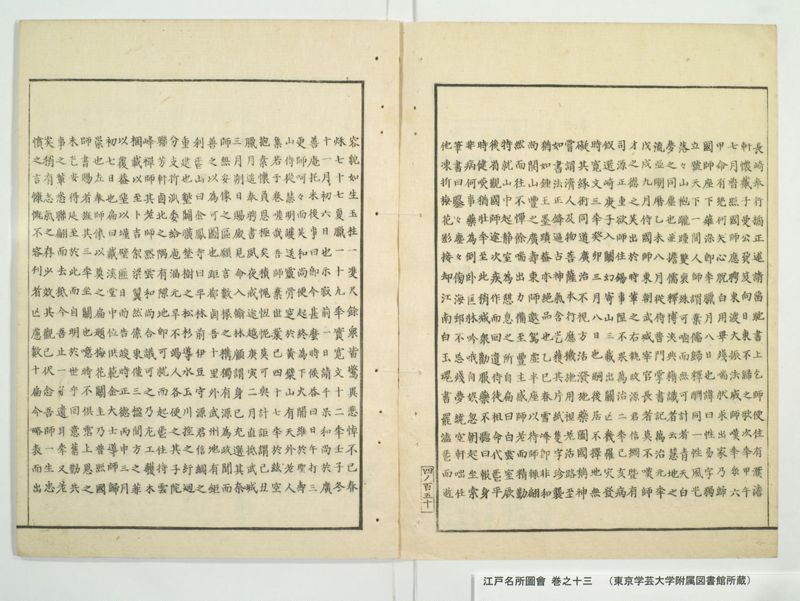
翻刻
【右丁】
長崎奉行橘正述請畱馳書上乞師便住有濮澹
軒懐戴子曼公負#5笈向日東不帰之歌次秊#3甲午
七月普照国師応聘東渡大振法威師嘆秊垂#2六
甲命有幾#1何矢心脱白用畢残喘状求出家乃帰
国師座下薙染即秊臘月八日也諱曰性易字独
立号天下一間人師謂棄儒帰釈酬同一性風光#6
落々山袍躘蹱雙褏殊可哂#13而無可計者青天白
夢之同塵也並擔儒釈博浹典籍識者云慧地之
流亜明#7暦乙未八月従侍普門掌書記万治元秊
戊戌九月侍国師東朝武城宰官長者莫不嘆師
才之徳之美出於時輩之右執政源君信綱曁有
司源正重欲師住錫事阻不果万治二秊己亥病
假還崎庚子入関幻寄山三載出関亡幾罹灾発
時寛文三秊癸卯三月八日也嗣後居不択地無
礙其縁術同道広治不視方活溌施薬闔国称神
嘗謂済人及物菩薩本行応機施用祖老活路至
如書法正鋒逼古神気含光獲其片紙隻字珍襲
猶如鍾王墨蹟葢亦絶品也乙巳春雪峰即非和
尚開山豊之広寿東師邀駕虚半座以待師輒翩
然而往不憚余喘出力備至豊主感師老而精勤
特就山中起静室為憩息之所自扁曰白雲室厥
後省覲国師途次疾作而回遣侍徒祖命代焉#8平
時健啖猶壮秊至此稍减衆勸服薬不聴曰報身
非病何事薬為倒臥匡牀吟哦自娯忽朝起坐索
筆書曰鑿々塵々𠊓#11海邨#9不忘残夢繞空軒咄任
他凍折梅花影接却江南白玉魂書罷溘焉而逝
【左丁】
容貌如生玉柱一雙#10尺余衆皆驚異悲悼不已春
秋七十七夏臘一十九秊実寛文十二秊壬子冬
十一月初六日也示寂前一日請千呆和尚於広
善庵托末後事曰即今甚麼時候荅曰日午打三
更師呵々而笑和尚便起終為下火闍維於聖寿
山侍従慧明護送霊骨窆於黄檗山有天外老人
集若于#12巻嘊哉吾師棄世業已四十七秊於玆空
抱素懐負恩極矣積愧忸怩莫可与計詎謂己丑
臘月遥奉聘書夙夜戒途越庚寅二月直抵武城
三月朔日賜殿見命入翰林顧謂身已充選其奈
師無采像之区願言数椽之糒#4独有源為政聞而
善之以為可図也距都卥吾十里外武州地有鉅
刹焉山曰金鳳寺曰平林前伊豆守源君信綱之
重建也墾闢曂埜樹之松杉導水玉川控之紆廻
分支折泒委給庖湢元旱不竭人各便之其子院
聨芳軒卥北之隅有隙地即可就而起焉住持雲
峰禅師其老師黙雲和尚合議可之乃庀工彠木
梱載以至卜吉架梁翼然傃東僅三楹間方之菲
以覆盖堊以墐壁匪日而告竣時正徳丙申三月
初七日也扁曰戴渓堂中位供範金大士導師帰
崇也左奉師像以奠之扁題梅花関主乃普照国
師書賜者旌其三秊坐関也噫時不倶霑上恩之
未光安得延至於此而自明於世乎回意旧勤共
事之輩悉聨翩而去祇今吾止一子遺耳秊又老
矣稍有志気之存少效其觀已伏念吾師一生忠
憤之言慷慨不容刊者亡慮数十扁今略表而出
現代語訳
## 【右丁】
長崎奉行・橘正述(たちばなまさのぶ)は、(禅師の)留錫(とどまること)を願って書を上奏し、師が便宜よく住めるよう請い申した。濮澹軒(ぼくたんけん)という人があり、戴子曼公を慕って、笈(おい)を負い日の東(日本)へ向かう「不帰(ふき)の歌」を詠んだ。
翌年(甲午、1654年)七月、普照国師(ふしょうこくし)が招聘に応じて東に渡り、法威を大いに振るわれた。禅師は、自らの年齢がもう六十歳に近づいていることを嘆じ、残る命がどれほどかを思い、一念発起して白衣を脱ぎ(俗服を脱いで)、残る命のすべてを費やす覚悟で出家を願い出て、国師(普照)の座下に帰し、髪を剃り染衣をまとった。それはその年の臘月(十二月)八日のことである。諱(いみな)を「性易(しょうえき)」、字(あざな)を「独立(どくりゅう)」、号を「天下一間人(てんかいっかんにん)」と称した。
禅師は「儒を捨て仏に帰すことは、同一の性の風光に酬いること(応えること)である。粗末な山の衣を着て、袖をぶらぶらさせているのは、甚だ笑うべきことかもしれないが、どうにもならないことだ。青天白日の夢の中で、塵と同じく過ごすのだ」と言われた。(禅師は)儒と仏の両方を担い、典籍に広く通じておられた。識者は「慧地(えち)の流れに次ぐ者だ」と言った。
明暦乙未(めいれき・きのとひつじ、1655年)八月、普門(ふもん)に侍して書記を掌(つかさど)った。万治元年(まんじ・1658年)戊戌九月、国師に侍して東(江戸)に赴き、武城(ぶじょう=江戸)の宰官や長者たちで、師の才徳の美しさが時輩(同時代の人々)の中で際立っていることを嘆美しない者はなかった。執政・源信綱(みなもとのぶつな=松平信綱)公および有司・源正重(みなもとまさしげ)は、師に住錫していただきたいと望んだが、事情があって果たせなかった。
万治二年(1659年)己亥、病のため長崎に帰った。庚子(1660年)、関(京都)に入り、「幻寄山(げんきざん)」に三年寄寓した。関を出てから間もなく、火災に遭った。それが起きたのは、寛文三年(1663年)癸卯三月八日のことである。
その後は居所を選ばず、縁に任せて障りなく過ごし、同道の人々を広く治し、方角を問わずに活発に施薬し、全国から神と称えられた。かつて「人と物を救済することは菩薩の本来の行いであり、機に応じて施し用いるのだ」と言われた。書法においては、正鋒(せいほう)をもって古(いにしえ)の神気を迫り、含光(がんこう)の趣があり、その一片の紙・一字を得た者は、鍾繇(しょうよう)・王羲之(おうぎし)の墨跡のように珍重した。これもまた絶品であった。
乙巳(きのとみ、1665年)春、雪峰即非和尚(せっぽうそくひおしょう)が豊後(ぶんご)の広寿山(こうじゅざん)で開山し、東師(ひがしのし)が駕(みこし)を招いて、半座を空けて待った。禅師はひらひらと赴き、残る息を惜しまず力を尽くして務めた。豊後の主は、師の老いてなお精勤である姿に感じ入り、山中に特に静室を起こして休息の場とし、自ら「白雲室(はくうんしつ)」と扁額を書いた。
その後、国師を訪れる途中で病が発し、引き返した。侍弟子・祖命(そめい)を遣わして代わりに赴かせた。平常は健啖(よく食べること)で壮年の頃と変わらなかったが、この頃より食もやや減った。衆が薬を服することを勧めたが聞かず、「この身体は病でない。何のために薬が必要か」と言われた。臥床に倒れ臥して、吟哦(ぎんが)して自ら楽しんでいたが、ある朝ふいに起き上がって座り、筆を求め、書して曰く、
> 鑿々塵々海邨(はいそん) 残夢の空軒に繞(めぐ)るを忘れず
> 咄(とつ)、任せよ 凍折(とうせつ)する梅花の影
> 接却(せっきゃく)す 江南の白玉の魂
書き終わるや、たちまちに息絶えて逝かれた。
## 【左丁】
容貌は生けるがごとく、玉のような(腕の)一双が一尺余りあり、衆はみな驚き異しんで、悲悼やまなかった。春秋七十七(歳)、夏臘(げろう、出家後の修行年)十九年。実に寛文十二年(1672年)壬子、冬十一月初六日のことである。
示寂の前日、千呆和尚(せんかいおしょう)を広善庵(こうぜんあん)に請い、末後の事を托して言われた。「ただ今、いかなる時候か」。千呆が答えて曰く「正午に三更を打つ」。禅師はははと笑われた。和尚はすぐに起ち、ついに荼毘(だび)の火を下し、聖寿山(しょうじゅざん)にて闍維(じゃい、荼毘)した。侍従・慧明(えみょう)が霊骨を護送して、黄檗山(おうばくさん)に葬った。
「天外老人(てんがいろうじん)」の集を若干巻有り。
嗚呼、わが師が世を去ってすでに四十七年になる。今に至るまで空しく素懐(そかい)を抱いて、御恩に背くこと甚だしい。積もった恥と忸怩(じくじ)とは計り知れない。思いがけず己丑(きちゅう、1709年)の臘月に、遠く招聘の書を奉じて、夙夜(しゅくや)戒めを厳にして旅立ち、庚寅(こういん、1710年)二月を越えて武城(江戸)に直ちに到着した。三月朔日(ついたち)、殿上の謁見を賜り、翰林(かんりん)に入るよう命じられた。顧みれば、身はすでに選に充てられたが、師(独立禅師)にとって像を安置すべき場所がないのが気がかりであり、数椽(すうけん)の堂宇のための干鍋(糒=かれいい、旅の食糧か。ここでは「資材・費用」のたとえか)を願うと言ったところ、ただ源為政(みなもとのためまさ)のみがこれを聞いて善しとし、「それは図ることができる」と言った。
「都・卥(ろ)より十里ほど離れた外に、武州(武蔵国)の地に大きな寺院があります。山を金鳳山(きんぽうざん)と言い、寺を平林寺(へいりんじ)と言います。先の伊豆守・源信綱(みなもとのぶつな=松平信綱)公が重建したものです。広野を開墾し、松や杉を植え、玉川(たまがわ)の水を引いて曲がりくねらせ、分流させて庖丁や浴室(湢)に給水しており、旱魃(かんばつ)のときにも涸れることがなく、人々がそれぞれ便利に使っています。その子院・聨芳軒(れんぽうけん)の北隅に空き地があり、そこに建てることができます」と。
住持・雲峰禅師(うんぽうぜんじ)とその老師・黙雲和尚(もくうんおしょう)とが合議して、これを可とした。そこで工人を集め、木材を計量して梱包し、運搬して至り、吉日を選んで棟上げし、棟が東に向いて翼のように(広がり)、わずか三楹間(さんえいかん、三間)の方であるが、菲(粗末な材)を以て屋根を葺き、白土(堊)を以て壁を塗り、日ならずして竣工した。時に正徳丙申(しょうとく・へいしん、1716年)三月七日のことである。
扁額に「戴渓堂(たいけいどう)」と書した。中には范金(はんきん、鋳造の金属製)の大士(観音菩薩)像を安置し、導師(独立禅師)の帰崇(きすう、帰依崇拝)のよすがとした。左には師の像を奉安して祀った。扁額の題「梅花関主(ばいかかんしゅ)」は、すなわち普照国師が書を賜ったものであり、(禅師が)三年間、関(禅の修行場)に坐したことを旌(たた)えたものである。
嗚呼、時が幸いにも(よい時に)恵まれなければ、上(かみ)の御恩の光が照り及ばぬまま、どうしてここまで延び、自ら世に明らかにすることができただろうか。思い返せば、旧来ともに勤め事にあたった輩(ともがら)は悉く連れ立って去ってしまい、ただ今、吾のみ一人残るのみとなった。年もまた老いたが、若干の志気の存するところ、わずかにその観(志)を効(ならい)果たすところである。伏して思うに、わが師の一生の忠憤の言葉、慷慨(こうがい)として刊行し得なかったものが、数十篇あると思われる。今、略してその要を表し出す。
英語訳
## [Right Page]
The Nagasaki Magistrate, Tachibana Masanobu (橘正述), memorialized the authorities requesting that the Master be permitted to remain and take up residence. A man by the name of Bokutan-ken (濮澹軒) composed a poem titled "Song of No Return" (不帰の歌), carried his book-box on his back, and followed Dai-shi Mankō eastward toward the Land of the Rising Sun.
The following year (Kōgo, 1654), in the seventh month, the Venerable Fushō Kokushi (普照国師) crossed east in response to an invitation and greatly exercised his dharmic authority. The Master lamented that his age was approaching sixty and reflected on how little time remained. With firm resolve, he cast off his white (lay) garments, determined to spend his remaining years in full, and petitioned for ordination. He returned to the seat of the National Master (Fushō) and had his head shaved and received the dyed robes of a monk. This was on the eighth day of the twelfth month of that same year. His Buddhist name (posthumous name, *imi-na*) was Shōeki (性易), his style name (*azana*) was Dokuryu (独立), and his pen name (号) was Tenka Ikkanmin (天下一間人, "The One Remaining Person Under Heaven").
The Master said: "To cast off Confucianism and return to Buddhism is to respond to the radiance of the single, undivided nature. To walk about in a rough mountain robe with sleeves dangling is perhaps laughable, but there is nothing to be done about it. In the dream of the blue sky and bright sun, I shall mix with the dust." He encompassed both Confucian and Buddhist learning and was widely versed in the classical texts. Those of discernment said he was "in the lineage of Echi (慧地), second only to him."
In the eighth month of Meireki Kinoto-Hitsuji (明暦乙未, 1655), he served in attendance at Fumon (普門) and took charge of the secretariat. In the ninth month of the first year of Manji (万治元年, Tsuchinoe-Inu, 1658), he accompanied the National Master to the east (Edo), and among the officials and leading figures of Jōshiro (武城, Edo), there was none who did not express admiration for how the Master's talent and virtue surpassed those of his contemporaries. The Senior Councillor (Rōjū) Minamoto no Nobutsuna (源信綱, i.e., Matsudaira Nobutsuna) and the official Minamoto no Masashige (源正重) wished the Master to take up permanent residence, but circumstances prevented this from coming to fruition.
In the second year of Manji (1659,己亥), the Master returned to Nagasaki on account of illness. In the year Kōshi (庚子, 1660), he entered Kansai (the capital region), and spent three years in sojourn at Genki-zan (幻寄山). Shortly after leaving Kansai, he suffered a fire. This occurred on the eighth day of the third month of the third year of Kanbun (寛文三年, 1663, Mizunoto-U).
After this, he settled wherever circumstance led him, without restriction, broadly ministering to those of the same path, actively distributing medicine without regard to direction, and was acclaimed throughout the country as a divine healer. He once said: "Saving people and relieving all beings is the fundamental practice of the Bodhisattva; one must apply oneself according to the needs of the moment." In the art of calligraphy, he pressed close to the ancient masters with upright, powerful brushwork, containing spiritual radiance within it; those who obtained even a scrap of paper or a single character from him treasured it like ink traces of Zhong Yao (鍾繇) or Wang Xizhi (王羲之). These, too, were items of supreme quality.
In the spring of Kinoto-Mi (乙巳, 1665), when the Venerable Seppō Sokhi (雪峰即非和尚) founded the temple at Kōjuzan (広寿山) in Bungo Province, the Eastern Master invited the Venerable Dokuryu to come in his palanquin, leaving the senior seat open to await him. The Master fluttered off thither without hesitation, sparing not his fading breath, giving his utmost in effort. The lord of Bungo, moved that the Master, though old, was so diligently devoted, specially erected a quiet chamber in the mountains as a place of repose; the Master himself inscribed it "Hakuun-shitsu" (白雲室, "White Cloud Chamber").
Thereafter, while journeying to pay respects to the National Master, he fell ill along the way and turned back, sending his attendant disciple Somei (祖命) in his stead. Normally he had a hearty appetite, unchanged from his vigorous years; but around this time his intake diminished somewhat. Those around him urged him to take medicine, but he would not listen, saying: "This body is not ill—what need is there for medicine?" He lay abed and amused himself composing and chanting verse. Then one morning he suddenly rose and sat up, called for brush and paper, and wrote:
> *Kaku-kaku, chin-chin, in the village amid the sea's dust—*
> *I cannot forget the fading dream that circles the empty veranda.*
> *Hah! Let it be—the shadow of the plum blossom broken by the freeze.*
> *And yet the soul of white jade from the south of the Yangtze reaches me still.*
When he had finished writing, he passed away quietly.
## [Left Page]
His countenance was as though alive; the pair of jade-like arms stretched out a foot and more. All present were astonished and struck with grief, mourning without end. He was seventy-seven years of age; his years since ordination were nineteen. This was truly on the sixth day of the eleventh month, in the winter of the twelfth year of Kanbun (寛文十二年壬子, 1672).
The day before his passing, he summoned the Venerable Senkai (千呆和尚) to Kōzen-an (広善庵) and entrusted him with his final affairs, saying: "What time is it right now?" Senkai replied: "At noon, three watches are being struck." The Master laughed aloud: "Ha, ha!" The Venerable Senkai thereupon rose and at the last performed the rites of cremation. The cremation (jāyi) took place at Shōjuzan (聖寿山). The attendant Emyō (慧明) escorted the sacred bones and they were interred at Ōbakusan (黄檗山).
There exist several volumes of collected works under the name "Tengai Rōjin" (天外老人, "Old Man Beyond the Heavens").
Alas! It has already been forty-seven years since my Master departed this world. To this day I have harbored my heartfelt wish in vain and have fallen most grievously short of repaying his great kindness. My accumulated shame and remorse are beyond reckoning. Unexpectedly, in the twelfth month of Kichū (己丑, 1709), I received from afar the letter of invitation, and setting out carefully both by night and day, I passed through into Kōin (庚寅, 1710) and arrived directly in Edo (武城) in the second month. On the first day of the third month, I was granted an audience in the great hall and commanded to enter the Hanlin Academy (翰林). Reflecting that my person had now been chosen for this honor, my concern was that there remained no place to enshrine the Master's image; I spoke of wishing for a few beams' worth of a modest hall, and only Minamoto no Tamemasa (源為政) heard this and approved, saying, "That can be arranged."
"Ten or so *ri* beyond the capital and Lake Lu (卥), there is a great temple in Musashi Province (武州). The mountain is called Kinpōzan (金鳳山), the temple Heirinji (平林寺). It was rebuilt by the late Lord of Izu, Minamoto no Nobutsuna (源信綱, i.e., Matsudaira Nobutsuna). The wild fields were cleared, pine and cedar trees planted; water was drawn from the Tamagawa River, winding and branching into separate channels to supply the kitchen and the bathhouse, and even in years of drought it never ran dry, benefiting everyone. In the north corner of the sub-temple Renpōken (聨芳軒), there is a plot of vacant land where a hall could be built."
The resident head priest, Zen Master Unpō (雲峰禅師), and his senior teacher, the Venerable Mokuun (黙雲和尚), discussed and approved the plan. Craftsmen were then assembled, lumber was measured and bundled and transported; an auspicious day was chosen for the raising of the ridgepole, and the hall rose facing east, wing-like in appearance, a modest structure of merely three bays (*san-ei*), its roof covered with rough material and its walls plastered with white clay. It was completed without delay. The day was the seventh of the third month of Shōtoku Hei-shin (正徳丙申, 1716).
The hall was inscribed "Taikeidō" (戴渓堂). In the center was enshrined a cast-metal image of the Great Being (Kannon Bodhisattva), as an object of veneration and homage to the founding Master. On the left, the Master's portrait was reverently installed and offered worship. The inscribed plaque reading "Baika Kan-shu" (梅花関主, "Master of the Plum Blossom Barrier") was a piece of calligraphy bestowed by Fushō Kokushi, commemorating the Master's three years of sitting in retreat (*sōkan*).
Alas! Had the times not been blessed with such favor, and had the light of the lord's grace not shone upon us, how could we have extended this far and made the Master's memory known to the world? Looking back, all those who formerly shared in the work alongside me have departed, one after another; now I alone remain. My years, too, have grown old, but while some measure of spirit and will remains, I have sought to carry out even a small part of this undertaking. In deep reverence, I reflect that my Master's words of loyal indignation throughout his life—passionately held and unable to be published—number no fewer than several dozen compositions. I now bring them briefly to light.