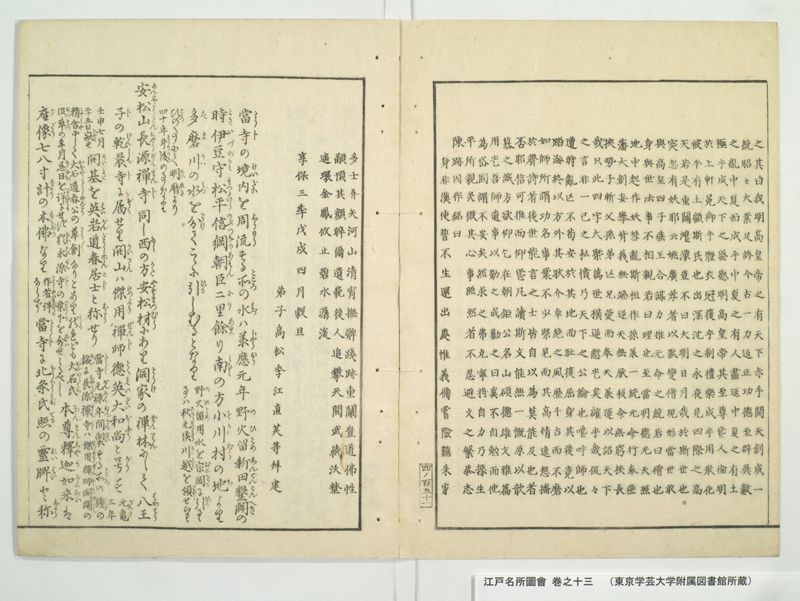
翻刻
【右丁】
之其曰我明高皇帝之有天下赤手開天創成一
統昭々大業足誇今古一力返正功徳至辟異数
之乱中夏而成乎中夏之有人尽返中夏之有土
極乎成天下之盛徳明高皇帝其至尊焉人倫明
於上軒冕御乎體衣冠復乎制礼楽成乎用教化
被乎有土顧斯民也出深沈之永夜見四際之高
天若是重闢鴻#1濛豈不曰大明日月哉於斯世也
突忽有妖耶云姚広孝者以獣変僧現形当世敢
与高皇四子燕王合謀力推元命之綂若曰僧也
身与世法事不相親若曰理也至当明徳光天照
地中起#2作妖彗乱斯祖作孫承一統元命行奉燕
藩大創妄挙背義無端逆天無厭殺命無窮挾長
挾勢子斬父孫弟亡兄愛#3而奉天承運以詔天下
哉只此四字大概万世横逆愆光矣確乎哉侃々
之言非一己之私憤乃天下之公論也鳴#4呼師也
遭時乱亡不苟安於其地而耻復屈身其後竟以
踏海終以方外其耿介卓絶之風歴千古而不磨
如師所謂功名事業不少概見而其高情逸想播
於声詩者後世能言之士皆自以為莫能及也者
否耶信可推而仰焉凡読斯文能無一慨原以歆
慕之誠方欲仰乞在朝鉅公名山碩徳雄文雅篇
用光吾師遺事以勤之或勧之曰奚不自勉而他
為岱固謂不安矣然求之弗克寧将自力乃拠生
平所親炙徴其心事照然者不忍避文之繁恭志
陳趾因作銘曰
身非漢使誓不生還出処惟義僃嘗険囏朱家
【左丁】
多士弄矢河山清宵撫髀践跡重関豈道仏性
顢頇其顔𦖒#5爾遺範後人追攀天開武蔵沃埜
遥環金鳳攸止碧水潺湲
享保三秊戊戌四月穀旦
弟子高松季江直芙等拝建
当寺(たうじ)の境内(けいだい)を周流(しうりう)する所(ところ)の水(みづ)は承応(じやうおう)元年 野火留(のひとめ)新田(しんでん)墾闢(こんへき)の
時(とき)伊豆守松平信綱朝臣(いづのかみまつたいらのぶつなのあそん)二里余(にりあま)り南(みなみ)の方 小川村(をかはむら)の地(ち)より
多磨川(たまかは)の水(みつ)を分(わけ)てこゝに引(ひか)しむるとなり《割書:野火留(のひとめ)用水を宗岡(むねをか)に引(ひか)るゝ|事は秋元侯(あきもとこう)川越(かはこえ)を領(りやう)せらるゝ》
《割書:頃(ころ)の事にて明暦(めいれき)より|四十年斗( はかり)後(のち)の事なり》
安松山(あんしようさん)長源禅寺(ちやうげんぜんじ)同し西(にし)の方(かた)安松村(やすまつむら)にあり洞家(とうけ)の禅林(ぜんりん)にして八王(はちわう)
子(じ)の乾晨寺(けんしんじ)に属(ぞく)せり開山(かいさん)は傑用禅師徳英大和尚(けつようぜんじとくえいだいおしやう)と号(がう)す《割書:元亀(げんき)|三年》
《割書:壬申七月|二十五日 寂(じやく)す》開基(かいき)を英岩道春居士(えいがんだうしゆんこじ)と称(しよう)せり《割書:当寺(たうじ)元禄年間(げんろくねんかん)製(せい)する所(ところ)の鐘(かね)の|銘(めい)に長源禅寺(ちやうげんぜんじ)は傑用禅師(けつようぜんじ)開闢(かいひやく)の》
《割書:精舎(しやうしや)にして大石道春公(おほいしだうしゆんこう)の草創(さう〳〵)なりとあり然(しか)れども大石氏(おほいしうち)|没卒(ぼつそつ)の年月 忌日(きにち)を詳(つまひらか)にせず猶(なほ)永源寺(えいげんじ)の条下(でうか)を合(あは)せみるべし》本尊(ほんそん)釈迦如来(しやかによらい)は
座像(ざざう)七八寸計( ばかり)の木仏(もくぶつ)なり《割書:作者(さくしや)詳(つまびらか)|ならず》当寺(たうじ)に北条氏照(ほうでううぢてる)の霊牌(れいはい)と称(しよう)
現代語訳
## 【右丁】
その(師の言葉として)曰く、「我が大明の高皇帝(こうこうてい)が天下を有するに当たり、赤手(せきしゅ、素手)をもって天を開き、一統を創し成した。その昭々たる大業は今古に誇るに足るものであり、一力をもって正(まさしさ)に返し、その功徳は異数(いすう、並外れた)の乱を辟(しりぞ)け、中夏(ちゅうか、中国)において成し遂げられた。中夏に人あるをことごとく中夏に帰し、中夏に土あるをことごとく返して、天下の盛徳を成した。明の高皇帝こそ、その至尊(しそん)である。人倫は上に明らかにされ、軒冕(けんべん、高官の礼服)を身に御し、衣冠(いかん)を復し、制(礼制)に則り、礼楽(れいがく)を成し、用(実際)に教化を施し、有土(うど、国土)に及ぼした。顧みれば、この民たちよ、深沈(しんちん)たる永夜(えいや)より出でて、四際(しさい)の高天を見るは、重ねて鴻濛(こうもう、天地開闢)を開くがごとし。大明の日月(じつげつ)と言わずしてなんと言おうや。」
しかるにこの世に突忽(とつこつ、突然)として妖邪(ようじゃ)なるものが現れた。云(いう)なる、姚広孝(ようこうこう)という者、獣が僧に変じて当世に現形し(姿を現し)、あえて高皇(こうこう)の四子(しし)たる燕王(えんおう)と合謀し、力をもって元命(げんめい、天命)の統を推し進めた。僧と言えばその身は世法(せほう、世俗の法)と事を相親しまざるものであるのに、理(ことわり)と言えば至当(しとう)なる明徳(めいとく)が光天(こうてん)に輝き地を照らす中において、妖彗(ようすい)を起こし、この祖(そ)の作(なし)たるものを乱し、孫に受け継がせた一統の元命を奪い、燕藩(えんぱん)を奉じて大いに妄挙(もうきょ)を創(はじ)め、義に背くこと端(はし)なく、天に逆らうこと厭(いと)いなく、命(いのち)を殺すこと窮まりなく、長を挟み勢いを挟んで、子が父を斬り、孫が兄を弑(しい)し、弟が兄を亡(ほろぼ)した。これを「愛(かわいがり)して、奉天承運(ほうてんしょううん)をもって天下に詔(みことのり)する」と言えようか。ただこの四字(奉天承運)は、おおよそ万世(ばんせい)にわたって横逆(おうぎゃく)にして愆光(けんこう、徳を損なう)するものである。確乎(かっこ)として正しい、侃々(かんかん)たるこの言は、一己(いっこ)の私憤(しふん)にあらず、すなわち天下の公論(こうろん)である。
嗚呼(ああ)、師は時の乱亡(らんぼう)に遭い、苟(いやしく)もその地に安んじることなく、さらにその後に身を屈することを恥じ、遂に海を踏み越えることをもって終え、方外(ほうがい、出家の境地)をもって終えた。その耿介卓絶(こうかいたくぜつ)たる風(ふう)は、千古(せんこ)を歴(へ)ても磨滅(まめつ)せることなし。師の言うところの功名事業(こうめいじぎょう)はわずかにも概見(がいけん)されるものではないが、その高情逸想(こうじょういっそう)にして声詩(せいし)に播(ひろ)まるものは、後世の能言(のうげん)の士みな自ら及ぶ能わずと為すものではなかろうか。まことに推して仰ぐべきものがある。およそこの文を読みて、一慨(いちがい)なきことがあろうか。本(もと)、歆慕(きんぼ、深く敬慕すること)の誠をもって、朝廷の鉅公(きょこう、大臣)、名山(めいざん)の碩徳(せきとく、高徳の僧)に雄文雅篇(ゆうぶんがへん)を仰ぎ乞い、わが師の遺事(いじ)を光(てら)し照らさんと欲した。あるいは(人に)勧められて曰く、「なぜ自ら勉めずして他(ひと)にやらせるのか」と。岱(たい、私)はもとより不安(ふあん、不十分)と思っていた。しかしながら、求めて克(か)わず、むしろ自力(じりき)に将(も)ちんとして、すなわち生平(せいへい)に親炙(しんしゃ、親しく薫陶を受けること)したところによりながら、その心事の照然(しょうぜん、明らかなる)たるものを徴(もと)め、文の繁(はん)なることを避けるに忍びず、恭(うやうや)しく志陳趾(しちんし、先師の事蹟を記す)して、よって銘(めい)を作りて曰く、
> 身は漢使(かんし)にあらず 誓いて生還せじ
> 出処(しゅっしょ)はただ義(ぎ)のみ 険囏(けんかん、艱難)を備(つぶさ)に嘗(な)めたり
> 朱家(しゅか)の多士(たし) 矢を弄して河山(かざん)あり
> 清宵(せいしょう) 髀(もも)を撫でて 重関(じゅうかん)の跡を践(ふ)む
## 【左丁】
> 豈道わんや 仏性(ぶっしょう)の顢頇(まんかん、ぼんやりとしている)たることを
> その顔を𦖒(みよ) 遺範(いはん)は後人の追攀(ついはん、仰ぎ従う)するところ
> 天、武蔵を開き 沃野(よくや)遥かに環(めぐ)る
> 金鳳(きんぽう)の攸止(ゆうし、とどまるところ) 碧水(へきすい)潺湲(せんかん、さらさらと流れる)たり
享保三年(きょうほうさんねん)戊戌(ぼじゅつ)四月穀旦(こくたん、吉日)
弟子 高松季江(たかまつすえなが)・直芙(ちょくふ)等 拝建(はいけん)
---
当寺(平林寺)の境内を周流する水は、承応元年(じょうおうがんねん、1652年)、野火留(のひとめ)新田墾闢(こんへき、開墾)の時、伊豆守松平信綱朝臣が二里余り南の方、小川村の地より多摩川の水を分けてここに引かせたとのことである。
《割注:野火留用水を宗岡(むねおか)に引かれることは、秋元侯が川越を領せられる頃の事であって、明暦より四十年ばかり後のことである。》
安松山長源禅寺(あんしょうざんちょうげんぜんじ)は同じく西の方の安松村(やすまつむら)にあり、洞家(曹洞宗)の禅林にして、八王子の乾晨寺(けんしんじ)に属する。開山は傑用禅師徳英大和尚と号す。《割注:元亀三年壬申七月二十五日に寂す。》開基を英岩道春居士(えいがんどうしゅんこじ)と称する。《割注:当寺の元禄年間に製する所の鐘の銘に「長源禅寺は傑用禅師開闢の精舎にして、大石道春公の草創なり」とある。しかれども大石氏の没卒の年月・忌日を詳らかにせず。なお永源寺の条下をあわせ見るべし。》本尊の釈迦如来は座像七、八寸ばかりの木仏なり。《割注:作者詳らかならず。》当寺に北条氏照(ほうじょううじてる)の霊牌(れいはい)と称する
英語訳
## [Right Page]
The Master's words were as follows: "When our Great Ming Taizu, the High Emperor, came to possess the realm, he opened Heaven with his bare hands and founded a unified dynasty. His glorious and resplendent great enterprise is worthy of pride throughout all ages. By his own power alone he restored righteousness, and his meritorious virtue reached to quelling the extraordinary chaos; [the dynasty] was achieved within China. All the people of China were brought back to China; all the land of China was fully returned; the supreme virtue of All-under-Heaven was accomplished. The High Emperor of the Great Ming is truly the most exalted of all. Human relations were made clear from above; the regalia of high office [were worn appropriately]; robes and caps were restored; rites and music were established according to proper regulation; through their practical use, moral transformation was spread across all the land. Look upon these people—emerging from the deep and lasting night, beholding the high heavens on all four horizons: it was as if the primordial chaos was again divided and Heaven and Earth re-created. Can one say otherwise than that the Great Ming is like the sun and moon?"
And yet into this world there suddenly appeared a wicked and treacherous figure: one called Yao Guangxiao (姚広孝), who transformed from beast into monk and manifested in that age. He dared to conspire with Yan Wang (燕王), the fourth son of the High Emperor, and used force to usurp the heavenly mandate of legitimate succession. If one were to call him a monk, his person and deeds had nothing to do with the laws of the secular world; yet if one were to speak of principle, right in the midst of the radiant virtue of the Ming, shining its light upon heaven and illuminating the earth, he stirred up treacherous comets of rebellion, disordered the founding ancestors' legacy that grandson had received from grandfather, and in service of the Yan principality launched his reckless enterprise. He turned against righteousness without cause, defied Heaven without restraint, slaughtered the living without end, wielded seniority and power so that sons slew fathers, grandsons destroyed elder brothers, and younger brothers wiped out elder brothers—and yet all this was proclaimed to the realm under the phrase "reverently receiving the Mandate of Heaven" (奉天承運). These four characters alone are in broad outline an affront to virtue for ten thousand generations. How resolute and upright these words! This was no private resentment of one individual—it was the public judgment of All-under-Heaven.
Alas! The Master encountered the time of dynastic ruin, and would not consent to rest comfortably in that land; furthermore, he was ashamed to submit himself beneath those who came after, and in the end crossed the sea, concluding his life as one dwelling beyond worldly bounds [i.e., as a Buddhist monk]. His unbending, lofty, and transcendent spirit will not be worn away through a thousand ages. The Master's meritorious deeds and enterprises are not to be even cursorily glimpsed, but his lofty sentiments and free-ranging thoughts, spread through his verse and poetry—will not men of eloquence in later generations all feel themselves unable to attain to them? Indeed, he is one to be esteemed and revered. Can anyone read this text and feel no stirring of emotion? Originally, with sincere admiration and longing, I had wished to seek from the great ministers of the court and the men of profound virtue from famous mountains grand prose and elegant verse to illuminate the traces left by my Master. Someone encouraged me, saying: "Why not exert yourself and not leave it to others?" I had always thought myself inadequate. Yet since seeking [such contributors] proved unsuccessful, I resolved to rely on my own effort; and so, basing myself on what I had personally absorbed through direct discipleship during his lifetime, and seeking out those aspects of his inner life that shone clearly, I could not bring myself to avoid the prolixity of the writing, and reverently set down a record of his traces, composing the following inscription:
> *My person is not a Han envoy—I swear I shall not return alive;*
> *My conduct has only righteousness—I have thoroughly tasted hardship and danger.*
> *Many loyal men of the Ming house, toying with arrows amid rivers and mountains;*
> *In the clear night, rubbing my thighs, I tread the path through the many barriers.*
## [Left Page]
> *How could I speak of the Buddha-nature being dull and clouded?*
> *Look upon that face—the legacy left behind is what later men pursue and follow.*
> *Heaven opens onto Musashi, where the fertile plain stretches far around;*
> *The resting-place of Kinpō [temple], where the blue waters flow and murmur on.*
Fourth month, an auspicious day, in the third year of Kyōhō, Tsuchinoe-Inu (1718).
Disciples Takamatsu Suenaga (高松季江), Chokufu (直芙), and others, reverently erected [this monument].
---
The water that flows throughout the precinct of this temple (Heirinji) was, at the time of the land reclamation of Nohitome (野火留) New Fields in the first year of Jōō (承応, 1652), diverted by the Izu no Kami (Lord of Izu), Lord Matsudaira Nobusuna, from the land of Ogawa Village (小川村), more than two *ri* to the south, and channeled here from the Tama River (多摩川).
*Marginal note: The diversion of the Nohitome irrigation water to Muneoka (宗岡) was carried out during the time when Lord Akimoto held Kawagoe (川越), some forty years after the Meireki era.*
Anshōzan Chōgen Zenji (安松山長源禅寺) is likewise situated in Yasumatsumura (安松村) to the west. It is a Sōtō-sect Zen temple affiliated with Kenshinji (乾晨寺) in Hachiōji (八王子). The founding abbot bore the title Ketsuyō Zenji Tokue Daiosho (傑用禅師徳英大和尚). *Marginal note: He passed away on the twenty-fifth day of the seventh month of the third year of Genki (元亀, 1572), the cyclical year Mizunoe-Saru (壬申).* The founding patron is called Eigandōshun Koji (英岩道春居士). *Marginal note: The inscription on the bell cast at this temple during the Genroku era reads: "Chōgen Zenji is the hermitage opened by Ketsuyō Zenji and was founded by Lord Ōishi Dōshun (大石道春公)." However, the year, month, and death-anniversary of the Ōishi family [founder] are not known in detail. One should also consult the entry on Eigenji (永源寺) in conjunction.* The principal image is a seated Śākyamuni Buddha in wood, approximately seven or eight *sun* [roughly 20–24 cm] in height. *Marginal note: The maker is not known in detail.* At this temple there is what is called the memorial tablet (霊牌) of Hōjō Ujiteru (北条氏照)…