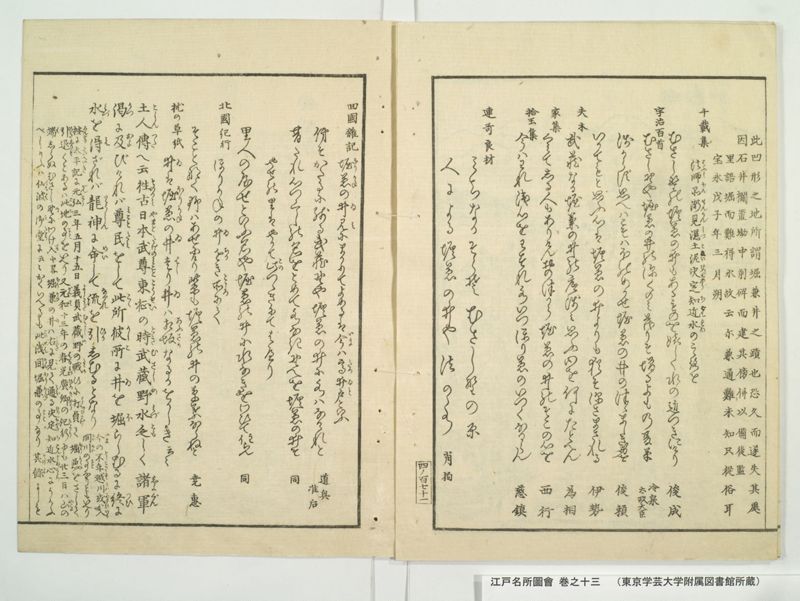
翻刻
【右丁】
此凹形之地所謂堀兼井之蹟也恐久而遂失其処
因石井欄置■#1中削碑而建其傍併以備後監
里語堀而難得水故云尓兼通難未知只従俗耳
宝永戊子年三月朔
千載集 法師品(はふしほん)漸見湿土泥(せんけんしつとてい)決定知近水(けつぢやうちごんすい)のこゝろを
むさし野の堀兼の井もあるものを嬉しく水の近つきにけり 俊成
宇治百首
むさし野や堀兼の井の深くのみ茂りそ増るよもの夏草 《割書:冷泉| 太政大臣》
浅からず思へはこそはほのめかせ堀兼の井のつゝましき身を 俊頼
いかてもと思ふ心は堀兼の井よりも猶そ深さまされる 伊勢
夫木
武蔵なる堀兼の井の底浅み思ふ心を何にたとへん 為相
家集
くみてしる人もありけんおのつから堀兼の井のそこの心を 西行
拾玉集
今はわれ浅心をわすれ水いつほり兼のいつくなるらん 慈鎮
連哥良材
みちなるそらそむさし野の原
人による堀兼の井や法の水 肖拍
【左丁】
回国雑記 《振り仮名:堀兼の井|ほりかね ゐ 》見(み)にまかりてよめるは今(いま)は高井戸(たかゐと)といふ
俤そかたるに残る武蔵野や堀兼の井に水はなけれと 《割書:道興| 准后》
昔たれ心いくしの名をとめて水なき野へを堀兼の井そ 同
やせの里はやかて此(この)つゝきにてはへり
里人のやせといふ名や堀兼の井に水なきをわひて住らん 同
北国紀行 《振り仮名:ほりかねの井| ゐ 》近(ちか)き所(ところ)にて
そことなく野はあせにけり此原も堀兼の井の草葉ならねと 尭恵
枕の草紙 井(ゐ)は《振り仮名:堀兼の井|ほりかね ゐ 》《振り仮名:走り井|はし ゐ 》は相坂(あふさか)なるかをかしき云々
土人(としん)伝(つた)へ云 往古(そのかみ)日本武尊(やまとたけのみこと)東征(とうせい)の時(とき)武蔵野(むさしの)水(みづ)乏(とも)しく諸軍(しよぐん)
渇(かつ)に及(およ)びければ尊(みこと)民(たみ)をして此所彼所(こゝかしこ)に井(ゐ)を堀(ほ)らしむるに終(つひ)に
水(みづ)を得(え)ざれば龍神(りうしん)に命(めい)して流(ながれ)を引(ひか)しむるとなり《割書:今(いま)の不年越川(としこさすかは)或(あるひ)は入(いる)|間川(まかは)の事(こと)なりともいへり》
《割書:按(あんする)に太平記(たいへいき)に元弘(げんこう)三年五月十五日 義貞(よしさだ)武蔵野(むさしの)の戦(たゝか)ひに打負(うちまけ)て堀兼(ほりかね)をさして|引退(ひきしりそ)くとあるは此地(このち)の事(こと)をいへり又 元和(げんわ)十三年の春(はる)光広卿(みつひろきやう)の紀行(きかう)にも廿三日は山(やま)の》
《割書:端(は)しらぬむさし野(の)にわけ入(いる)《割書:中略》《振り仮名:堀兼の井|ほりかね ゐ 》は右(みぎ)に見(み)て通(とほ)る決定知近水(けつぢやうちこんすゐ)心(こゝろ)にうかふ|べしけふは仙波(せんは)の御堂(みたう)に云々かくいへるも此(この)浅間(せんけん)堀兼(ほりかね)の事(こと)なり其余(そのよ)にも》
現代語訳
【右丁】
この凹状の地こそが、いわゆる堀兼井の旧跡である。長い年月を経て、ついにその場所が失われてしまうことを恐れ、石の井桁を〔碑の〕中に置き、碑を削って傍らに建て、また後世への記録として備えた。
里の言い伝えによれば、「掘っても水が得られなかったため、こう呼ぶ」という。「兼」は「難」(かたし=難しい)の意とも言い、ただ俗説に従うまでのことで、真意は未詳である。
宝永戊子年(1708年)三月朔日
『千載集』 法師品(巻・僧侶の部)の「漸見湿土泥、決定知近水(しだいに湿った土泥を見れば、必ずや近くに水があると知る)」の心を詠む:
武蔵野の 堀兼の井も あるものを 嬉しく水の 近づきにけり 俊成
『宇治百首』
武蔵野や 堀兼の井の 深くのみ 茂りそ増る よもの夏草 冷泉太政大臣
浅からず 思へばこそは ほのめかせ 堀兼の井の つつましき身を 俊頼
いかてもと 思ふ心は 堀兼の 井よりも猶ぞ 深さまされる 伊勢
『夫木(和歌抄)』
武蔵なる 堀兼の井の 底浅み 思ふ心を 何にたとへん 為相
『家集』
汲みて知る 人もありけん おのづから 堀兼の井の 底の心を 西行
『拾玉集』
今はわれ 浅心を 忘れ水 いつ掘り兼の いづくなるらん 慈鎮
『連歌良材』
みちなるぞら 武蔵野の原
人による 堀兼の井や 法の水 肖拍
---
【左丁】
『回国雑記』 堀兼の井を見に参って詠んだ歌。今は「高井戸」と言う:
俤ぞ 語るに残る 武蔵野や 堀兼の井に 水はなけれど 道興准后
昔誰れ 心いくしの 名をとめて 水なき野辺を 掘り兼の井ぞ 同
やせの里は、やがてこの続きにあります。
里人の やせという名や 堀兼の井に 水なきをわびて 住むらん 同
『北国紀行』 堀兼の井の近くで詠んだ歌:
そことなく 野はあせにけり この原も 堀兼の井の 草葉ならねど 尭恵
『枕草子』 「井は堀兼の井、走り井は逢坂にあるのがおもしろい」云々
土地の人の伝えによると:
昔、日本武尊(やまとたけるのみこと)が東征の折、武蔵野では水が乏しく、諸軍がひどく渇いたため、尊は民に命じてあちこちに井戸を掘らせたが、ついに水を得られなかったので、龍神に命じて水流を引かせた、とのことである。〔今の「年越川」、あるいは「入間川」のことだとも言われる。〕
〔按ずるに、『太平記』に「元弘三年(1333年)五月十五日、義貞が武蔵野の戦いに打ち負け、堀兼をさして引き退く」とあるのは、この地のことを言っている。また元和〔十三年〕の春、光広卿の紀行にも「二十三日は、山の端も知らぬ武蔵野に分け入り…(中略)…堀兼の井は右に見て通る、『決定知近水(必ずや近くに水があると知る)』の心が浮かぶ。今日は仙波の御堂に…」云々とあるのも、この浅間・堀兼のことである。その他にも…〕
英語訳
**[Right Folio]**
This depression in the land is the very site of the so-called Horikane Well. Fearing that the location would eventually be lost to time, a stone well-coping was placed [at the center of the monument], a stone stele was carved and erected nearby, and all this was prepared as a record for future generations.
According to local tradition, the place is so named because "digging here, one could not obtain water." The character *kane* (兼) is said by some to mean *kata-shi* (難, "difficult"), though this is merely a popular explanation, and the true etymology remains unknown.
Written on the first day of the third month, Hōei *Boshi* year (1708)
From the *Senzaishū* (Collection of a Thousand Years), the "Monks' Section," evoking the spirit of the Chinese verse *"Gradually seeing moist muddy earth, one knows for certain that water is near"*:
> *Musashino no / Horikane no i mo / aru mono wo / ureshiku mizu no / chikaduki ni keri*
> (Even the well of Horikane on Musashino Plain does exist — how joyful it is that water has now drawn so near!)
> — Shunzei
From the *Uji Hyakushu* (One Hundred Poems of Uji):
> *Musashino ya / Horikane no i no / fukaku nomi / shigeri zo masaru / yomo no natsukusa*
> (On Musashino, at the Horikane Well, the summer grasses grow ever thicker and deeper on all sides.)
> — Reizei no Daijō-daijin (the Minister of the Left of the Reizei line)
> *Asakarazu / omoeba koso wa / honomekase / Horikane no i no / tsutsumashiki mi wo*
> (Only because my feelings are deep do I hint at them — like the well of Horikane, my heart is modest and restrained.)
> — Toshiyori
> *Ikatemo to / omou kokoro wa / Horikane no / i yori mo nao zo / fukasa mosarero*
> (My yearning heart surpasses even the Horikane Well in depth.)
> — Ise
From the *Fuboku* (Fuboku Wakashō, the Fuboku Anthology):
> *Musashi naru / Horikane no i no / soko asami / omou kokoro wo / nani ni tatoen*
> (The Horikane Well in Musashi is shallow at its bottom — to what shall I compare my longing heart?)
> — Tamenari
From a *Personal Collection* (Kashū):
> *Kumite shiru / hito mo arikemu / onodukara / Horikane no i no / soko no kokoro wo*
> (Perhaps someone has drawn from it and understood — the depths of the heart, like the Horikane Well, reveal themselves naturally.)
> — Saigyō
From the *Shūgyokushū* (Collection of Gathered Jewels):
> *Ima wa ware / asagokoro wo / wasure-mizu / itsu Horikane no / izuku naru ran*
> (Now I forget my shallow heart like forgotten water — where ever shall the well of "hard-to-dig" be found?)
> — Jichin
From *Renga Ryōzai* (Good Materials for Linked Verse):
> *Michi naru sora zo / Musashino no hara* / *Hito ni yoru / Horikane no i ya / nori no mizu*
> (The sky stretches over Musashino Plain — / Depending on the person, the Horikane Well may be the water of the Buddhist Law.)
> — Shōhaku
---
**[Left Folio]**
From *Kaikoku Zakki* (Miscellaneous Notes on Traveling the Provinces): Verses composed upon visiting the Horikane Well. [The area] is now called Takaido:
> *Omokage zo / kataru ni nokoru / Musashino ya / Horikane no i ni / mizu wa nakeredo*
> (The lingering image speaks still of Musashino — though there is no water in the Horikane Well.)
> — Dōkō Jugo (Archbishop Dōkō)
> *Mukashi dare / kokoro ikushi no / na wo tomete / mizu naki nobe wo / Horikane no i zo*
> (Who long ago left this name behind, struggling in heart, making a well in the waterless fields of Horikane?)
> — Same
*(Note: The village of Yase lies immediately adjacent to this area.)*
> *Satobito no / yase to iu na ya / Horikane no i ni / mizu naki wo wabite / sumu ran*
> (Do the villagers bear the name "Yase" (thin/wasted) because they live in lamentation over the waterless Horikane Well?)
> — Same
From *Hokkoku Kikō* (Travel Record of the Northern Provinces), composed near the Horikane Well:
> *Soko to naku / no wa ase ni keri / kono hara mo / Horikane no i no / kusaba naranedo*
> (Somehow the fields have faded — though this plain is not the very grasses of the Horikane Well.)
> — Gyōkei
From *Makura no Sōshi* (The Pillow Book): "Among wells, the Horikane Well; among *hashiri-i* (running springs), the one at Ōsaka — these are charming," and so forth.
Local people transmit the following account:
Long ago, when Prince Yamato Takeru made his eastern campaign, water was scarce on Musashino Plain and all the troops were tormented by thirst. The Prince ordered the people to dig wells here and there, but in the end no water was obtained, so he commanded the dragon deity to draw a flow of water to the place. [Some say this refers to what is now the Toshikosazu River, or alternatively the Iruma River.]
[Note: According to the *Taiheiki*, on the fifteenth day of the fifth month of Genkō 3 (1333), Yoshisada lost the battle on Musashino and retreated toward Horikane — this refers to this very location. Furthermore, in the spring of Genna [13th year], in the travel record of Lord Mitsuhiro, it is written: "On the twenty-third day, we entered the depths of Musashino where one cannot tell where the mountains end… (abbreviated) …the Horikane Well we passed on our right, and the thought arose: 'Seeing moist earth, one knows water is near.' Today, at the temple of Senba…" and so forth — this too refers to this Sengen-Horikane site. And among other sources as well…]