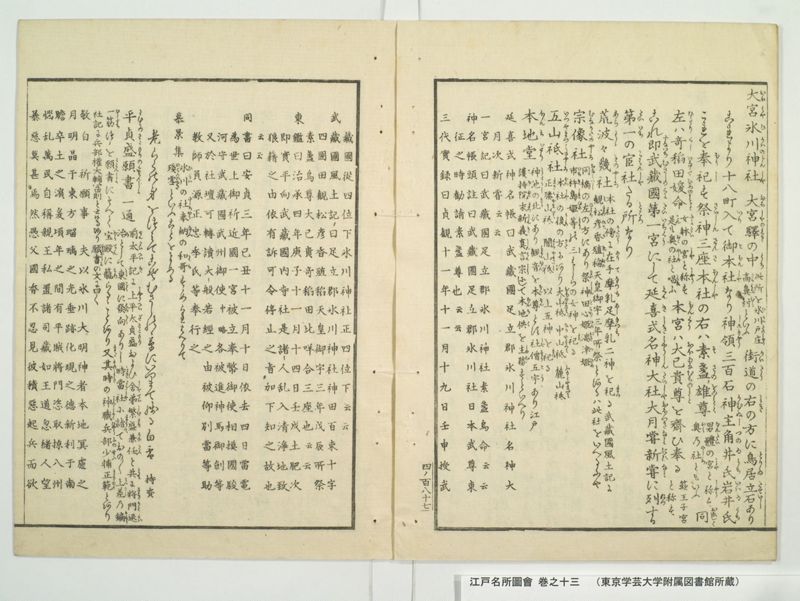
翻刻
【右丁】
大宮氷川神社(おほみやひかはのじんしや) 大宮駅(おほみやのえき)の中(うち)《割書:此所を氷川戸庄(ひかはとのしやう)|高鼻村(たかはなむら)といふ》街道(かいたう)の右(みき)の方に鳥居(とりゐ)立石(たていし)あり
これより十八町 入(いり)て御本社(こほんしや)なり神領(しんりやう)三百石 神主(かむぬし)角井氏(つのゐうち)岩井氏(いはゐうち)
これを奉祀(ほうし)す祭神三座(さいしんさんさ)本社(ほんしや)の右は素盞雄尊(そさのをのみこと)《割書:《振り仮名:男体の宮|なんたい みや》と称(しやう)す|《振り仮名:奥の社|おく やしろ》ともいふ》同(おなしく)
左(ひたり)は奇稲田媛命(くしいなたひめのみこと)《割書:《振り仮名:女体の宮|によたい みや》と称(しやう)す|是(これ)も《振り仮名:奥の社|おく やしろ》と唱(とな)ふ》本宮(ほんくう)は大己貴尊(おほあなむちのみこと)を斎ひ奉る《割書:簸王子宮|と称す》
これ即(すなはち)武蔵国第一宮(むさしのくにたいいちくう)にして延喜式(えんきしき)名神大社(みやうしんたいしや)大月嘗新嘗(おほつきなみにひなみ)に列する
第一(たいいち)の宦舎(くわんしや)たる所(ところ)なり
荒波々幾社(あらはゝきのやしろ)《割書:本社の傍(かたはら)に在(あり)手摩乳(てなつち)足摩乳(あしなつち)二神を祀(まつ)る武蔵国風土記に|観松彦香殖稲(みまつひこかゑしねの)天皇御宇三年所祭とあるは此社をいへるにや》
宗像社(むなかたのやしろ)《割書:同橋(おなしはし)の左(ひたり)の方にあり祭神(さいしん)田心姫(たこりひめ)湍津姫(おきつひめ) |市杵島姫(いちきしまひめ)等(とう)の三(み)はしらの女神を祀(まつ)る》
五山祇社(いつやまつみのやしろ)《割書:本社(ほんしy)の後(うしろ)の方(かた)にあり《振り仮名:大-山-祇|おほやまつみ》中山祇(なかやまつみ)麓山祇(ふもとやまつみ)|正勝山祇(まさかやまつみ)闇山祇(くらやまつみ)以上五神を祀(まつ)る》
本地堂(ほんちだう)《割書:神池(みたらし)の北(きた)にあり観音(くわんおん)を本尊(ほんそん)とす社僧(しやそう)五宇(こう)あり江戸|護持院末(こちゐんまつ)新義真言宗(しんきしんこんしう)にして本地供(ほんちく)を主務(しゆむ)すといへり》
延喜式神名帳曰武蔵国足立郡氷川神社名神大
月次新嘗云云
一宮記曰武蔵国足立郡氷川神社素盞烏命云云
神名帳頭註曰武蔵国足立郡氷川社日本武尊東
征之時勧請素盞尊也云云
三代実録曰貞観十一年十一月十九日壬申授武
【左丁】
蔵国従四位下氷川神社正四位下云云
武蔵国風土記曰足立郡氷川神社神田百束十字
四囲田観松彦香殖稲天皇御宇三年戊辰所祭
素盞烏尊大己貴奇稲田比咩合三座也云云
東鑑曰治承四年庚子十一月十四日壬戌土肥次
即実平向武蔵国内寺社是諸-人乱入清浄地致
狼藉之由依有訴可令停止之旨加下知之故也
云云
同書曰安貞三年己丑十一月十日依去四日雷電
為世上御祈近国一宮被立奉幣御使相摸国駿
河守武蔵国武州御使《割書:中略》各被進神馬御剣等
又於社壇可転読大-般若経之由被仰別当等助
教師員源忠季氏等奉行之
慕景集《割書:氷川(ひかは)の社(やしろ)奉納(ほうなふ)の和哥(わか)すめらきはへりて|残雪(のこんのゆき)といふことをよめる》
老らくの身をつみてこそむさしのゝ草にいつまて残る白雪 持資
平貞盛願書(たひらのさたもりのくわんじよ)一通《割書:前太平記(せんたいへいき)に上平太貞盛(しやうへいださたもり)およひ舎弟(しやてい)繁盛兼任(しけもりかねたふ)と共(とも)に将門(まさかと)退(たい)|治(ち)として東国(とうこく)に発向(はつかう)ありし時(とき)当社(たうしや)に詣(まうて)ておの〳〵上差(うはさし)の鏑(かふら)》
《割書:一筋(ひとすち)つゝを願書(くわんしよ)にそへて宝殿(ほうてん)に籠(こめ)らるゝことあり又(また)其時(そのとき)の神職(しんしよく)兵部少輔正範(ひやうふのせふ まさのり)とあり|社記に兵部権大輔富則と云けるあり願書(くわんしよ)の文に曰く》
敬白 祈願事 夫以氷川大明神者本地冥慮之
月明晶于東方瑠璃之光垂跡化現之徳新利于南
贍卒土之浜爰頃年之間有平賊将門恣取掠八州
悩乱万民自称親王私置諸司蔵如王道忽緒人望
暴悪莫甚焉然愚父国香不忍見彼積悪起兵而欲
現代語訳
【右丁】
**大宮氷川神社** 大宮宿の中(この地を氷川戸庄・高鼻村という)、街道の右手に鳥居と立石がある。ここから十八町入ったところに御本社がある。神領は三百石。神主は角井氏・岩井氏がこれを奉祀する。祭神は三座あり、本社の右は素盞雄尊(男体宮とも、奥の社とも称する)、同じく左は奇稲田媛命(女体宮とも称し、これも奥の社と唱える)、本宮は大己貴尊を斎い奉る(簸王子宮と称する)。これすなわち武蔵国第一宮であり、延喜式の名神大社にして、大月次・新嘗の祭りに列せられる、第一の官社たる所である。
**荒波々幾社** 本社の傍らにある。手摩乳・足摩乳の二神を祀る。武蔵国風土記に「観松彦香殖稲天皇の御宇三年に所祭」とあるのは、この社をいうのであろうか。
**宗像社** 同じく橋の左の方にある。祭神は田心姫・湍津姫・市杵島姫等、三柱の女神を祀る。
**五山祇社** 本社の後ろの方にある。大山祇・中山祇・麓山祇・正勝山祇・闇山祇、以上五神を祀る。
**本地堂** 神池(みたらし)の北にある。観音を本尊とする。社僧五宇あり、江戸護持院の末寺、新義真言宗にして、本地供を主務とするという。
---
延喜式神名帳にいわく「武蔵国足立郡 氷川神社 名神大 月次新嘗」云々。
一宮記にいわく「武蔵国足立郡 氷川神社 素盞烏命」云々。
神名帳頭注にいわく「武蔵国足立郡 氷川社 日本武尊東征の時、素盞尊を勧請す」云々。
三代実録にいわく「貞観十一年十一月十九日壬申、武
【左丁】
蔵国従四位下氷川神社に正四位下を授く」云々。
武蔵国風土記にいわく「足立郡 氷川神社 神田百束十字 四囲田 観松彦香殖稲天皇御宇三年戊辰に祭られた所にして、素盞烏尊・大己貴・奇稲田比咩、合わせて三座なり」云々。
東鑑(吾妻鏡)にいわく「治承四年庚子十一月十四日壬戌、土肥次郎実平、武蔵国内の寺社において諸人が乱入し清浄地に狼藉を致すとの訴えがあり、これを停止せしめるよう下知を加える」云々。
同書にいわく「安貞三年己丑十一月十日、去る四日の雷電のため、世上御祈祷として近国一宮に奉幣の御使が立てられた。相模国・駿河守・武蔵国武州御使(中略)各々神馬・御剣等を進められ、また社壇において大般若経を転読すべき旨が仰せられ、別当等・助教師員・源忠季氏等が奉行した」。
慕景集(氷川の社に奉納した和歌、「すめらきはへりて残雪」という題にて詠める):
老らくの身をつみてこそ 武蔵野の 草にいつまで 残る白雪 持資
**平貞盛の願書 一通** 前太平記に、上平太貞盛および舎弟の繁盛・兼任と共に将門退治として東国に発向した時、当社に詣でてそれぞれ上差しの鏑矢一筋ずつを願書に添えて宝殿に籠めたことがあると記されている。またその時の神職は兵部少輔正範とある。社記には兵部権大輔富則と書いてあるものもある。願書の文にいわく:
「謹んで申し上げます。祈願の事。そもそも氷川大明神は、本地冥慮の月明、東方瑠璃の光に晶たかく、垂跡化現の徳は南贍部洲の地に新たな利益をもたらされます。ここ近年の間、賊将門が恣にも八州を取り掠め、万民を悩乱し、自ら親王と称し、私に諸司を置き、蔵するところ王道の緒を忽にし、人望を失い、暴悪このうえなし。しかるに愚父国香はかの積悪を見るに忍びず、兵を起こして(退治しようと)欲したが……」
英語訳
**[Right Page]**
**Omiya Hikawa Shrine** Located within Omiya post-station (this area is called Hikawato-no-shō and Takahana Village), on the right side of the highway stands a torii gate and a standing stone. Proceeding eighteen chō (approximately 2km) from here, one reaches the main shrine. The shrine's landholding is 300 koku. The shrine priests, the Tsunoi and Iwai clans, conduct the ritual services. There are three enshrined deities: to the right of the main shrine is Susanoo-no-Mikoto (also called the Nantai-no-Miya, or "Male Body Shrine," and also referred to as the Oku-no-Yashiro, "Inner Shrine"); to the left is Kushiinadahime-no-Mikoto (also called the Nyotai-no-Miya, or "Female Body Shrine," also referred to as the Oku-no-Yashiro); and the main sanctuary enshrines Ōanamuchi-no-Mikoto (called the Hi-no-Ōji-Miya). This is none other than the First Shrine of Musashi Province, listed in the Engishiki as a Myōjin Taisha (Grand Shrine of Eminent Deity), included in the Ōtsukisami and Niiname festivals, and is the foremost of official shrines.
**Arahawaki Shrine** Located beside the main shrine. It enshrines two deities, Tenazuchi and Ashinazuchi. The Musashi no Kuni Fudoki states that it was "established in the third year of Emperor Mimatsu-hiko Kaeshine's reign," which likely refers to this shrine.
**Munakata Shrine** Located to the left of the same bridge. The enshrined deities are three goddesses: Tagirihime, Okitsuhime (Tagorihime), and Ichikishimahime.
**Itsuyamatsuminosha (Five Mountain Deity Shrine)** Located behind the main shrine. It enshrines five deities: Ōyamatsumikami, Nakayamatumikami, Fumotoyamatsumikami, Masakayamatsumikami, and Kurayamatsumikami.
**Honchidō (Main Sanctuary Hall)** Located to the north of the sacred pond (Mitarashi). The principal object of worship is Kannon (Avalokiteśvara). There are five temple monks attached to the shrine. It is a branch temple of the Gochiin in Edo, belonging to the Shingi Shingon sect, and its primary duty is said to be the performance of Honchi-ku (ceremonies honoring the original Buddhist manifestations of Shinto deities).
---
The Engishiki Jinmyōchō (Register of Deities in the Procedures of the Engi Era) states: "Hikawa Shrine, Adachi District, Musashi Province — Myōjin Taisha, Tsukisami, Niiname," etc.
The Ichinomiya-ki (Record of First Shrines) states: "Hikawa Shrine, Adachi District, Musashi Province — [Enshrining] Susanoo-no-Mikoto," etc.
The marginal annotation to the Jinmyōchō states: "Hikawa Shrine, Adachi District, Musashi Province — When Prince Yamato Takeru conducted his eastern campaign, he invoked Susanoo-no-Mikoto [here]," etc.
The Sandai Jitsuroku (Veritable Records of Three Reigns) states: "On the 19th day of the 11th month of Jōgan 11 (869), on the day of Mizunoe-Saru, Hikawa Shrine of Musashi Province was elevated from Junior Fourth Rank Lower to
**[Left Page]**
Senior Fourth Rank Lower," etc.
The Musashi no Kuni Fudoki (Gazetteer of Musashi Province) states: "Hikawa Shrine, Adachi District — shrine fields of one hundred sheaves, cross-shaped, with surrounding paddies. In the third year of the Warden year (Boshin) of Emperor Mimatsu-hiko Kaeshine's reign, the enshrined deities were Susanoo-no-Mikoto, Ōnamuchi, and Kushiinadahime — three deities in total," etc.
The Azuma Kagami (Mirror of the East) states: "On the 14th day of the 11th month, Mizunoe-Inu, in the 4th year of Jishō (1180), Doi Jirō Sanehira issued a directive to stop various persons from violating and causing disorder (rōzeki) in the sacred precincts of temples and shrines within Musashi Province, following reports of such conduct," etc.
The same text states: "On the 10th day of the 11th month of Antei 3 (1229), due to the thunder and lightning of the 4th of that month, messengers bearing votive offerings (heihaku) were dispatched to the first shrines of nearby provinces for prayers for the realm. Messengers were sent to Sagami Province, Suruga Province, and Musashi Province (abbreviated)…each presenting divine horses, sacred swords, etc. Furthermore, it was decreed that the Daihannya-kyō (Mahāprajñāpāramitā Sūtra) be recited at the shrine altar, with the bettō (shrine-temple administrator), assistant instructors, Minamoto no Tadaki and others serving as overseers."
From the *Bokeishū* (a poetry collection) — a waka poem dedicated to Hikawa Shrine, composed on the theme "the imperial visit and lingering snow":
> *Oirakuno mi wo tsumite koso Musashino no kusa ni itsumade nokoru shirayuki* — Mochizane
> ("Only by bearing the weight of old age do I ponder: like the white snow lingering on the grasses of Musashino, how long shall I remain?")
**Petition of Taira no Sadamori — One Document** According to the *Zen Taiheiki* (Pre-Taiheiki), when Jōheita Sadamori, together with his younger brothers Shigemori and Kanetō, set out for the eastern provinces to suppress Masakado, they visited this shrine and each dedicated one hawking-arrow (kaburaya, a whistling arrow) with a written petition, which were placed in the sacred storehouse. The shrine official at that time is recorded as Hyōbu-no-Shō Masanori; however, the shrine records also refer to him as Hyōbu-Gondaifu Tominori. The petition reads as follows:
"Respectfully submitted: A prayer. The great deity Hikawa Daimyōjin shines with the luminous wisdom of the original ground (honji), brilliant as the moon in the east, radiant as the lapis lazuli light, and the virtue of the manifested trace (suijaku) bestows new blessings upon all the lands of the southern continent [Jambudvīpa]. In recent years, the rebel Masakado has wantonly plundered and seized the eight provinces, causing suffering and disorder among the people, proclaiming himself a Prince, privately appointing officials at will — behavior that suddenly undermines the order of the imperial way and loses the trust of the people, wickedness unsurpassed. However, my late father Kunika (Kunimoto), unable to bear witnessing such accumulated evil, raised arms in order to…"