翻刻
○所揭于《場所:信上兩國境碓冰嶺》熊野宮社者一事
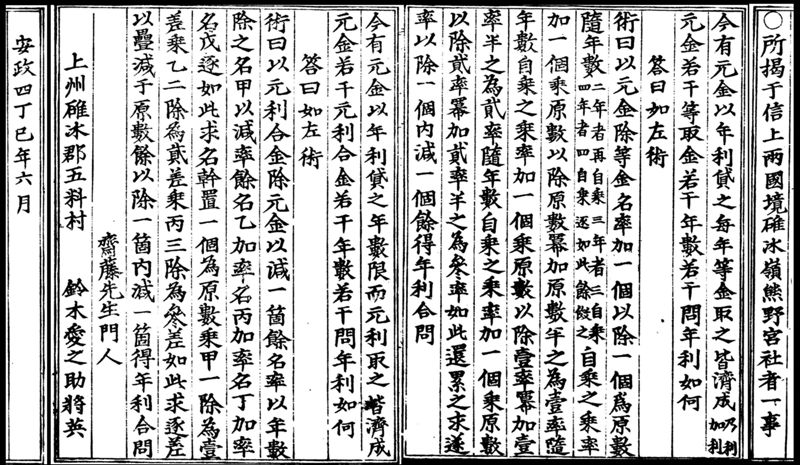
今有元金以年利貸之每年等金取之皆濟成《割書:乃利|加利》
元金𠰥干等取金𠰥干年𢿙𠰥干問年利如何
答曰如左術
術曰以元金除等金名率加一個以除一個爲原𢿙
隨年𢿙《割書:二年者再自乘三年者三自乘|四年者四自乘逐󠄁如此餘傚之》自乘之乘率
加一個乘原𢿙以除原𢿙冪加原𢿙半󠄁之為壹率󠄁隨
年𢿙自乘之乘率加一個乘原𢿙以除壹率冪加壹
率半之為貳率隨年𢿙自乘之乘率加一個乘原𢿙
以除貳率冪加貳率半之為參率如此還󠄁累之求遂󠄂
率以除一個内減一個餘得年利合問
今有元金以年利貸之年𢿙限而元利取之皆濟成
元金𠰥干元利合金𠰥干年𢿙𠰥干問年利如何
答曰如左術
術曰以元利合金除元金以減一箇餘名率以年𢿙
除之名甲以減率餘名乙加率名丙加率名丁加率
名戊逐󠄁如此求名幹置一個為原𢿙乘甲一除為壹
差乘乙二除為貳差乘丙三除為參差如此求逐󠄁差
以疊減于原𢿙餘以除一箇内減一箇得年利合問
《人物*先生:斎藤》先生門人
《場所:上州碓冰郡五料邑》 《人物*奉納者:鈴木愛之助將英》
《日時:安政四丁巳年六月》
現代語訳
## 【場所:信州・上州両国の境、碓氷嶺】熊野宮社に掲げたる一事
**【問題一】**
今、元金があり、年利にて貸し付け、毎年等金(均等な金額)を取り立て、すべて返済し終えるものとする(すなわち利に利が加わる複利)。
元金○○干、等取金(年賦取立金)○○干、年数○○干とするとき、年利はいかほどか。
**答:左の術の如し。**
**術:**
元金を等金(年賦金)で割り、その商を「率」と名付け、一を加えたものを一(=率+1)として、一(=1個)を割り、これを「原数」とする。
年数に従い(二年ならば二度掛け、三年ならば三度掛け、四年ならば四度掛け、以下同様に)「率」を自乗し、これに一を加えたものを「原数」に掛け、一を除し、原数の冪(二乗)に原数を加えて半分にしたものを「壱率」とする。
年数に従い「率」を自乗し、一を加えたものを「原数」に掛け、一を除し、壱率の冪(二乗)に壱率を加えて半分にしたものを「弐率」とする。
年数に従い「率」を自乗し、一を加えたものを「原数」に掛け、一を除し、弐率の冪(二乗)に弐率を加えて半分にしたものを「参率」とする。
このようにして繰り返し累ねて「遂率」を求め、一を割り内から一を減ずれば、残りが年利となる。問いに合う。
---
**【問題二】**
今、元金があり、年利にて貸し付け、年数を限って元利合計を取り立て、すべて返済し終えるものとする。
元金○○干、元利合計金○○干、年数○○干とするとき、年利はいかほどか。
**答:左の術の如し。**
**術:**
元利合計金を元金で割り、一を減じ、残りを「率」と名付ける。年数で割り「甲」と名付ける。率より甲を引き、残りを「乙」と名付ける。率に加え「丙」と名付ける。率に加え「丁」と名付ける。率に加え「戊」と名付ける。以下同様にして「幹」を求める。
一を置き「原数」とする。甲を掛け一で除したものを「壱差」とする。乙を掛け二で除したものを「弐差」とする。丙を掛け三で除したものを「参差」とする。このようにして各差を求め、原数より順々に減じていき、残りをもって一を割り、内から一を減ずれば年利を得る。問いに合う。
---
**【斎藤】先生門人**
**【上州碓氷郡五料邑】 鈴木愛之助將英**
**安政四丁巳年六月**
英語訳
## A Matter Dedicated to Kumano Shrine [located at: the border between Shinano and Jōshū provinces, Usui Pass]
**[Problem 1]**
Suppose there is a principal sum lent out at annual interest, with equal annual payments collected until the debt is fully settled (that is, with compound interest, where interest accrues upon interest).
Given: principal = [some amount], annual payment = [some amount], number of years = [some amount]; what is the annual interest rate?
**Answer: As given in the method below.**
**Method:**
Divide the principal by the annual payment amount; call the result the "ratio" (*ritsu*). Add one to it. Divide one by this sum; call the result the "original number" (*gensū*).
Raise the "ratio" to the power corresponding to the number of years (for two years, multiply it by itself twice; for three years, three times; for four years, four times; and so on in this manner). Add one to this result, multiply by the "original number," divide by one, then add the square of the "original number" to the "original number" itself and halve the sum; call this the "first rate" (*ichi-ritsu*).
Raise the "ratio" to the power corresponding to the number of years, add one, multiply by the "original number," divide by one, then add the square of the first rate to the first rate itself and halve the sum; call this the "second rate" (*ni-ritsu*).
Raise the "ratio" to the power corresponding to the number of years, add one, multiply by the "original number," divide by one, then add the square of the second rate to the second rate itself and halve the sum; call this the "third rate" (*san-ritsu*).
Continue accumulating in this manner to obtain the "final rate" (*tsui-ritsu*). Divide one by this final rate, then subtract one from the result; the remainder is the annual interest rate. This agrees with the problem.
---
**[Problem 2]**
Suppose there is a principal sum lent out at annual interest, with a fixed term, after which the combined total of principal and interest is collected and the debt is fully settled.
Given: principal = [some amount], combined principal-and-interest total = [some amount], number of years = [some amount]; what is the annual interest rate?
**Answer: As given in the method below.**
**Method:**
Divide the principal-and-interest total by the principal; subtract one; call the remainder the "ratio" (*ritsu*). Divide by the number of years; call the result *kō* (甲). Subtract *kō* from the ratio; call the remainder *otsu* (乙). Add the ratio; call it *hei* (丙). Add the ratio; call it *tei* (丁). Add the ratio; call it *bo* (戊). Continue in this manner to obtain *kan* (幹).
Set one as the "original number" (*gensū*). Multiply by *kō* and divide by one; call this the "first difference" (*ichi-sa*). Multiply by *otsu* and divide by two; call this the "second difference" (*ni-sa*). Multiply by *hei* and divide by three; call this the "third difference" (*san-sa*). Obtain each successive difference in this manner, and subtract them cumulatively from the "original number." Divide one by the remainder and subtract one; the result is the annual interest rate. This agrees with the problem.
---
          **Disciple of [Saitō] Sensei**
  **[Jōshū, Usui District, Goryō Village]  Suzuki Ainosuke Masahide**
  **Ansei 4, Year of the Hinoto-Mi (1857), Sixth Month**