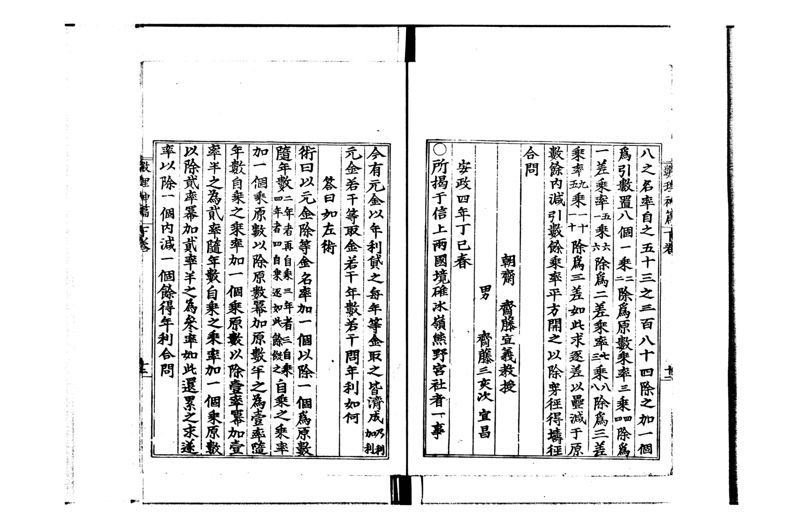
翻刻
八之名率自之五十三之三百八十四除之加一個
爲引𢿙置八個一乘《割書:二|二》除爲原𢿙乘率三乘《割書:四|四》除爲
一差乘率《割書:五|一》乘《割書:六|六》除爲二差乘率《割書:七|三》乘《割書:八|八》除爲三差
乘率《割書:九|五》乘《割書:一十|一十》除爲三差如此求逐󠄁差爲疊減于原
𢿙餘内減引𢿙餘乘率平方開之以除穿徑得壔徑
合問
朝齋 《人物*先生:齋藤宜義敎授》
男 《人物*奉納者:齋藤三㐪次宜昌》
《日時:安政四年丁巳春》
○所揭于《場所:信上兩國境碓冰嶺》熊野宮社者一事
今有元金以年利貸之每年等金取之皆濟成《割書:乃利|加利》
元金𠰥干等取金𠰥干年𢿙𠰥干問年利如何
答曰如左術
術曰以元金除等金名率加一個以除一個爲原𢿙
隨年𢿙《割書:二年者再自乘三年者三自乘|四年者四自乘逐󠄁如此餘傚之》自乘之乘率
加一個乘原𢿙以除原𢿙冪加原𢿙半󠄁之為壹率隨
年𢿙自乘之乘率加一個乘原𢿙以除壹率冪加壹
率半之為貳率隨年𢿙自乘之乘率加一個乘原𢿙
以除貳率冪加貳率半之為參率如此還󠄁累之求遂󠄂
率以除一個内減一個餘得年利合問
現代語訳
## 【前ページからの続き:円柱・穿孔問題の術の末尾部分】
八をもって「率」と名付け、自乗し(五十三分の三百八十四)で割り、一を加えたものを「引数」とする。
八個を置き、一を乗じ、【割書:二/二】で除したものを「原数」とする。率を乗じ三を乗じ【割書:四/四】で除したものを「一差」とする。率を乗じ【割書:五/一】を乗じ【割書:六/六】で除したものを「二差」とする。率を乗じ【割書:七/三】を乗じ【割書:八/八】で除したものを「三差」とする。率を乗じ【割書:九/五】を乗じ【割書:一十/一十】で除したものを「三差」(四差)とする。このようにして各差を求め、順々に原数より減じ、残りの内から「引数」を減じ、残りに率を乗じ、平方根を開き、これをもって「穿径(穴の径)」を割れば「壔径(円柱の径)」を得る。問いに合う。
---
朝齋 **【齋藤宜義】教授**
男 **【齋藤三㐪次宜昌】**
**安政四年丁巳春**
---
## 【場所:信州・上州両国の境、碓氷嶺】熊野宮社に掲げたる一事
**【問題:再掲】**
今、元金があり、年利にて貸し付け、毎年等金(均等な金額)を取り立て、すべて返済し終えるものとする(すなわち利に利が加わる複利)。
元金○○干、等取金(年賦取立金)○○干、年数○○干とするとき、年利はいかほどか。
**答:左の術の如し。**
**術:**
元金を等金(年賦金)で割り、その商を「率」と名付け、一を加えたものをもって一を割り、これを「原数」とする。
年数に従い(二年ならば二度掛け、三年ならば三度掛け、四年ならば四度掛け、以下同様に)「率」を自乗し、これに一を加えたものを「原数」に掛け、一を除し、原数の冪(二乗)に原数を加えて半分にしたものを「壱率」とする。
年数に従い「率」を自乗し、一を加えたものを「原数」に掛け、一を除し、壱率の冪(二乗)に壱率を加えて半分にしたものを「弐率」とする。
年数に従い「率」を自乗し、一を加えたものを「原数」に掛け、一を除し、弐率の冪(二乗)に弐率を加えて半分にしたものを「参率」とする。
このようにして繰り返し累ねて「遂率」を求め、一を割り内から一を減ずれば、残りが年利となる。問いに合う。
英語訳
## [Continuation from the Previous Page: End of the Cylinder/Bore Diameter Problem]
Name eight as the "ratio" (*ritsu*); square it, divide by 384/53, and add one; call this the "引数" (*hiki-sū*, "subtractive number").
Place eight; multiply by one and divide by [2/2] to obtain the "original number" (*gensū*). Multiply by the ratio, multiply by three, and divide by [4/4] to obtain the "first difference" (*ichi-sa*). Multiply by the ratio, multiply by [5/1], and divide by [6/6] to obtain the "second difference" (*ni-sa*). Multiply by the ratio, multiply by [7/3], and divide by [8/8] to obtain the "third difference" (*san-sa*). Multiply by the ratio, multiply by [9/5], and divide by [10/10] to obtain the "[fourth] difference" (*shi-sa*). Obtain each successive difference in this manner, and subtract them cumulatively from the "original number." Subtract the "subtractive number" from the remainder, multiply the result by the ratio, extract the square root, and divide by this the bore diameter (*sен-kei*); the result is the cylinder diameter (*dō-kei*). This agrees with the problem.
---
      Chōsai **[Saitō Yoshinori], Teacher**
         His son: **[Saitō Sankichi Yoshiaki]**
  **Ansei 4, Year of the Hinoto-Mi (1857), Spring**
---
## A Matter Dedicated to Kumano Shrine [located at: the border between Shinano and Jōshū provinces, Usui Pass]
**[Problem: Repeated]**
Suppose there is a principal sum lent out at annual interest, with equal annual payments collected until the debt is fully settled (that is, with compound interest, where interest accrues upon interest).
Given: principal = [some amount], annual payment = [some amount], number of years = [some amount]; what is the annual interest rate?
**Answer: As given in the method below.**
**Method:**
Divide the principal by the annual payment amount; call the result the "ratio" (*ritsu*). Add one to it. Divide one by this sum; call the result the "original number" (*gensū*).
Raise the "ratio" to the power corresponding to the number of years (for two years, multiply it by itself twice; for three years, three times; for four years, four times; and so on in this manner). Add one to this result, multiply by the "original number," divide by one, then add the square of the "original number" to the "original number" itself and halve the sum; call this the "first rate" (*ichi-ritsu*).
Raise the "ratio" to the power corresponding to the number of years, add one, multiply by the "original number," divide by one, then add the square of the first rate to the first rate itself and halve the sum; call this the "second rate" (*ni-ritsu*).
Raise the "ratio" to the power corresponding to the number of years, add one, multiply by the "original number," divide by one, then add the square of the second rate to the second rate itself and halve the sum; call this the "third rate" (*san-ritsu*).
Continue accumulating in this manner to obtain the "final rate" (*tsui-ritsu*). Divide one by this final rate, then subtract one from the result; the remainder is the annual interest rate. This agrees with the problem.