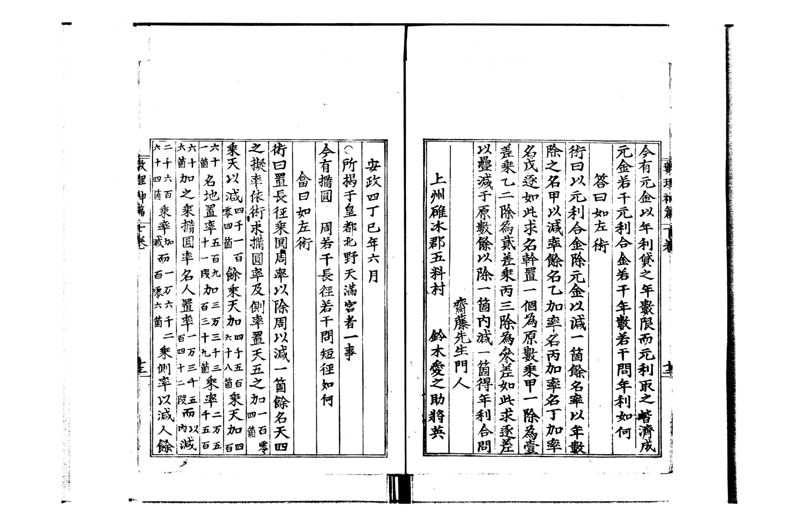
翻刻
今有元金以年利貸之年𢿙限而元利取之皆濟成
元金𠰥干元利合金𠰥干年𢿙𠰥干問年利如何
答曰如左術
術曰以元利合金除元金以減一箇餘名率以年𢿙
除之名甲以減率餘名乙加率名丙加率名丁加率
名戊逐󠄁如此求名幹置一個為原𢿙乘甲一除為壹
差乘乙二除為貳差乘丙三除為參差如此求逐󠄁差
以疊減于原𢿙餘以除一箇内減一箇得年利合問
《人物*先生:齋藤先生》門人
《場所:上州碓冰郡五料村》 《人物*奉納者:鈴木愛之助將英》
《日時:安政四丁巳年六月》
○所揭于《場所:皇都》北野天滿宮者一事
今有撱円 周𠰥干長徑𠰥干問短徑如何
畣曰如左術
術曰置長徑乘圓周率以除周以減一箇餘名天四
之擬率依術求撱円率及側率置展五之加《割書:一百零|四箇》
乘天以減《割書:四千一百|零四箇》餘乘天加《割書:四千五百|六十八箇》乘天加《割書:四|百》
《割書:六十|一箇》名地置率《割書:五百九|十一段》加《割書:三万三千三|百三十九箇》乘率《割書:二万五|千五百》
《割書:六十|六箇》加之乘撱円率名人置率《割書:一万三千五|百四十二段》而《割書:以|内》減
《割書:二千六百|六十四箇》乘率《割書:加|減》而《割書:一万六千二|百零六箇》乘側率以減人餘
現代語訳
## 【問題:元利合計による年利計算】
今、元金があり、年利にて貸し付け、年数を定めて元利合計を一括にて取り立て、すべて返済し終えるものとする。
元金○○干、元利合金(元利合計)○○干、年数○○干とするとき、年利はいかほどか。
**答:左の術の如し。**
**術:**
元利合金をもって元金を割り、一を減ずれば、残りを「率」と名付ける。これを年数で割り「甲」と名付ける。率から甲を減じた残りを「乙」と名付ける。乙に率を加えたものを「丙」と名付ける。丙に率を加えたものを「丁」と名付ける。丁に率を加えたものを「戊」と名付ける。このようにして順々に名付けて「幹」を求める。
一を置いて「原数」とする。甲を乗じ一で割れば「壱差」となる。乙を乗じ二で割れば「弐差」となる。丙を乗じ三で割れば「参差」となる。このようにして各差を順々に求め、原数より累減し、残りをもって一を割り、内から一を減ずれば年利を得る。問いに合う。
---
**齋藤先生**門人
**【上州碓氷郡五料村】** **鈴木愛之助將英**
**安政四丁巳年六月**
---
## 【皇都】北野天滿宮に掲げたる一事
**【問題:楕円の短径を求める】**
今、楕円がある。周○○干、長径○○干とするとき、短径はいかほどか。
**答:左の術の如し。**
**術:**
長径を置き、円周率を乗じ、これをもって周を割り、一を減ずれば、残りを「天」と名付ける。「天」を四乗する。擬率の術によって楕円率および側率を求める。
展(天の五乗)を置き、【割書:一百零四箇(一〇四)】を加え、天を乗じ【割書:四千一百零四箇(四一〇四)】を減じ、残りに天を乗じ、【割書:四千五百六十八箇(四五六八)】を加え、天を乗じ、【割書:四百六十一箇(四六一)】を加えたものを「地」と名付ける。
率【割書:五百九十一段(五九一)】を置き、【割書:三万三千三百三十九箇(三三三三九)】を加え、率を乗じ、【割書:二万五千五百六十六箇(二五五六六)】を加え、これを楕円率に乗じたものを「人」と名付ける。
率【割書:一万三千五百四十二段(一三五四二)】を置き、内より【割書:二千六百六十四箇(二六六四)】を減じ、率を乗じ(加減して)【割書:一万六千二百零六箇(一六二〇六)】を加え、側率を乗じ、これを「人」から減ずれば残りは……
英語訳
## [Problem: Finding the Annual Interest Rate from Principal and Total Amount]
Suppose there is a principal sum lent at annual interest, to be settled in full after a fixed number of years, with both principal and interest collected together at the end.
Given: principal = [some amount], total of principal and interest combined = [some amount], number of years = [some amount]; what is the annual interest rate?
**Answer: As given in the method below.**
**Method:**
Divide the principal by the total principal-plus-interest amount, then subtract one; call the remainder the "ratio" (*ritsu*). Divide this ratio by the number of years; call the result "Kō" (甲, "A"). Subtract Kō from the ratio; call the remainder "Otsu" (乙, "B"). Add the ratio to Otsu; call the result "Hei" (丙, "C"). Add the ratio to Hei; call the result "Tei" (丁, "D"). Add the ratio to Tei; call the result "Bo" (戊, "E"). Continue naming in this manner to obtain the "trunk" (*miki*, 幹).
Place one as the "original number" (*gensū*). Multiply by Kō and divide by one to obtain the "first difference" (*ichi-sa*). Multiply by Otsu and divide by two to obtain the "second difference" (*ni-sa*). Multiply by Hei and divide by three to obtain the "third difference" (*san-sa*). Continue obtaining each successive difference in this manner, subtract them cumulatively from the "original number," divide one by the remainder, then subtract one from the result; the annual interest rate is obtained. This agrees with the problem.
---
          A pupil of **Saitō Sensei**
 **[Goryō Village, Usui District, Jōshū Province]**  **Suzuki Ainosuke Masahide**
        **Ansei 4, Year of Hinoto-Mi (1857), Sixth Month**
---
## A Matter Dedicated to Kitano Tenmangū Shrine [in the Imperial Capital (Kyoto)]
**[Problem: Finding the Minor Axis of an Ellipse]**
Suppose there is an ellipse. Given: circumference = [some amount], major axis = [some amount]; what is the minor axis?
**Answer: As given in the method below.**
**Method:**
Place the major axis, multiply by the circular ratio (π), divide this into the circumference, subtract one; call the remainder "Ten" (天, "Heaven"). Raise Ten to the fourth power.
Using the method of the "pseudo-ratio" (*gi-ritsu*), find the "ellipse ratio" (*daen-ritsu*) and the "side ratio" (*soku-ritsu*).
Place the fifth power of Ten (*Ten* to the fifth), add [104], multiply by Ten, subtract [4,104], multiply the remainder by Ten, add [4,568], multiply by Ten, add [461]; call this "Chi" (地, "Earth").
Place the ratio at [591 steps], add [33,339], multiply by the ratio, add [25,566], multiply by the ellipse ratio; call this "Jin" (人, "Person/Human").
Place the ratio at [13,542 steps], subtract [2,664] from within, multiply by the ratio, (add or subtract as appropriate) add [16,206], multiply by the side ratio, subtract this from "Jin"; the remainder is…
*(Page continues)*