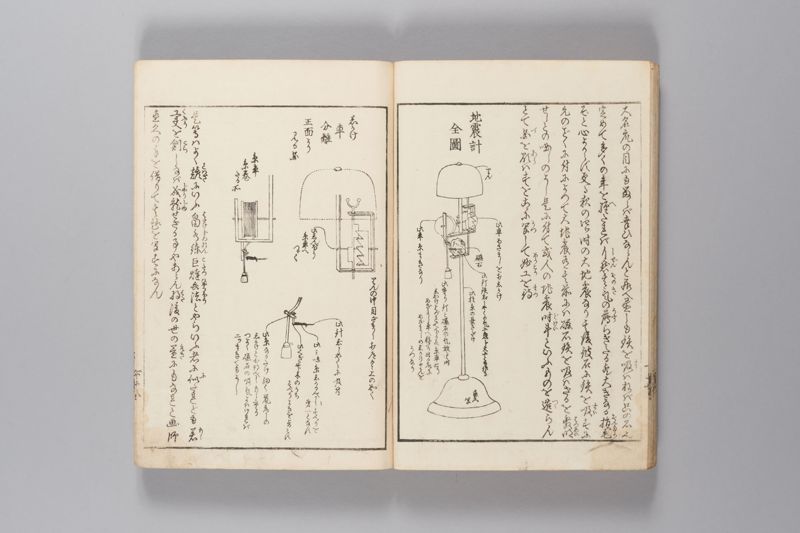
翻刻
【右丁】
大名衆の目にも留らば幸ひならんと居へ置しも鉄を吸(す)はねば只の石也
定めて多くの年を経(へ)たれば自然(しぜん)其(その)気(き)の薄(うす)らぎたる歟大きなる損毛(そんもう)
ぞと心よからず更る夜の四ツ時の大地震なり其後彼石に鉄を吸(すは)すに
元のごとくに付によつて大地震有其前には磁石鉄を吸はざるを発明(はつめい)
せしとの咄しのよし是に付て或人の地震 時斗(どけい)といふものを造(つく)らん
とて図(づ)を顕(あら)はすをこゝに写(うつ)して妙工(めうこう)を待(まつ)
地震計
全図
りん
此車めさましを打しかけ
磁石
此釘鉄じしやくの気に応じ大小とも作る
此柱糸の長さだけ
此重り釘と磁石の気放るゝ時
しかけはづれて下る故糸車廻り
めざまし車へ移り廻る故に
めざましのしかけりんを
うつなり
此車 糸まきなり
直久
写
【左丁】
しかけ
車
分離
正面より
みる図
りんの中目ざまし打道具上の如く
此しんぼう
糸車へ
つゞく
糸車
糸巻
たる所
此針じしやくに吸付
此三味糸しかるべしすへりを
第一となす
此くぎ竹木のうち
すべりよきを旨とす
此糸なるたけ細く鼠落しの
しかけと心得べしもし重り
つよく磁石の吸気よはければ
二ツまきてもよし
是等はよく諺(ことはざ)にいふ畠水練(はたけすゐれん)巨燵兵法(こたつひやうほう)とやらいふ者に似(に)たれども若(もし)
工夫(くふう)を創(こら)しなば成就(じやうじゆ)せざる事やあらん将(はた)後の世の益(えき)にもなれと画師
直久の手を借りて其趣を写すになん
現代語訳
【右丁】
大名方のお目にも留まれば幸いであろうと置いておいたものの、鉄を吸いつけなければただの石に過ぎない。きっと長い年月を経たために、自然とその磁気が薄れてしまったのだろうと、気分がすぐれないままでいたところ、夜更けの四つ時(午前零時頃)の大地震であった。その後、かの石に鉄を近づけてみると、元のように吸いつくようになった。よって、大地震がある前には磁石が鉄を吸いつけなくなることを発見したという話だということである。
これに因んで、ある人が「地震時計」というものを作ろうとして、その設計図を描いたものをここに写し取り、優れた職人(の手に委ねることを)待つとする。
【地震計 全図】
りん(鈴)
この車は目覚まし(鐘)を打つ仕掛けとなっている
磁石
この釘は磁石の磁気に応じて動く(大小ともに作る)
この柱は糸の長さ分だけ(の高さ)
この重りは、釘と磁石の磁気が離れる時に仕掛けが外れて下に落ちる。それによって糸車が回り、目覚まし車へと回転が伝わり、目覚まし(鐘)の仕掛けのりん(鈴)を打つのである
この車は糸巻きである
直久 写
【左丁】
仕掛け車 分離(した状態)
正面から見た図
りんの中(の)目覚まし打ち道具は上(の図)の通り
このしんぼう(心棒)は糸車へと続く
糸車 糸を巻いているところ
この針は磁石に吸いつく
この三味線の糸(のような細い糸)はなるべく滑りのよいものを第一とする
この釘は竹または木の中で滑りのよいものを旨とする
この糸はなるべく細く、鼠落とし(ねずみとり)の仕掛けと同じ原理と心得るべし。もし重りが重く、磁石の磁気が弱ければ(糸を)二重に巻いてもよい
これらは、よく諺にいう「畠水練」「炬燵兵法」とやらいうものに似ているけれども、もし工夫を凝らすならば、成就しないことがあろうか。また後の世の益にもなれと(願い)、画師・直久の手を借りてその趣旨を写し取ったものである。
英語訳
【Right folio】
It had been kept in hopes that it might catch the eye of a daimyo lord — but a lodestone that does not attract iron is nothing more than an ordinary stone. Surely, the proprietor thought, after so many years its magnetism must have naturally grown weak; this was quite a loss, and he felt considerably dispirited. Then came the great earthquake in the middle of the night, at the fourth hour (*yotsu-doki*, around midnight). After that, when iron was brought near the stone, it adhered just as it had before. From this, it was discovered that prior to the great earthquake, the lodestone had ceased to attract iron — or so the story goes.
Inspired by this account, a certain person conceived of making something to be called an "earthquake timepiece" (*jishin-dokei*), and drew up a design for it. That design is here copied down, in hopes that a skilled craftsman may be found to bring it to completion.
**Seismometer — Full Diagram**
*Rin* (bell/chime)
This wheel is connected to the mechanism that strikes the alarm bell.
Magnet (*jishaku*)
This nail responds to the magnetic force of the magnet — to be made in both large and small sizes.
This post/pillar — (its height corresponds to) the length of the thread.
This weight: when the magnetic connection between the nail and the magnet is released, the mechanism disengages and the weight falls, causing the thread-wheel to rotate; this rotation is transmitted to the alarm wheel, which in turn strikes the chime (*rin*) of the alarm mechanism.
This wheel serves as the thread-spool.
*Copied by Naohisa*
【Left folio】
The mechanism wheel — separated (i.e., shown disassembled).
View from the front.
The alarm-striking mechanism inside the chime (*rin*) is as shown above.
This spindle (*shinbō*) connects to the thread-wheel.
Thread-wheel — showing where the thread is wound.
This needle is attracted to the magnet.
For this (thread — use something similar to) shamisen strings; above all, one should use material with the smoothest possible glide.
For this nail, the key principle is to choose bamboo or wood with the smoothest possible surface.
This thread should be made as thin as possible; the mechanism should be thought of in the same way as a mousetrap (*nezumiotoshi*). If the weight is heavy and the magnetic attraction of the lodestone is weak, it may be wound twice.
All of this may resemble what the proverb calls "swimming practice in a field" (*hatake suiren*) or "military strategy from inside a *kotatsu*" (*kotatsu hyōhō*) — in other words, armchair theorizing — but if one truly applies ingenuity and effort, surely it could be brought to fruition. And perhaps it may prove of benefit to future generations — it is with this hope that the design has been copied here, with the assistance of the painter Naohisa.