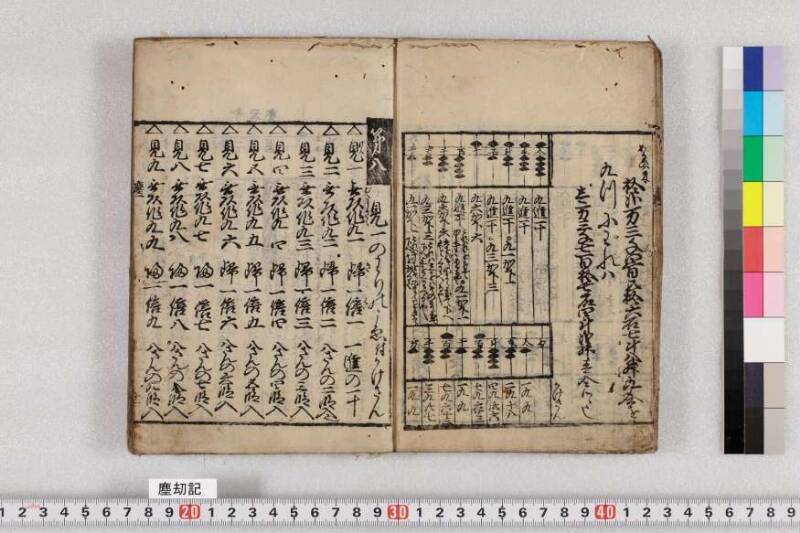
翻刻
【一巻十丁裏】
あるひは米拾弍万三千四百五十六石七斗八升九合を
九つにわれは
壱万三千七百十拾七石四斗弍升壱合つゝ也
かけさん
九合 九進一十 勺
八升 九進一十 一合 一九 九
七斗 九進一十○九一加下一 二升 二九 十八
六石 九進一十○九三加下三 四斗 四九 卅六
五十 九六加下六 七石 七九 六十三
四百 九進一十《割書:これは九をあて|加へ五とわくる也》九一加下一 一十 一九 九
三千 九六加下六《割書:六をはそのまま置て下へ|六とくわへる也》 七百 七九 六十三
二万 九三加下三《割書:これは三をはそのまま置て|下へ三をとわへる也》 三千 三九 廾七
一十 九一加下一《割書:これは十をそのままをきて|下へ十と加る也》 一万
【一巻十一丁表】
《題:第八 見一のわりのこゑ 付かけさん》
△見(けん)一/無(む)頭(とう)作(さく)九一 帰(き)一/倍(はい)一 一進の一十
△見二無頭作九二 帰一倍二 八さんの二段入也
△見三無頭作九三 帰一倍三 八さんの三段入
△見四無頭作九四 帰一倍四 八さんの四段入
△見五無頭作九五 帰一倍五 八さんの五段入
△見六無頭作九六 帰一倍六 八さんの六段入
△見七無頭作九七 帰一倍七 八さんの七段入
△見八無頭作九八 帰一倍八 八さんの八段入
△見九無頭作九九 帰一倍九 八さんの九段入
現代語訳
【一巻十丁裏】
たとえば、米十二万三千四百五十六石七斗八升九合を
九つに割れば、
一万三千七百十七石四斗二升一合ずつとなる。
(以下、そろばんによる計算の手順)
九合 九進一十 (勺)
八升 九進一十 一合 一九 九
七斗 九進一十○九一加下一 二升 二九 十八
六石 九進一十○九三加下三 四斗 四九 三十六
五十 九六加下六 七石 七九 六十三
四百 九進一十〔これは九を当て加へ五と別くる也〕九一加下一 一十 一九 九
三千 九六加下六〔六はそのまま置きて下へ六と加える也〕 七百 七九 六十三
二万 九三加下三〔これは三はそのまま置きて下へ三を加える也〕 三千 三九 二十七
一十万 九一加下一〔これは十をそのまま置きて下へ一と加える也〕 一万
【一巻十一丁表】
《第八 見一の割りの声 付けかけ算》
△見一(けんいち) 無頭(むとう)は九一と作る 帰一(きいち) 倍一(ばいいち) 一進(いっしん)の一十
△見二(けんに) 無頭は九二と作る 帰一 倍二 八算の二段入也
△見三(けんさん) 無頭は九三と作る 帰一 倍三 八算の三段入
△見四(けんし) 無頭は九四と作る 帰一 倍四 八算の四段入
△見五(けんご) 無頭は九五と作る 帰一 倍五 八算の五段入
△見六(けんろく) 無頭は九六と作る 帰一 倍六 八算の六段入
△見七(けんしち) 無頭は九七と作る 帰一 倍七 八算の七段入
△見八(けんはち) 無頭は九八と作る 帰一 倍八 八算の八段入
△見九(けんく) 無頭は九九と作る 帰一 倍九 八算の九段入
英語訳
[Folio 1, Sheet 10, Verso]
Suppose there are 123,456 koku, 7 to, 8 shō, 9 gō of rice,
and it is divided into nine equal parts:
The result is 13,717 koku, 4 to, 2 shō, 1 gō each.
(The following shows the step-by-step abacus calculation:)
9 gō: 9→10 (shaku)
8 shō: 9→10 1 gō: 1×9 = 9
7 to: 9→10 [○9-1: add 1 below] 2 shō: 2×9 = 18
6 koku: 9→10 [○9-3: add 3 below] 4 to: 4×9 = 36
50: 9-6: add 6 below 7 koku: 7×9 = 63
400: 9→10 [Note: apply 9, add and separate as 5] 9-1: add 1 below 10: 1×9 = 9
3,000: 9-6: add 6 below [Note: place 6 as-is, add 6 below] 700: 7×9 = 63
20,000: 9-3: add 3 below [Note: place 3 as-is, add 3 below] 3,000: 3×9 = 27
100,000: 9-1: add 1 below [Note: leave 10 as-is, add 1 below] 10,000
[Folio 1, Sheet 11, Recto]
《Section 8: The Spoken Rules for "Ken'ichi" Division, with Multiplication》
△ Ken'ichi (見一): When there is no leading digit, make it 9-1. Ki'ichi (return to 1). Bai'ichi (double 1). One advance makes ten.
△ Ken'ni (見二): When there is no leading digit, make it 9-2. Return to 1. Double 2. Enter the second row of the eight-times table.
△ Ken'san (見三): When there is no leading digit, make it 9-3. Return to 1. Double 3. Enter the third row of the eight-times table.
△ Ken'shi (見四): When there is no leading digit, make it 9-4. Return to 1. Double 4. Enter the fourth row of the eight-times table.
△ Ken'go (見五): When there is no leading digit, make it 9-5. Return to 1. Double 5. Enter the fifth row of the eight-times table.
△ Ken'roku (見六): When there is no leading digit, make it 9-6. Return to 1. Double 6. Enter the sixth row of the eight-times table.
△ Ken'shichi (見七): When there is no leading digit, make it 9-7. Return to 1. Double 7. Enter the seventh row of the eight-times table.
△ Ken'hachi (見八): When there is no leading digit, make it 9-8. Return to 1. Double 8. Enter the eighth row of the eight-times table.
△ Ken'ku (見九): When there is no leading digit, make it 9-9. Return to 1. Double 9. Enter the ninth row of the eight-times table.