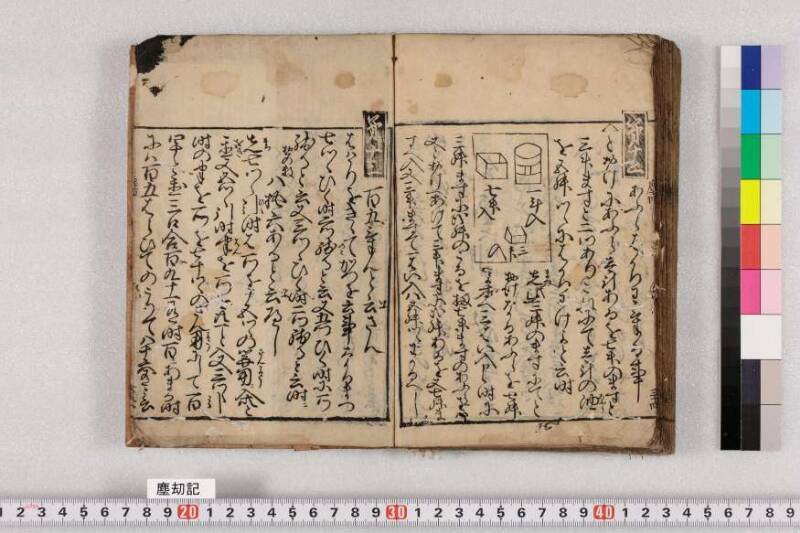
翻刻
【四巻三十四丁裏】
《題:第十二 あふらはかりわける事》
△とおけにあふら壱斗あるを七升のますと
三升ますと二つありこれにて壱斗の油(あふら)
を五升つつにはかりわけよと云時
[一斗入]
[三升入]
[七升入]
先(まつ)此二升のますにてと
おけなるあふらを七升
よすへ三はい入申候時に
三升ますに弐升のこるを扨七升ますのあふらをは
又とおけへあけて三升ますに弐升あるを又七升ま
すへ入又三升ますて一はい入は五升つつわかるへし
【四巻卅五丁表】
《題:第十三 百五けんと云さん》
ははかりをききてかつを云事なりまつ
七つつひく時二つ残(のこ)ると云又五つひく時に一つ
残ると云又三つつひく時二つ残ると云時に
《割書:物の数》八拾六あると云(いふ)へし
先(まつ)七つつ引(ひく)時は一つを十五つつの算用(さんよう)に入卅と
置(をき)又五つつ引時半(はん)を一つを廿一と入又三つつ引
時の半を一つを七十つつのさん用(よう)にして百
四十と置三石合百九十一有時百にあまる時
には百五はらひてのこりて八十六有と云
現代語訳
【四巻三十四丁裏】
《題:第十二 油を量り分ける事》
△ある桶に油が一斗あるのを、七升の枡と
三升の枡の二つがある。これにて一斗の油を
五升ずつに量り分けよと言う時、
[一斗入]
[三升入]
[七升入]
まず、この三升の枡にて、
桶にある油を七升(ます)へ
三杯(みたして)入れる。その時に
三升枡に二升残るを、さて七升枡の油を
また桶へあけて、三升枡に二升あるのをまた七升枡
へ入れ、また三升枡で一杯入れれば、五升ずつ分かれるべし。
---
【四巻三十五丁表】
《題:第十三 百五減と言う算》
端数を聞いて(もとの)数を言う事なり。まず、
七つずつ引く時に二つ残ると言う。また五つ引く時に一つ
残ると言う。また三つずつ引く時に二つ残ると言う時に、
《物の数》八十六あると言うべし。
まず、七つずつ引く時は、一つを十五ずつの算用に入れ、三十と
置く。また五つずつ引く時の(余りの)一つを二十一と入れる。また三つずつ引く
時の(余りの)一つを七十ずつの算用にして
百四十と置く。三つ合わせて百九十一あるとき、百を超える時
には百五を払って(引いて)、残りが八十六あると言う。
英語訳
【Volume 4, Folio 34 verso】
《Title: Problem 12 — Dividing Oil by Measuring》
△ There is a tub containing 1 *to* of oil, and there are two measuring vessels: one of 7 *shō* capacity and one of 3 *shō* capacity. The question asks: how do you divide the 1 *to* of oil into two equal portions of 5 *shō* each using these vessels?
[1-*to* tub]
[3-*shō* measure]
[7-*shō* measure]
First, using the 3-*shō* measure,
pour oil from the tub into the 7-*shō*
measure, filling it three times (i.e., 3×3=9 *shō*). At this point,
2 *shō* will remain in the 3-*shō* measure. Then, pour the oil from the 7-*shō* measure back into the tub, transfer the 2 *shō* remaining in the 3-*shō* measure into the 7-*shō* measure, and then fill the 7-*shō* measure once more with one full 3-*shō* measure — and thus the oil will be divided into 5 *shō* each.
---
【Volume 4, Folio 35 recto】
《Title: Problem 13 — The "105 Ken" Calculation》
This is the art of stating the original number upon hearing the remainders. First:
when dividing by 7, the remainder is 2. When dividing by 5, the remainder is 1.
When dividing by 3, the remainder is 2. In this case,
the answer is: the number is **86**.
Method: When dividing by 7, count each unit of remainder as 15, so place 2 × 15 = 30.
When dividing by 5, count each unit of remainder as 21, so (1 × 21 =) 21.
When dividing by 3, count each unit of remainder as 70, so (2 × 70 =) 140.
Summing all three gives 191. When the total exceeds 100,
subtract multiples of 105, and the remainder is 86 — that is the answer.