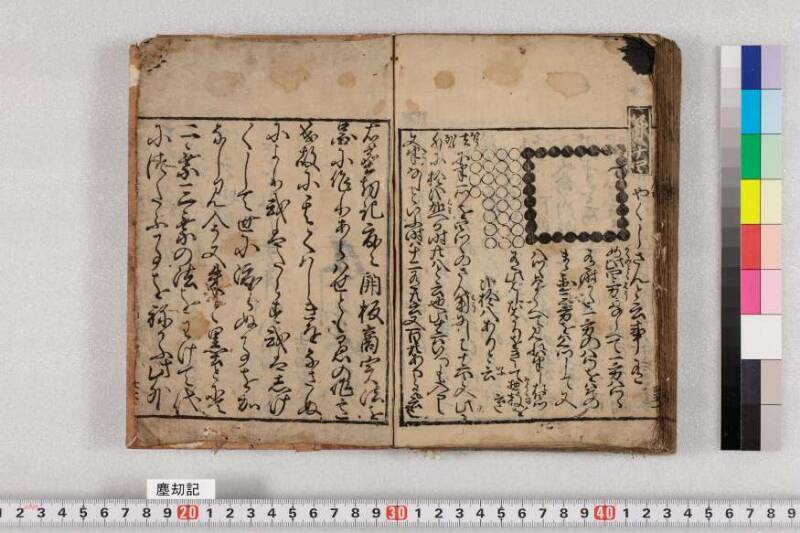
翻刻
【四巻卅五丁裏】
《題:第十四 やくしさんと云事有》
如此(かくのことく)四/方(はう)にならへて一方八つつ
有時かた一方の八つをはその
まま置二方をはくつして又
八つつならへて見れは半した四つ
有此#1ばしたはかりをききて惣(そう)数(かす)を云也
弐拾八ありと云(いふ)
法(ほう)に半一つを四つつのさん用(よう)にして十六と又/此(この)
外(ほか)に拾弐/加(くわ)へる時廿八と云也此十六いつも入申候
又/半(はん)なしといふ時は十二有共云又百廿あるとも云也
【四巻卅六丁表】
右塵#2劫記度々開板商実法を
圖に作りあらはせとも愚の作意
成故に其くはしきをなさぬ
により或はたらす或はしけ
くして世に渡らぬ事をか
なしみ今又朱と墨とにて
二乗三乗の法をわけて代
につたふ事をねかふ此外
現代語訳
【四巻三十五丁裏】
《第十四 薬師算(やくしさん)と云う事あり》
このように四方(四辺)に並べて、一辺に八つずつある時、片方の一辺の八つはそのまま置き、二方(ふたつの辺)を崩して、また八つずつ並べて見れば、端(はした)が四つある。この端(はした)ばかりを聞いて、総数を言うなり。
二十八ありと言う。
法(ほう):端の一つを四つずつの算用にして十六、さらにこの外に十二を加える時、二十八と言うなり。この十六はいつも入れ申す候。また端なしという時は十二あると言う。また百二十あるとも言う。
---
【四巻三十六丁表】
右、塵劫記(じんこうき)は、度々(たびたび)開板(かいはん)し、商実法(しょうじつほう)を図に作り表せども、愚の作意(さくい)なる故に、その詳しきをなさぬにより、或いは足らず、或いは繁くして(しげくして)世に渡らぬ事を悲しみ、今また朱と墨とにて二乗三乗の法を分けて、代(よ)に伝うる事を願う。この外、
英語訳
【Volume 4, Folio 35 verso】
《Problem 14: The Algorithm Called "Yakushi-san" (Medicinal Master Calculation)》
Arrange objects in a square formation (on four sides) such that there are 8 on each side. Keep one side's 8 in place, dismantle the remaining two sides, then rearrange them so that there are again 8 on each side — and one finds there is a remainder (端, *hashita*) of 4. By hearing only this remainder, one announces the total number.
One declares: there are 28.
Method: Take the remainder, multiply by 4 (one unit of remainder = 4 in the calculation), giving 16; then add 12 to this, and one arrives at 28. The value 16 is always added as a fixed component. When there is no remainder (*han nashi*), one says there are 12. [The maximum total] is also said to be 120.
---
【Volume 4, Folio 36 recto】
This *Jinkōki* has been published (*kaihanshi*) many times, and though the methods of commercial calculation (*shōjitsuhō*) have been illustrated and presented, because this is the work of a humble mind (*gu no sakui*), it has not been made sufficiently detailed — and thus I have felt sorrow that, being in some respects deficient and in others too complex, it has not spread widely in the world. Now once more, by means of red and black [ink/text], I wish to divide and present the methods of squaring and cubing so that they may be transmitted to future generations. Beyond this,