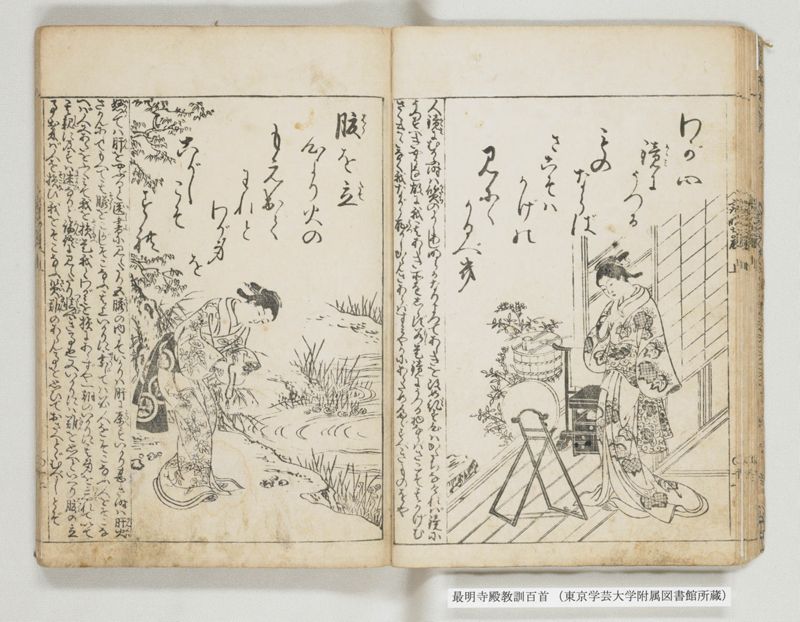
翻刻
【右丁】
わが心
鏡(かゝみ)に
うつる
もの
ならば
さこそは
かげの
みにく
かるべき
人 鏡(かゝみ)にむかふ時は質(かたち)のよしあし明らかなりよつてあしきを改め糺(たゝ)す心はかたちなければ鏡に
うつすべきやうなし故に我其あしき所をしらず若(もし)是鏡にうつる物ならばさこそ其かげむ
さくきたなく我ながら恥(はつ)かしからんさあらばすみやかにあらためたゞすべきものをや
【左丁】
腹(はら)を立(たて)
心より火の
もえ出て
われと
わが身
を
こがし
こそ
すれ
怒(いかり)ては肝(かん)をやぶると医書(いしよ)に見えたり又 臓(そう)の内にていかりは肝に属(そく)すいかり甚き時は肝火(かんくは)
さかんにしてもへて其 臓(そう)をこがしそこなふ其上いかりに乗(せう)じては必人をそこなふ人をそこな
へば人又あたをふくみて我を損(そこなふ)是我とわがみを損にあらずや一朝のいかりに其身を忘(わす)れて以て
其 親(しん)に及すは迷(まよひ)なりと論語(ろんご)に見えたり慎(つゝしむ)べき事也又いかりには難(なん)を思へといへり腹(はら)の立
事出来ば人を損(そこな)ひ我をそこなふ災難(さいなん)のあらん事を思ひておさへとゞむべしとぞ
現代語訳
【右丁】
(歌)
わが心
鏡に
映る
もの
ならば
さこそは
影の
醜く
あるべき
(解説)
人が鏡に向かうとき、顔かたちの良し悪しは明らかにわかる。だからこそ、悪いところを改め、正すことができる。しかし、心には形がないので、鏡に映すことができない。それゆえ、自分のどこが悪いのかを知ることができないのである。もし、これが鏡に映るものならば、さぞかしその影は醜く汚らしく、自分ながら恥ずかしく思われることだろう。そうであれば、すみやかに改め、正すべきものではないか。
【左丁】
(歌)
腹を立て
心より火の
燃え出でて
われと
わが身を
焦がし
こそ
すれ
(解説)
怒ることは肝(かん)を傷つけると医書に記されている。また、五臓の中で怒りは肝に属し、怒りが甚だしい時は肝の火が盛んに燃えて、その臓を焦がし傷める。その上、怒りに任せては必ず人を傷つけてしまう。人を傷つければ、人もまた恨みを抱いて我が身を損なう。これは、自ら自分の身を損なうことに他ならないではないか。「一朝の怒りにその身を忘れて、もって親に及ぼすは迷いである」と『論語』に記されている。慎むべきことである。また、「怒りには難を思え」ともいう。腹の立つことが起きたならば、人を傷つけ、自分をも傷つける災難が起きるであろうことを思い、こらえ止めるべきである。
英語訳
[Right folio]
*(Poem)*
If only my heart
could be reflected
in a mirror —
how very ugly
its shadow
would surely be.
*(Commentary)*
When a person faces a mirror, the good and ill of their appearance becomes clearly visible, and so they are able to correct and improve upon what is wanting. But because the heart has no physical form, it cannot be reflected in a mirror — and therefore one cannot know one's own faults. If the heart were something that could be reflected in a mirror, how very ugly and repulsive its shadow would surely appear; one would be ashamed of it even in one's own eyes. Were that truly so, one ought to reform and correct oneself without delay.
[Left folio]
*(Poem)*
Giving rise to anger,
a fire burns forth
from within the heart —
scorching none other
than one's
own self.
*(Commentary)*
It is recorded in medical texts that anger injures the liver. Furthermore, among the five visceral organs, anger is associated with the liver; when anger is extreme, the fire of the liver blazes fiercely, scorching and damaging that organ. Moreover, when one gives free rein to anger, one will inevitably harm others. If one harms others, they in turn will harbor resentment and bring harm upon oneself. Is this not the same as wounding oneself with one's own hand? The *Analects of Confucius* states: "To forget oneself in a moment of anger, thereby bringing harm upon one's parents, is delusion." This is something one must guard against most carefully. It is also said: "When gripped by anger, think of the calamity it will bring." When something arises that provokes one's temper, one should call to mind the disaster that will befall — the harm done to others and to oneself — and restrain and check that anger.