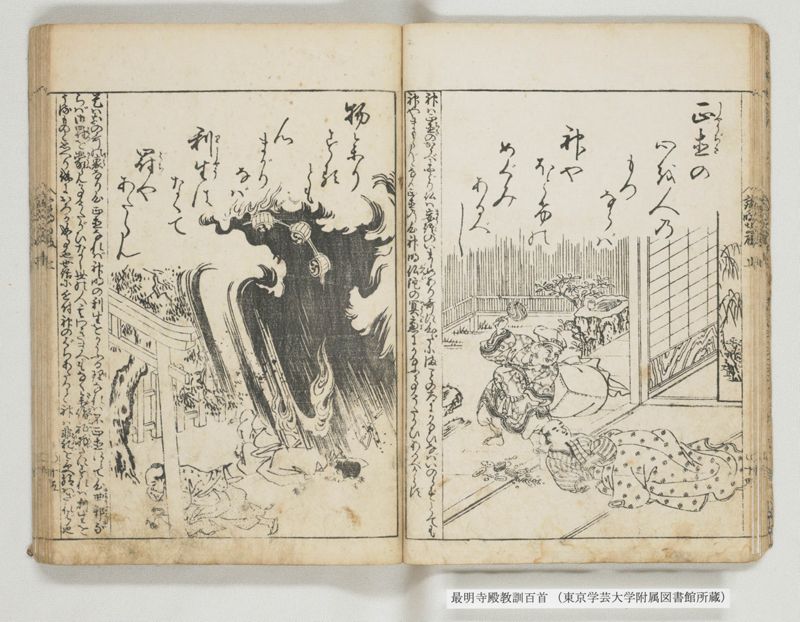
翻刻
【右丁】
正直(しやうぢき)の
心を人の
もつ
ならば
神や
ほとけの
めぐみ
あるべ
し
神は正 直(ちき)のかうべにやどり仏は妄語(まうこ)のいましめあり哥に心だにまことの道にかなひなばいのらずとても
神やまもらんとなん正直の心神明 仏陀(ぶつだ)の冥慮(めうりよ)にかなふ事うたかひあるべからず
【左丁】
物参り
する
とも
心
まがり
なば
利生(りしやう)は
なくて
罰(ばち)や
あたらん
是は前の哥の裏(うら)なり心正直なれば神明の利生をかうふる理(り)なれば不正直にして心 曲(まかり)邪(よこしま)な
らば御 罰(はつ)を蒙(かうふ)らん事うたがひなし世の人其わきまへもなく参詣(さんけい)礼拝(らいはい)だにすれば利生を
うるものと思へり誠におろか成事也世俗に近付神のばちあたると神は非礼を受給はざれば也
現代語訳
【右丁】
(歌)
正直の
心を人の
もつ
ならば
神や
仏の
めぐみ
あるべし
(解説)
「神は正直の頭(こうべ)に宿る」といわれ、仏には妄語(うそ)を戒める教えがある。歌にも、「心だにまことの道にかないなば、いのらずとても神やまもらん」とある。正直の心は、神明・仏陀の御心にかなうことに、疑いの余地はない。
【左丁】
(歌)
物参りを
する
とも
心が
曲がり
なば
利生は
なくて
罰(ばち)や
あたらん
(解説)
この歌は、前の歌の裏(反面)を示したものである。心が正直であれば神明の御利益(ごりやく)をこうむるのが道理であるから、正直でなく心が曲がり、邪(よこしま)であれば、神の御罰を受けることは疑いない。世の人々はその道理もわきまえず、参詣・礼拝さえすれば御利益を得られるものと思っている。まことに愚かなことである。世間では「近づきの神の罰当たる」ともいわれる。神は礼に外れたことはお受けにならないからである。
英語訳
[Right folio]
*(Poem)*
If only people
would hold
in their hearts
a spirit
of honesty —
surely the grace
of gods
and buddhas
would be theirs.
*(Commentary)*
It is said that "the gods dwell upon the heads of the honest," and the Buddha has laid down precepts against false speech. There is a poem that goes: "If only the heart walks the true path, the gods will protect you even without prayer." That an honest heart accords with the divine will of the gods and buddhas admits of no doubt.
[Left folio]
*(Poem)*
Even if you make
pilgrimages
and offerings,
if your heart
is crooked,
you shall receive
not blessing
but divine punishment.
*(Commentary)*
This poem presents the reverse of the preceding one. Since it is the natural principle that an honest heart receives the blessings of the gods, it follows without doubt that one whose heart is dishonest, crooked, and wicked will incur divine punishment. The people of the world, without understanding this principle, believe that simply making pilgrimages and performing acts of worship is sufficient to obtain blessings. This is truly foolish. The popular saying goes, "Punishment comes from the god one is close to" — for the gods do not accept what is contrary to propriety and rite.