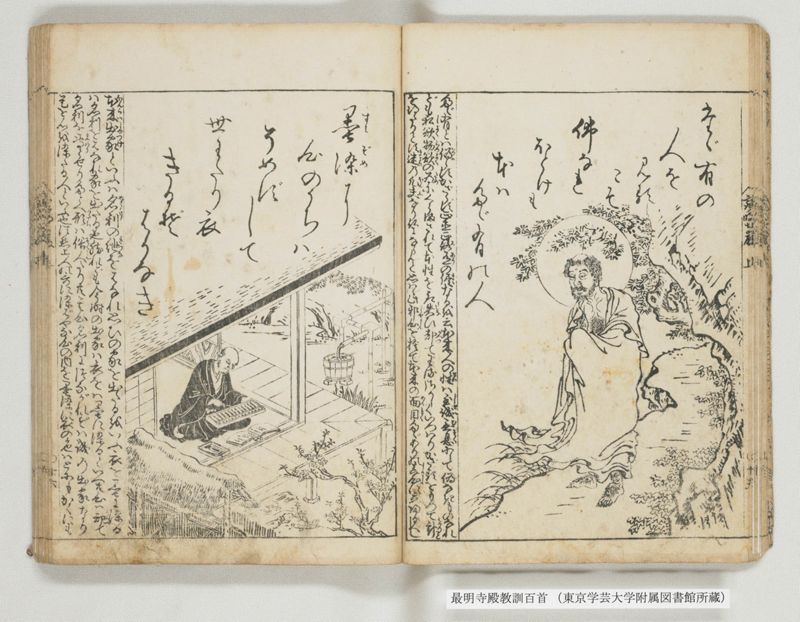
翻刻
【右丁】
たゞ有の
人を
見る
こそ
仏なれ
ほとけも
本は
たゞ有の人
たゞ有とは偽(いつは)らすかざらず正直正 路(ろ)有(あり)の儘(まゝ)なるを云本来人の性(せい)は至誠(しせい)無息(むそく)にして偽なきものなれ
ども私欲(しよく)物欲(ふつよく)の為(ため)にくらまされて本性を取 失(うしな)ひ却(かへつ)てわるさかしくいつはりかざるをもつて計(はかりこと)
を得たりとす迷(まよひ)の凡夫(ほんふ)なり仏にならんと思はゞ此 邪心(じやしん)を捨て本来の面目(めんもく)たゞありの真心(しんしん)に立帰るべし
【左丁】
墨染(すみぞめ)に
心のうちは
そめず
して
世わたり衣
きるぞ
はかなき
本来(ほんらい)出家(しゆつけ)といふは名利(めうり)の紲(きつな)をはなれ思ひの家を出たるをいふ衣を墨に染る
は名利をはなれ家を出たる也然れども今時の出家は衣をは墨に染るといへ共心は却(かへつ)て
名利を専(もつはら)とせりたとへ形(かたち)は俗人(そくしん)たり共其心名利につながれずは誠の出家なり
是を心を染たる人といふ也法然上人の哥に染ばやな心の内を墨染に衣の色はとにもかくにも
現代語訳
【右丁】
(歌)
ただ有りの
人を
見るこそ
仏なれ
仏も
もとは
ただ有りの人
(解説)
「ただ有り」とは、偽らず、飾らず、正直に、ありのままであることをいう。もともと人の本性は、至誠にして偽りなきものである。しかしながら、私欲・物欲のために本性が曇らされ、かえって悪賢くなり、偽ったり飾ったりすることをもって計略を得たりと思うようになる。これが迷いの凡夫というものである。仏になろうと思うならば、この邪心を捨て、本来の面目である「ただ有り」の真心に立ち返るべきである。
【左丁】
(歌)
墨染の
衣(ころも)は染めても
心の内は
染めずして
世をわたる衣
着るぞ
はかなき
(解説)
そもそも「出家」というのは、名利(名声と利欲)のきずなを離れ、思いの家を出ることをいう。衣を墨色に染めるのは、名利を離れ家を出た(出家した)ことの表れである。しかし今の時代の出家者は、衣は墨に染めるといっても、心はかえって名利を専らとしている。たとえ形は俗人であっても、その心が名利につながれていなければ、それが誠の出家である。これを「心を染めた人」という。法然上人の歌に、「染めばやな 心の内を 墨染に 衣の色は とにもかくにも」とある。
英語訳
[Right folio]
*(Poem)*
To see the person
who is simply
as they are —
that is to see
a buddha;
for the buddha too
was once just
an ordinary person, simply as they were.
*(Commentary)*
"Simply as one is" (*tada-ari*) means to be without deception, without pretense — honest, and exactly as one naturally is. By original nature, the human heart is one of utmost sincerity, entirely free of falsehood. Yet it becomes clouded by personal desire and worldly greed, causing one to lose one's true nature and, conversely, to become cunningly wicked, taking deception and pretense as one's strategy. This is the deluded ordinary person (*bonbu*). If one wishes to become a buddha, one must abandon this wicked heart and return to the true mind of one's original nature — the mind of "simply being as one is."
[Left folio]
*(Poem)*
Though you dye your robes
in ink-black,
if the heart within
remains undyed —
how fleeting
to wear the robes
of one who has crossed the world!
*(Commentary)*
In its original sense, "leaving home" (*shukke*, monastic ordination) means to sever the bonds of fame and profit, and to leave behind the house of worldly attachment. Dyeing one's robes in black is the outward expression of having left behind fame and profit and departed from home. Yet the monks of the present age, though they dye their robes in black, have their hearts turned all the more toward fame and profit. Even if one's outward form is that of a layperson, if one's heart is not bound by fame and profit, that is true renunciation. Such a person is called one who has "dyed the heart." The Venerable Hōnen composed a poem on this theme: "Would that I could dye — the inside of the heart — in ink-black; as for the color of the robe, it matters little either way."