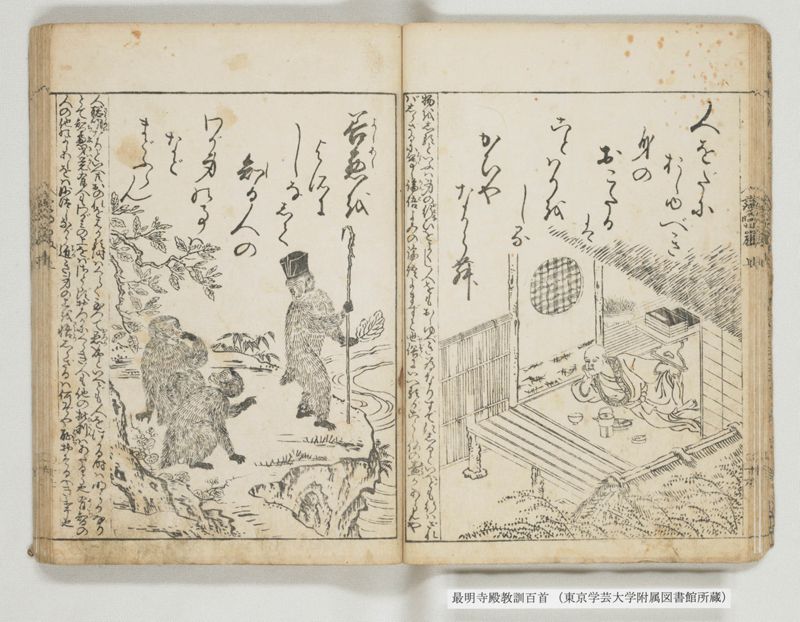
翻刻
【右丁】
人をだに
おしゆべき
身の
おこたる
は
ことはりを
しる
かひや
なからむ
物をしるといふは身の行(おこな)ひをよくし人をもおしゆべき為なりすでにしるといへども行はざれ
ばしらざるに等(ひと)し論語(ろんこ)よみの論語よまずと世俗(せぞく)にいへるがごとし何の益(ゑき)かあらんや
【左丁】
善悪(よしあし)を
よそに
しなして
知(し)る人の
わが身の事は
など
まどふらん
人 聡明(さうめい)なりといへ共おのれをはかる時はくらく至つて愚(おろか)成といへども人をはかる時は明らかなり
とて智恵(ちゑ)才覚(さいかく)有人もわがみの上をばおとらずおろかにくらき人も他の批判(ひはん)はあたると也 有智(うち)の
人の他のよしあしをは沙汰しながら近(ちか)き身の上を悟(さとり)しらざるは何ぞや恥(はぢ)おそるべき事也
現代語訳
【右丁】
(歌)
人をさえ
教えるべき
身でありながら
おこたる(怠ける)とは
道理を知る
かいが
ないではないか
(解説)
ものを知るということは、自らの行いを正しくし、人をも教え導くためのものである。すでに知っているといっても、実際に行わなければ、知らないのと同じことである。「論語読みの論語知らず」と世間でいわれるとおり、何の益があろうか(いや、何の益もない)。
【左丁】
(歌)
善し悪しを
他人のこととして
批評できる人が
わが身のことは
なぜ
迷うのであろうか
(解説)
人は聡明であるといっても、自分自身のことを判断するときは暗く(わからなくなり)、たとえ至って愚かであるといっても、他人のことを判断するときは明らかによく見えるものである。つまり、知恵や才覚のある人でも自分自身のことはおろそかになり、劣った者でも他人への批判は的を射るということだ。知恵ある人が他人の善し悪しをあれこれ言いながら、身近な自分自身のことを悟り知らないのはどういうわけか。まことに恥じ、恐れるべきことである。
英語訳
[Right folio]
*(Poem)*
Even one who ought
to teach others —
if they themselves
are neglectful,
what good is it
to claim
they know
the Way?
*(Commentary)*
To know something means to refine one's own conduct and thereby be fit to teach and guide others. Even if one already "knows," if one does not put that knowledge into practice, it is no different from not knowing at all. As the popular saying goes, "the reader of the *Analects* who does not live by the *Analects*" — what benefit can there be in such knowledge?
[Left folio]
*(Poem)*
The one who can clearly discern
good and ill
in others as if from afar —
why is it that
when it comes
to their own self,
they are lost?
*(Commentary)*
Even one who is called perceptive becomes dim when it comes to judging themselves; and even one who is thoroughly foolish can see clearly when judging others. That is to say: even a person of great wisdom and ingenuity tends to be inattentive to their own affairs, while even a lesser person can hit the mark when criticizing others. How is it, then, that a person of learning and intellect, who readily pronounces on the good and ill of others, fails to perceive and understand what lies close at hand — their own self? This is something of which one ought truly to be ashamed and wary.