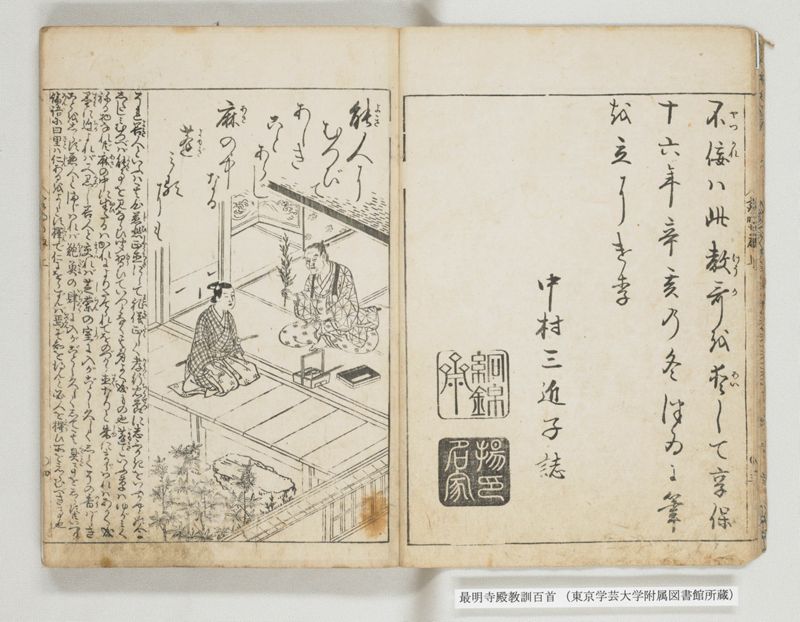
翻刻
【右丁】
不侫(やつかれ)は此 教哥(けうか)を愛(あい)して享保
十六年辛亥の冬つゐに筆
を立にけり
中村三近子誌
【印】#1【印】#2
【左丁】
能(よき)人に
むつびて
あしき
こと
あらじ
麻(あさ)の中なる
蓬(よもぎ)
みる
にも
それ善(よき)人といふは其心 慈悲(じひ)正直(しやうちき)にして礼儀(れいき)正(たゝ)しく孝行(かう〳〵)忠節(ちうせつ)に志ふかきをいふかやうの人に
したしみむつべば能(よき)事を見ならひ聞 習(なら)ひていつとなく其身よく成もの也 蓬(よもき)といふ草はゆがみく
ねる物なれ゛共 麻(あさ)の中に生(おひ)たるはかれによりたてられてをのづから直(すぐ)なりと朱(しゆ)にまじはれはあかく成
墨(すみ)に近(ちか)よれば又 黒(くろ)し善人と交(ましは)れば芝蘭(しらん)の室(しつ)に入がごとし久しくしてその香(かう)ばしき
ことをしらず悪人とまじはれば鮑魚(ほうぎよ)の肆(いちくら)に入がごとし久しくして其 臭(くさき)事をしらず共いへり
論語(ろんこ)に曰 里(さと)は仁(じん)あるをよしとす択(えらん)で仁にをらずんば焉(いつくん)ぞ知を得んと必人を撰(えら)ひ所をえらむべき事也
現代語訳
【右丁】
この拙者(わたくし)はこの教訓の歌を愛して、享保十六年辛亥の冬、ついに筆を執ることとなった。
中村三近子 誌
【印】【印】
【左丁】
(歌)
良き人に
親しみ交われば
悪しき
こと
あるまじ
麻の中なる
蓬を
見ても
わかること
(解説)
そもそも「善き人」というのは、その心が慈悲深く正直であり、礼儀正しく、孝行・忠節の志の篤い人のことをいう。このような人に親しみ交われば、良いことを見習い、聞き習って、いつの間にかその身も善くなるものである。蓬(よもぎ)という草はもともと曲がりくねるものであるが、麻の中に生えたものは、麻に支えられて自然とまっすぐになる。また、朱に交われば赤くなり、墨に近づけばまた黒くなるという。善人と交われば、芝蘭の室に入るようなものであり、長くいるうちにその芳しい香りに気づかなくなる。悪人と交われば、鮑魚の店に入るようなものであり、長くいるうちにその臭さにも気づかなくなる、とも言われている。
『論語』に曰く、「里(住む里)は仁のあるところを良しとする。選んで仁のあるところに住まなければ、どうして知恵を得ることができようか」と。必ず人を選び、住む場所をも選ぶべきことである。
英語訳
[Right folio]
I, your humble servant, having long cherished these poems of moral instruction, finally took up my brush in the winter of the sixteenth year of Kyōhō, the year of Kanoto-i (1731).
Written by Nakamura Sankoshi
[Seal] [Seal]
[Left folio]
*(Poem)*
If you keep company
with good people,
evil things
shall
not befall you —
just as the mugwort
growing among hemp
shows us
plainly.
*(Commentary)*
A "good person" is one whose heart is filled with compassion and honesty, who is proper in conduct and etiquette, and who is deeply devoted to filial piety and loyal service. If one draws close to and associates with such a person, one will learn to see and hear good things, and before long one's own character will naturally improve. The mugwort plant is by nature crooked and wandering, yet when it grows among hemp, it is held upright by those stalks and becomes straight of its own accord. Similarly, it is said: mix with vermilion and you turn red; draw near to ink and you turn black. To associate with good people is like entering a room filled with芝蘭 (*shiran* — orchid and thoroughwort); after dwelling there long, one ceases to notice how fragrant it is. To associate with wicked people is like entering a fishmonger's stall; after dwelling there long, one ceases to notice how foul the smell has become — so it is said.
The *Analects of Confucius* states: "For a village, benevolence (*ren*) makes it a fine place. To choose to live where there is no benevolence — how can one attain wisdom?" One must take care to choose one's companions and one's place of dwelling wisely.