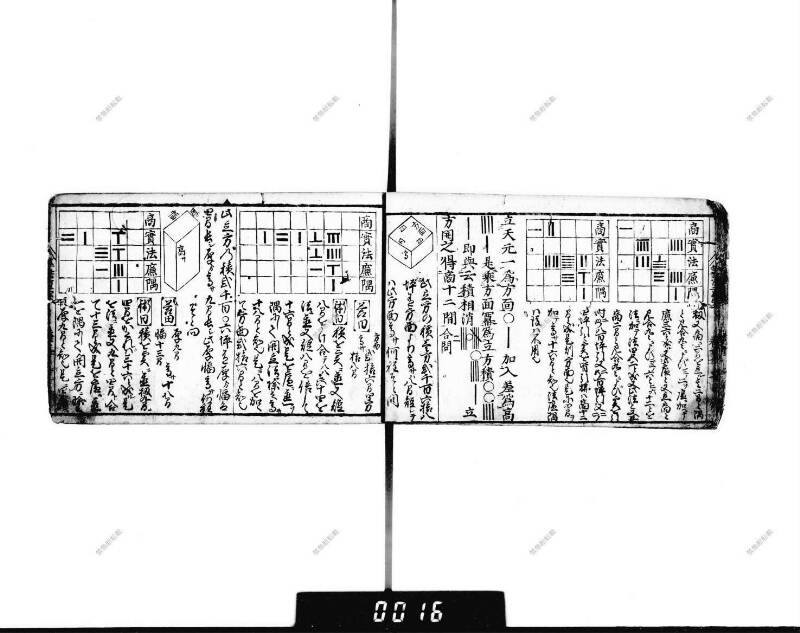
翻刻
〽扨又商 ̄ニ二間を立 ̄ル其二間と隅
と見合九々 ̄ニよび《割書:一二》 ̄ノ二 ̄ヲ廉 ̄ニ加ヘ ̄テ
廉三六と成 ̄ル又此廉と又立商と
見合九々 ̄ニよび《割書:二三》 ̄ノ六と《割書:二六》十二とを
法 ̄ニ加 ̄テ法四五二と成又此法と又立
商二間と見合九々 ̄ニよび実を引
時《割書:二|四》ノ八百坪引又《割書:二|五》ノ百坪引又《割書:二|二》ノ
四坪引と実を皆引払は商十二
間と成是則方面也是に四間 ̄ヲ
加 ̄テ高 ̄サ十六間と知也法廉隅
は後は不用也
立_二|天元一_一為_二方面_一「0┃1」加_二入差_一為_レ高
「4┃1」是 ̄ニ乗_二方面冪_一為_二立方積_一「0┃0┃4
し即興伝法
┃1」即与_二云積_一相消「ー2304┃0┃4┃1」立
方開之得_二商十二間_一合間
此立方の積壱万弐千百六拾八
坪有方面より高 ̄サハ八間短 ̄シテ
は此方面高 ̄サ何程そと問
《割書:方面》弐拾六間四方
[答曰]《割書:高サ》拾八間
[術曰]積を実 ̄ニ置又短
八間をかけ合 ̄テ《割書:八八》六十四を
法 ̄ニ置又短八間を倍して
十六間と成是を廉 ̄ニ置 ̄ヲ
隅にして開立法 ̄ニ除之高 ̄サ
十八間と知也是 ̄ニ八間を加へ
て方西弐拾六間と知也
▲此立方の積弐千百〇六坪有厚ゟ幅は
四間長 ̄シ厚ゟ高 ̄サ九間長 ̄シ此厚幅高 ̄サ何程
そと問
厚九間
[答曰] 高 ̄サ十八間
幅十三間
[術曰]積を実 ̄ニ置扨九間 ̄ニ
四間をかくれば三十六と成 ̄ル是
を法 ̄ニ置又九間と四間 ̄ト合
て十三間と成是を廉 ̄ニ置
一を隅にして開立方 ̄ニ除之
□厚九間と知也是 ̄ニ四□
現代語訳
〽さて又商に2間を立てる。その2間と隅とを見合わせて九々により1×2の2を廉に加えて廉36となる。又この廉と又立てた商とを見合わせて九々により2×3の6と2×6の12とを法に加えて法452となる。又この法と又立てた商2間とを見合わせて九々により実を引く時、2×4の800坪引き、又2×5の100坪引き、又2×2の4坪引きと実を皆引き払えば商12間となる。これ則ち方面なり。これに4間を加えて高さ16間と知るなり。法・廉・隅は後は不用なり。
天元一を立てて方面とし、差を加え入れて高さとする。これに方面の冪を乗じて立方積とする。即ち云う積と相消する。これを立方開して商12間を得る。問いに合う。
この立方の積12,168坪がある。方面より高さは8間短い。この方面・高さは何程かと問う。
答え曰く《方面:26間四方、高さ:18間》
術曰く:積を実に置く。又短い8間をかけ合わせて8×8の64を法に置く。又短い8間を倍して16間となる。これを廉に置く。1を隅にして開立法に除之、高さ18間と知るなり。これに8間を加えて方面26間と知るなり。
▲この立方の積2,106坪がある。厚さより幅は4間長く、厚さより高さは9間長い。この厚さ・幅・高さは何程かと問う。
厚さ9間
答え曰く: 高さ18間
幅13間
術曰く:積を実に置く。さて9間に4間をかければ36となる。これを法に置く。又9間と4間と合わせて13間となる。これを廉に置く。1を隅にして開立方に除之、□厚さ9間と知るなり。これに4□
英語訳
〽Now again establish 2 ken in the quotient. Compare this 2 ken with the corner using the multiplication table to add 2 from 1×2 to the auxiliary divisor, making it 36. Again compare this auxiliary divisor with the newly established quotient using the multiplication table to add 6 from 2×3 and 12 from 2×6 to the divisor, making it 452. Again compare this divisor with the newly established quotient of 2 ken using the multiplication table to subtract from the dividend: subtract 800 tsubo from 2×4, subtract 100 tsubo from 2×5, and subtract 4 tsubo from 2×2. When all are subtracted from the dividend, the quotient becomes 12 ken. This is the square face. Adding 4 ken to this gives the height as 16 ken. The divisor, auxiliary divisor, and corner are not needed afterwards.
Establish the unknown quantity (天元) as 1 for the square face, add the difference to make the height. Multiply this by the power of the square face to make the cubic volume. It cancels with the stated volume. Opening this by cube root extraction yields a quotient of 12 ken. This matches the problem.
There is a cubic volume of 12,168 tsubo. The height is 8 ken shorter than the square face. What are this square face and height?
Answer: 《Square face: 26 ken square, Height: 18 ken》
Method: Place the volume in the dividend. Multiply the shortage of 8 ken together to get 64 from 8×8 and place it in the divisor. Double the shortage of 8 ken to make 16 ken. Place this in the auxiliary divisor. Using 1 as the corner, divide by the cube root extraction method to find the height as 18 ken. Adding 8 ken to this gives the square face as 26 ken.
▲There is a cubic volume of 2,106 tsubo. The width is 4 ken longer than the thickness, and the height is 9 ken longer than the thickness. What are this thickness, width, and height?
Thickness: 9 ken
Answer: Height: 18 ken
Width: 13 ken
Method: Place the volume in the dividend. Multiply 9 ken by 4 ken to get 36. Place this in the divisor. Add 9 ken and 4 ken together to make 13 ken. Place this in the auxiliary divisor. Using 1 as the corner, divide by cube root extraction to find □ thickness as 9 ken. Adding 4 □ to this