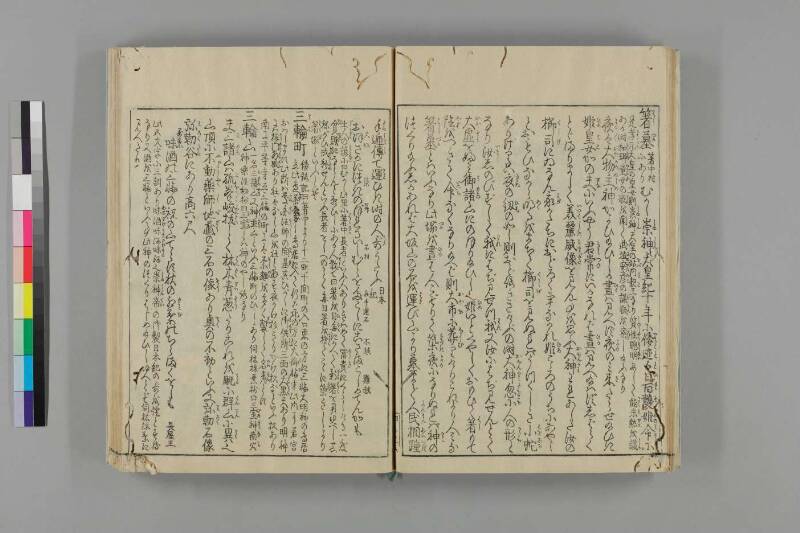
翻刻
【コマ180】
【右丁】
箸墓(はしつか)《割書:箸中村|にあり》むかし崇神天皇紀十年(しゆしん )に《振り仮名:倭迹々日百襲姫𫝇|やまとととひもゝそひめのみこと》#1に
《割書:是 孝元天皇(かうけん )の皇女則 崇神天皇(しゆしん )の姑内親王(をばみこ)なり質性聰明(しつしやうそうめい)にして能(よく)未然(みせん)を識(しる)|ある时 和珥童女(わにのはらはめ)の歌(うた)を聞て武埴安彦(はにのやすひこ)の謀反(むほん)を察(さつ)し給ふなり》
夜々(よる〳〵)大物主神(おほものぬしの )かよひ給ひしか晝(ひる)は見へず夜のみ來(き)たらせ給ひき
姫皇女(ひめみこ)かの夫(せな)にいふやう君(きみ)常(つね)にいかなれば晝(ひる)は見へ給はずしばらく
とどまりまして美麗威像(いつくしきみすがた)を見ん事を思ふ大神(おほんかみ)われあした汝の
櫛司(くしげ)にゐなん我(わが)かたちにおどろく事なかれ姫(ひめ)こゝろのうちにあやし
とおもひなから明(あく)るをまちて櫛司(くしげ)を見ぬればうつくしき小蛇(こをろち)
ありけり只 衣(きぬ)の紐(ひも)の如し則おどろきさけぶの时 大神(おほんかみ)忽(たちまち)に人の形と
なり汝(いまし)しのびずして我(われ)にはぢ見せつ我(われ)又汝にはぢ見せんとて
大虚(おほそら)をふみ御諸山(みもろ )にのほり給ひし也 姫(ひめ)いとくやしくおもひて箸(はし)もて
陰(ほぞ)をつきて《振り仮名:𫝇|いのち》なくなり給へば則 大市(おほち)に葬(ほうむ)りけりこれより人みな
箸墓(はしづか)とはいふなり此 塚(つか)を晝(ひる)は人こぞりて築(きづき)夜(よる)になりぬれば神(かみ)の
つくり給ふしかあれば大坂山の石を運(はこ)び山より墓まで人民相踵(にんみんあいつぎ)
【左丁】
手逓傳(たきしまし)て運(はこ)ひき时の人 哥(うた)うたふ《割書:日本|紀》
おほさか(大坂 )につき(築)のぼ(曻)れる いしむら(石村 )を たこしに(毎手運石)こさま(不越 )こしかてん(難越 )かも
《割書:土人(どじん)の諺(ことわざ)に曰むかし此里に箸中長者といふ人ありきはめて冨貴(ふうき)にくらしける一度|貧賤(ひんせん)にならんと願ひしにある人 教(をしへ)て曰箸を日毎(ひこと)にかへて新箸(さらはし)を用ゆべし其》
《割書:ねがひ成就(じやうじゆ)せんといふ長者をしへのことく毎日箸を捨(すて)てこゝに築(きづ)きしより|箸塚(はしつか)といふとぞ》
三輪町(みわ )《割書:倭路記曰箸中より十二町十間町の入口東の方に三輪大明神の鳥居|立此邊 茶屋(ちや )多(おゝ)し鳥居に入て行ば北の方に大御輪寺( みわ )此内に𠰥宮》
《割書:おはします此所は慶圓法師(けいゑんほうし)の開基(かいき)其ひがしに御供所(こくうしよ)三面の大黒天(たいこく )あり明神|には樓門(ろうもん)拝殿(はいでん)あり社はなし山を社と拝す衣かけ杉きりかけ杦なといふ杦あり》
《割書:南に平等寺立三輪の町には素麺(そうめん)を多く製(せい)して名産(めいさん)とす》
三輪山《割書:一名 三諸山(みもろやま)又 神並山(かみなみ )といふ三輪町のひかしにあり詞林採葉抄曰 三室神南火( むろかみなみ)|神樂注秘抄曰 三室(みむろ)とは神のやしろなり》
夫 三諸山(みもろ )は孤峯峻抜(こほうしゆんはつ)して林木靑葱(りんもくせいそう)たりこれを眺(みる)に群山(くんさん)に異(こと)也
山頂に不動藥師地藏(ふどうやくしぢざう)の三石の像(そう)あり奥(をく)の不動といふ又 弥勒(みろく)石像
弥勒谷(みろくたに)にあり髙六尺
《割書:萬葉》
味酒の三輪の祝の山てらす秋の紅葉(もみぢ)のちらまくをしも 長屋王
《割書:此五文字に三訓あり味酒(あぢさけ)味酒(うまさけ)味酒(うる )也 崇神帝(しゆしんてい)の御製日本紀の哥を証とする|なり又酒を三輪といふ事此神のつくりはじめ給ひしゆへとぞ詞林採葉に》
《割書:見へたり》
現代語訳
## 【コマ180】
### 【右丁】
**箸墓(はしつか)**〔箸中村にあり〕
むかし、崇神天皇紀十年(すじんてんのうきじゅうねん)に、倭迹々日百襲姫命(やまとととひももそひめのみこと)——これは孝元天皇(こうけんてんのう)の皇女にして、崇神天皇の叔母にあたる内親王なり。性質聡明にして、よく未然の事を察知される。ある時、和珥の童女(わにのわらはめ)の歌を聞いて、武埴安彦(たけはにやすひこ)の謀反を見抜かれた方である——に、夜ごと大物主神(おおものぬしのかみ)が通われたが、昼間は姿を見せず、夜だけおいでになった。
姫皇女がその夫(せな)に申されるには、「あなたはいつも、なぜ昼間はお姿が見えないのですか。しばらくとどまって、あなたの美しいお姿を見たいと思います」と。大神はお答えになって、「われは明朝、汝の櫛笥(くしげ)の中に入っておろう。わが姿を見ても驚いてはならぬ」とおっしゃった。姫はふしぎに思いながらも夜明けを待って、櫛笥を開けて見ると、美しい小さな蛇(こをろち)がおり、ちょうど衣の紐のような細さであった。姫は驚いて叫んだ。その時、大神はたちまち人の姿になり、「汝、耐えきれずに我に恥を見せた。我もまた汝に恥を見せよう」とおっしゃって、大空を踏んで御諸山(みもろやま、三輪山)へ登っていかれた。
姫はたいそう後悔し、箸(はし)をもって陰部(ほぞ)を突いて命を落とされた。そこで大市(おおち)に葬られた。これよりすべての人が「箸墓(はしつか)」と呼ぶようになった。この塚は、昼間は人々が集まって築き、夜になると神がお造りになるという。大坂山の石を運び、山から墓まで人民が次々と手渡しして運んだ。
### 【左丁】
手渡しして運んだという。その時の人々が歌を詠んだ(『日本紀』より)。
> おほさかに つきのぼれる いしむらを たごしにこさま こしかてんかも
>
>(大坂山に積み上げるための石の群れを、手ごとに運びあげよ、越えられないことよ)
〔土地の人の言い伝えによれば、むかしこの里に「箸中長者」という人がいた。たいへん裕福に暮らしていたが、一度は貧しくなりたいと願った。すると、ある人が教えて、「毎日箸を替えて、新しい箸を使うようにしなさい。そうすれば願いが叶うでしょう」と言った。長者はその教えの通りに毎日箸を捨てた。その箸を積み上げたことから、「箸塚(はしつか)」と言うようになった、ということである。〕
---
**三輪町(みわちょう)**
〔『倭路記(やまじき)』にいう——箸中より十二町十間(約1.3キロ)の、町の入口、東の方に三輪大明神の鳥居が立っており、この辺りには茶屋が多い。鳥居を入って進めば、北の方に大御輪寺(おおみわでら)があり、その中に宮がある。この地は慶圓法師(けいえんほうし)の開基(かいき)による。その東に御供所(こくうしょ)があり、三面の大黒天がある。明神には楼門(ろうもん)・拝殿(はいでん)があるが、社殿はない——山そのものを社として拝む。衣かけ杉・切りかけ杉などという杉の木がある。南に平等寺が立つ。三輪の町には素麺(そうめん)を多く製造して名産とする。〕
---
**三輪山(みわやま)**
一名、三諸山(みもろやま)、また神並山(かみなみやま)ともいう。三輪町の東にある。〔『詞林採葉抄(しりんさいようしょう)』にいう——三室(みむろ)は神の南の火〔神楽に関わる語〕。『神楽注秘抄(かぐらちゅうひしょう)』にいう——三室(みむろ)とは神の社(やしろ)のことである。〕
そもそも三諸山は、ひとつの峰が険しく高くそびえ(孤峯峻抜)、林の木々は青々と茂っている。これを眺めると、他の山々とは異なる趣がある。山頂には不動・薬師・地蔵の三体の石像があり、「奥の不動」という。また、弥勒の石像が弥勒谷にあり、高さ六尺(約1.8メートル)である。
〔『万葉集』より〕
> 味酒(あぢさけ)の 三輪の祝(はふり)の 山てらす 秋の紅葉の ちらまくをしも
>
> ——長屋王(ながやのおおきみ)
〔「味酒(あぢさけ)」の五文字には三つの読み方がある——「あぢさけ」「うまさけ」「うるわし」の三訓がある。崇神天皇の御製(『日本紀』の歌)をもってその証拠とする。また、酒のことを「三輪」というのは、この神が酒を造り始められたことによるという。『詞林採葉』に見える。〕
英語訳
## [Plate 180]
### [Right Page]
**Hashibaka (箸墓) — "Chopstick Mound"** *(located in Hashinaka Village)*
Long ago, in the tenth year of the reign of Emperor Sujin (崇神天皇), the princess Yamato-totohimomoso-hime no Mikoto (倭迹々日百襲姫命) — who was the imperial daughter of Emperor Kōgen (孝元天皇) and thus the paternal aunt of Emperor Sujin, a princess of clear and perceptive nature, who had once discerned the rebellion of Takehaniasuhiko (武埴安彦) upon hearing the song of a Wani maiden — was nightly visited by the god Ōmononushi (大物主神). The god never appeared in the daytime; he came only at night.
The princess said to her husband: "My lord, why is it that you never appear in the daylight? I wish you would tarry a while so that I might behold your beautiful form." The great god replied: "Tomorrow morning I shall be inside your comb-box (kushige). Do not be startled by my form." Though the princess found this strange, she waited for dawn and opened the comb-box — and there was a beautiful little serpent, no larger than the cord of a garment. She was startled and cried out. At that moment, the great god instantly resumed human form and said: "You could not restrain yourself and have shamed me. Now I shall shame you in return." With that, he strode across the great sky and ascended Mount Mimoro (三輪山).
The princess was overcome with remorse, and thrust a chopstick into her private parts, and died. She was then buried at Ōchi (大市). From this event, all people came to call the place "Hashibaka" (箸墓, "Chopstick Mound"). The mound is said to have been built by people gathering together in the daytime, while at night the gods continued its construction. Stones from Mount Ōsaka were transported, and the people formed a chain from the mountain to the tomb, passing the stones from hand to hand.
### [Left Page]
...and carried the stones in this relay fashion. The people of that time sang a song (from the *Nihongi*):
> *Ōsaka ni / tsuki-noboreru / ishimura wo / tagoshi ni kosama / koshikaten kamo*
>
> (How we struggle to pass, hand by hand, the great clusters of stones being raised up at Ōsaka Mountain — truly it cannot be crossed!)
[According to a local folk saying: Long ago in this village there lived a person known as the "Hashinaka Chōja" (箸中長者, the wealthy elder of Hashinaka), who lived in the greatest prosperity. He once wished to experience poverty. Someone taught him, saying: "Change your chopsticks every day and use only fresh chopsticks; your wish shall be granted." The wealthy man followed this advice and discarded chopsticks every single day. The accumulated chopsticks were piled up here, and from this the place came to be called "Hashibaka (Chopstick Mound)" — or so the story goes.]
---
**Miwa-chō (三輪町) — the Town of Miwa**
[According to the *Yamajiki* (倭路記): From Hashinaka, about twelve chō and ten ken (approximately 1.3 km) along, at the entrance to the town on the eastern side, stands the torii gate of the Miwa Daimyōjin (三輪大明神) shrine. There are many teahouses in this vicinity. Entering through the torii and proceeding, one finds Ōmiwa-dera (大御輪寺) to the north, within which is an inner sanctuary. This place was founded by the priest Keien (慶圓法師). To its east is the Kokūsho (御供所, the offering office), where there is a three-faced Daikokuten (大黒天) image. The shrine has a two-storied gate (rōmon) and a worship hall (haiden), but no main shrine building — the mountain itself is worshipped as the sanctuary. There are cedar trees known as "Koromo-kake Sugi" (robe-hanging cedar) and "Kirikake Sugi" (notched cedar) and others. To the south stands Byōdōji Temple. The town of Miwa is famous for producing large quantities of *sōmen* (thin wheat noodles) as its specialty product.]
---
**Mount Miwa (三輪山)**
Also known as Mount Mimoro (三諸山) or Mount Kaminami (神並山). It lies to the east of Miwa-chō. [The *Shirinosaiyōshō* (詞林採葉抄) states: "Mimuro — the southern fire of the god." The *Kagura-chū Hishō* (神楽注秘抄) states: "Mimuro means the dwelling/sanctuary of the gods."]
Mount Mimoro rises as a solitary peak, steep and towering, its forest trees lush and deeply green. When one gazes upon it, it appears quite unlike the surrounding mountains. At the summit stand three stone images — Fudō (不動), Yakushi (薬師), and Jizō (地蔵) — known as the "Inner Fudō" (奥の不動). There is also a stone image of Maitreya (Miroku, 弥勒) in Miroku Valley, standing six shaku (approximately 1.8 meters) tall.
[From the *Man'yōshū*:]
> *Ajisake no / Miwa no hafuri no / yamaterasu / aki no momiji no / chiramaku wo shimo*
>
> (How I lament the scattering of the autumn leaves that illuminate the mountain of the priests of Miwa, where the refined sake is made!)
>
> — Prince Nagaya (長屋王)
[The five characters "味酒" have three possible readings: *ajisake*, *umasake*, and *uruwashi*. The poem composed by Emperor Sujin in the *Nihongi* (日本紀) is cited as evidence. Furthermore, the fact that sake is referred to as "Miwa" derives from this deity having first created sake — as recorded in the *Shirinosaiyō* (詞林採葉).]