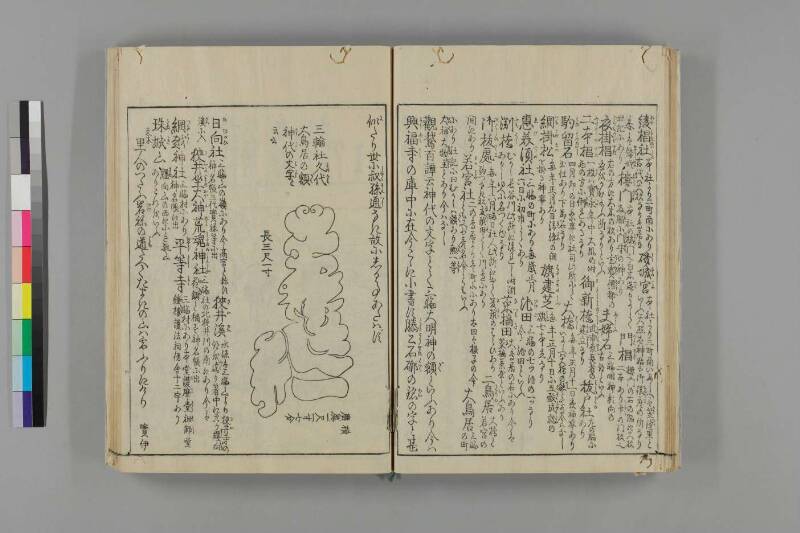
翻刻
【コマ185】
【右丁】
綾椙社(あやすきのやしろ)《割書:本社より二町南にあり|古代は大杦なり鳥居有》磯城宮(しきのみや)《割書:本社より三町南いにしへは笠縫(かさぬい)里と|いふ天照太神始て御鎮座( ちんざ)の所なり》
《割書:委は倭姫(やまとひめ)|丗紀にあり》樓門(らうもん)《割書:本社の樓門也白木 造(つく)りにして|両脇( わき)に門守(かどもり)の神あり》門椙(かとすぎ)《割書:樓門の右の脇に大杦|二本あり《振り仮名:𭅳|しるし》の門杦也》
衣掛椙(ころもかけすぎ)《割書:右の方に大木の杦あり玄賔僧都(がんひんそうつ)の|衣をかけ給ふ所なりといふ》夫婦石(ふうふ )《割書:三輪明神影向の|古跡といふ》
二本椙(ふたもとのすき)《割書:一株は寳永(ほうへい)年中大風の时|西の方に倒(たを)れあるなり》御新槗(みたらしのはし)《割書:武市原長者(たけいちはら )の|建立(こんりう)なり》祓戸社《割書:㔫の脇に|あり》
駒留石(こまとめのいし)《割書:四月卯の日祭事に社司此所にて|出仕あり下馬石なり》大槗( はし)《割書:毎年正月十一日夜神事あり|いにしへは大槗の能(のう)とて有今はなし》
綱掛松(つなかけまつ)《割書:毎年正月九日 清浄(きよめ)の綱|を掛る神事あり》旗建芝(はたたてのしば)《割書:毎年正月十日に五穀成就(ごごくじやうじゆ)の|旗(はた)七本立なり》
惠美須社(ゑびすの )《割書:三輪の町にあり毎歳正月|六日に初市とてあり》池田(いけた)《割書:三輪の七ツ池の一つなり|今池田といふ》
渕槗(ふちはし)《割書:むかし長谷川此所に流れし时渕|ありしゆへに名つくるなり》菜摘田(なつみた)《割書:大鳥居の右にあり今は|菜摘茶屋といふあり》
御祓處(をはらひしよ)《割書:毎年六月晦日社人此所に出て夏越(なこし)のはらひあり|駒つなき松 夏越田(なこした)とて川辺にあり》二鳥居( とりゐ)《割書:大槗と|𠰥宮の》
《割書:間にあり》《振り仮名:𠰥宮社|わかみや 》《割書:二の鳥居より壱町北にあり太田々根子の𫝇|とも又少彦名𫝇ともいふ》大鳥居《割書:三輪|の町》
《割書:にあり社記に曰むかしは額(がく)あり勲一等(くん とう)|大神大物主(おゝが ものぬし)とあり今はなし》
觀鵞百譚云神代の文字とて三輪大明神の額(がく)といふあり今は
興福寺(こうふくし)の庫中に在今こゝに小書す滕公石槨(とうこうせきくはく)#1の銘(めい)の字と甚
【左丁】
似(に)たり丗に叔孫通(しゆくそんつう)なき故にしる事あたはず
【挿絵上部】
三輪社 久代(そのかみ)
大鳥居の額(がく)
神代(かみよ)の文字(もじ)と
云云
【挿絵】
長三尺一寸
横
廣一尺一寸七分
【本文続き】
日向社(ひむかひ )《割書:三輪山の嶺にあり今髙宮と称す|神名帳三代實禄#2等に出》狹井渓(さいかは)《割書:水源は三輪山より狹井寺の|跡を遶(めぐ)り箸中に至り纒向(まきむき)》
《割書:渓(かは)に入》狹井坐大神荒魂神社(さいにいますおほかあらみたまのしんしや)《割書:三輪社の北狹井川の南にあり今は|花鎮(けちん)と穪す神名帳に出》
綱越神社(つなこし )《割書:三輪村にあり|神名帳に出》平等寺(びやうとうじ)《割書:三輪村にあり本堂 護摩堂(ごまたう)祖師堂(そし )|鐘樓(しゆらう)護法祠僧舎十二宇あり》
珠城山(たまき )《割書:纒向山の西に小き孤山|ありこれをいふ》
《割書:|夫木》
里人のつたふ岩(いは)ねの道(みち)たへてたまきの山は雪ふりにけり 實伊
現代語訳
【コマ185】
【右丁】
**綾杉社(あやすきのやしろ)**〔割書:本社より二町南にある。古代は大杉あり、鳥居有〕
**磯城宮(しきのみや)**〔割書:本社より三町南。いにしえは笠縫(かさぬい)里といい、天照大神が初めて御鎮座された所である。詳しくは『倭姫世紀』にある〕
**楼門(ろうもん)**〔割書:本社の楼門である。白木造りにして、両脇に門守の神がある〕
**門杉(かどすぎ)**〔割書:楼門の右の脇に大杉二本あり、印(しるし)の門杉である〕
**衣掛杉(ころもかけすぎ)**〔割書:右の方に大木の杉がある。鑑真僧都(がんじんそうず)が衣を掛けられた所なりという〕
**夫婦石(ふうふいし)**〔割書:三輪明神が影向(ようごう)された古跡という〕
**二本杉(ふたもとのすぎ)**〔割書:一株は宝永年中(1704〜1711)の大風のとき西の方に倒れたままである〕
**御手洗橋(みたらしのはし)**〔割書:武市原長者(たけいちはらのちょうじゃ)の建立である〕
**祓戸社(はらいどしゃ)**〔割書:橋の脇にある〕
**駒留石(こまとめのいし)**〔割書:四月卯の日の祭事に、社司がこの所で出仕する下馬石である〕
**大橋(おおはし)**〔割書:毎年正月十一日の夜に神事がある。いにしえは「大橋の能(のう)」とて行われたが、今はない〕
**綱掛松(つなかけまつ)**〔割書:毎年正月九日に清浄の綱を掛ける神事がある〕
**旗建芝(はたたてのしば)**〔割書:毎年正月十日に、五穀成就の旗を七本立てる〕
**恵比須社(えびすのやしろ)**〔割書:三輪の町にある。毎年正月六日に初市とて(市が)ある〕
**池田(いけだ)**〔割書:三輪の七つ池の一つである。今は池田という〕
**渕橋(ふちばし)**〔割書:むかし長谷川がこの所に流れていたとき淵があったゆえに、名付けられた〕
**菜摘田(なつみた)**〔割書:大鳥居の右にある。今は菜摘茶屋という店がある〕
**御祓処(おはらいしょ)**〔割書:毎年六月晦日に社人がこの所に出て、夏越の祓いがある。駒つなき松・夏越田(なごしだ)とて川辺にある〕
**二ノ鳥居(にのとりい)**〔割書:大橋と若宮との間にある〕
**若宮社(わかみやしゃ)**〔割書:二ノ鳥居より一町北にある。太田々根子命(おおたたねこのみこと)とも、また少彦名命(すくなひこなのみこと)ともいう〕
**大鳥居(おおとりい)**〔割書:三輪の町にある。社記に曰く、むかしは額(がく)があり、「勲一等大神大物主(くんいっとうおおかのおおものぬし)」とあった。今はない〕
『観鵞百譚(かんがひゃくたん)』に云う:「神代の文字として、三輪大明神の額(がく)があるといわれているもの(の文字)が今は興福寺の庫(くら)の中にある。今ここに小さく書き記す。鄧公(滕公)石槨(とうこうせきかく)の銘(めい)の字と甚だ
【左丁】
似ている。世に叔孫通(しゅくそんつう)のような人がいないため、(神代文字であるかどうかを)知ることができない。」
【挿絵上部の説明】
三輪社、往古の 大鳥居の額(がく)
神代の文字と
云々
【挿絵キャプション】
縦三尺一寸
横一尺一寸七分
---
**日向社(ひむかいのやしろ)**〔割書:三輪山の嶺(みね)にある。今は髙宮(たかみや)と称す。『神名帳』・『三代実録』等に出ている〕
**狹井渓(さいがわ)**〔割書:水源は三輪山より出て、狹井寺(さいでら)の跡をめぐり、箸中(はしなか)に至り、纒向(まきむき)渓(かわ)に入る〕
**狹井坐大神荒魂神社(さいにいますおおかあらみたまのじんじゃ)**〔割書:三輪社の北、狹井川の南にある。今は花鎮(けちん)と称す。『神名帳』に出ている〕
**綱越神社(つなこしじんじゃ)**〔割書:三輪村にある。『神名帳』に出ている〕
**平等寺(びょうどうじ)**〔割書:三輪村にある。本堂・護摩堂・祖師堂・鐘楼・護法祠・僧舎十二宇(うかく)がある〕
**珠城山(たまきやま)**〔割書:纒向山(まきむくやま)の西に小さな孤山があり、これをいう〕
〔夫木和歌抄〕
里人の伝える岩根の道も絶えて、珠城山には雪が降り積もった 実伊(さねより)
英語訳
[Folio 185]
[Right page]
**Ayasugi Shrine (綾杉社)** [Annotation: Located two *chō* (approx. 218 m) south of the main shrine. In ancient times there was a great cedar here, and there is a torii gate.]
**Shiki Palace (磯城宮)** [Annotation: Located three *chō* (approx. 327 m) south of the main shrine. In ancient times it was called Kasanui Village, and it is the place where Amaterasu Ōkami was first enshrined. For details, see the *Yamatohime Seiki*.]
**Two-storied Gate (楼門)** [Annotation: This is the main shrine's *rōmon* gate, built of unpainted wood, with guardian deities on both sides.]
**Gate Cedar (門杉)** [Annotation: Two great cedars stand to the right of the *rōmon* gate; these are the marker cedars of the gate.]
**Robe-hanging Cedar (衣掛杉)** [Annotation: To the right stands a great cedar tree. It is said to be the place where the monk Ganjin (Jianzhen) hung his robes.]
**Wedded Rocks (夫婦石)** [Annotation: Said to be an ancient sacred site where the deity of Miwa *myōjin* made a divine manifestation (*yōgō*).]
**Two-trunked Cedar (二本杉)** [Annotation: One of the trunks fell to the west during a great storm in the Hōei era (1704–1711) and remains so to this day.]
**Mitarashi Bridge (御手洗橋)** [Annotation: Built by the wealthy patron Takeichihara no Chōja.]
**Haraido Shrine (祓戸社)** [Annotation: Located beside the bridge.]
**Horse-stopping Stone (駒留石)** [Annotation: On the festival day of the Hare in the fourth month, the shrine officials use this stone to dismount here; it is a dismounting stone (*gebaseki*).]
**Great Bridge (大橋)** [Annotation: Each year on the night of the eleventh day of the first month, there is a sacred ritual. In former times there was a performance of *nō* theater known as the "Great Bridge *Nō*," but this no longer takes place.]
**Rope-hanging Pine (綱掛松)** [Annotation: Each year on the ninth day of the first month, there is a sacred ritual in which a purified rope is hung.]
**Flag-planting Lawn (旗建芝)** [Annotation: Each year on the tenth day of the first month, seven flags praying for a bountiful harvest of the five grains are erected here.]
**Ebisu Shrine (恵比須社)** [Annotation: Located in the town of Miwa. Each year on the sixth day of the first month, there is a market known as the *Hatsuichi* (first market of the year).]
**Ikeda (池田)** [Annotation: One of the Seven Ponds of Miwa; it is now called Ikeda.]
**Fuchi Bridge (渕橋)** [Annotation: In former times, the Hase River flowed through this area, and because there was a deep pool (*fuchi*) here, the bridge was given this name.]
**Natsumida (菜摘田)** [Annotation: Located to the right of the great torii. It is now home to a teahouse called Natsumi Chaya.]
**Purification Ground (御祓処)** [Annotation: Each year on the last day of the sixth month, shrine attendants come here to perform the *Nagoshi no Harae* (summer purification ceremony). The horse-tying pine and a paddy field called *Nagoshida* are located along the riverbank.]
**Second Torii (二ノ鳥居)** [Annotation: Located between the Great Bridge and the Wakamiya Shrine.]
**Wakamiya Shrine (若宮社)** [Annotation: Located one *chō* north of the second torii. The enshrined deity is said to be either Ōtataneko no Mikoto or Sukunahikona no Mikoto.]
**Great Torii (大鳥居)** [Annotation: Located in the town of Miwa. According to the shrine records, in former times there was a plaque inscribed with the words "Ōka no Ōmononushi, First Order of Merit" (*kun-ittō*). This plaque no longer exists.]
The *Kanga Hyakudan* states: "There is said to be a plaque bearing the 'writing of the age of the gods,' attributed to Miwa Daimyōjin, which is now held in the storeroom of Kōfukuji Temple. I here copy it in small script. The characters bear a striking resemblance to those of the inscription on the stone sarcophagus of Lord Téng (Téng Gōng shí guǒ, 滕公石槨).
[Left page]
However, since there is no one in the present world like Shusun Tong (叔孫通) [a scholar of ancient script], we cannot determine its true nature."
[Caption for illustration]
The plaque of the Great Torii of Miwa Shrine from long ago — said to bear the writing of the age of the gods, and so forth.
[Dimensions of the plaque as illustrated]
Length: 3 *shaku* 1 *sun* (approx. 93.9 cm)
Width: 1 *shaku* 1 *sun* 7 *bu* (approx. 35.5 cm)
---
**Himukaisho Shrine / Takamiya (日向社)** [Annotation: Located on the summit of Mount Miwa. It is now called Takamiya (High Shrine). It appears in the *Jinmyōchō* and *Sandai Jitsuroku*, among other sources.]
**Sai River (狹井渓)** [Annotation: Its source is on Mount Miwa; it flows around the former site of Sai Temple, proceeds to Hashinaka, and then flows into the Maki-muku River.]
**Sai-ni-imasu Ōka Aramitama Jinja (狹井坐大神荒魂神社)** [Annotation: Located to the north of Miwa Shrine and south of the Sai River. It is now known as Kechinjinja (花鎮神社, Flower-calming Shrine). It appears in the *Jinmyōchō*.]
**Tsunakoshi Jinja (綱越神社)** [Annotation: Located in Miwa Village. It appears in the *Jinmyōchō*.]
**Byōdōji Temple (平等寺)** [Annotation: Located in Miwa Village. It has a main hall, a *goma* (ritual fire) hall, a founder's hall, a bell tower, a guardian deity shrine, and twelve monks' quarters.]
**Mount Tamaki (珠城山)** [Annotation: A small isolated hill to the west of Mount Makimuku; this is the peak referred to.]
[*Fuboku Wakashō*]
The rocky path passed down by the villagers has vanished,
and snow has fallen deep
upon Mount Tamaki.
*Saneyor*i