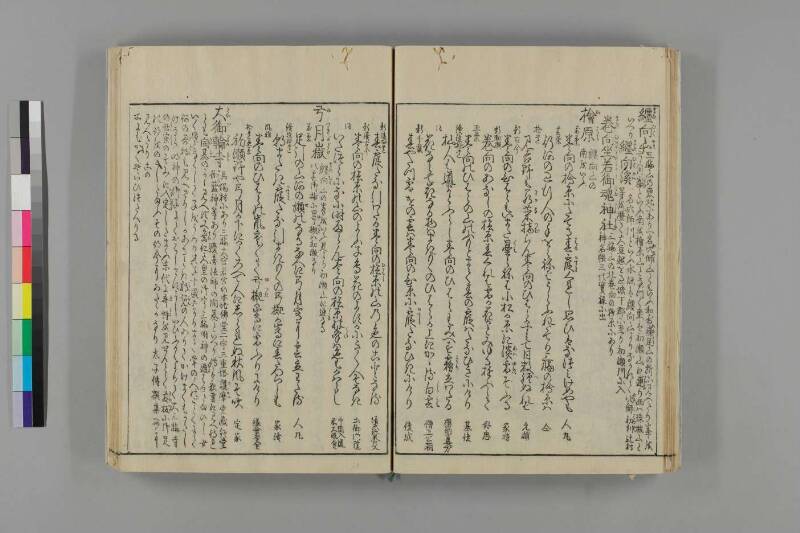
翻刻
【コマ187】
【右丁】
纒向山(まきむくやま)《割書:三輪山の東北にあり一名 穴師山(あなし )ともいふ和哥 痛足山(あなし )の所に見へたり峯を|弓月嶽( たけ)といふ南を檜原山となづく東は初瀬山に連(つらな)り西は珠城山と》
《割書:いへり》纒向渓(まきむくかは)《割書:一名穴師川といふ水源は纒向山よりなかれて穴師(あなし)初利(はつり)辻村|等を歴(へ)て大豆越を過城下郡に至り初瀬川に入》
《振り仮名:巻向坐𠰥御魂神社|まきむきにいますわかみたましんしや》《割書:三輪山の北巻向の桧原にあり|神名帳三代實禄に出》#1
檜原(ひはら)《割書:纒向山の|南をいふ》
《割書:萬葉》
巻向の桧原にたてる春霞(はるかすみ)くれし思ひはなつみけめやも 人丸#3
《割書:雲葉》
行河の過行人の手をらねばうらふれたてり三輪の桧原は 仝
《割書:拾遺》
み𠮷野も若菜摘(わかなつむ)らん巻向のひはらかすみて日数 経(へ)ぬれば 元輔
《割書:新古今》
巻向のひはらもいまた曇(くも)らねは小松か原に淡雪(あはゆき)ぞふる 家持
《割書:新勅撰》
巻向のあなしの桧原春くれは雪か花かとみゆるゆふして 好忠
《割書:玉葉》
巻向のひはらの山のふもとまて春の霞はたなひきにけり 基俊
《割書:續後拾遺》
杣人は道まとふらし巻向のひはらもみへす霧(きり)立わたる 権中納言長方
《割書:同》
花ならて花なる物はまきもくのひはらか上にかゝる白雲(しらくも) 僧正公朝
《割書:新千載》
春やたつ雪けの雲は巻向のひ原に霞(かすみ)たなひきにけり 俊成
【左丁】
《割書:新後拾遺》
春霞たな引わたる巻向の桧原(ひはら)の山の色のことなる 清原深養父
《割書:新續古今》
巻向の桧原の山のよふ子鳥花のよすかにきく人そなき 土御門院
《割書:同》
いたつらになに时雨らん巻向の桧原の峯(みね)は色もかはらし 《割書:中園入道|前大政大臣》
弓月嶽(ゆつきがだけ)《割書:纒向山(まきむく )の峯をいふ是より初瀬山に連(つらな)なる|八雲御抄に曰 弓槻#2は初瀬なり》
《割書:萬葉》
足引の山河の瀬のなるなへに弓月嵩に雲立わたる 人丸#3
《割書:續後拾遺》
朝またき霞(かすみ)たな引まきもくの弓槻#2か嵩に春たつらしも 家隆
《割書:風雅》
巻向のひはらの嵐寒〳〵て弓槻#2か嵩に雪ふりにけり 鎌倉右大臣
《割書:拾遺愚草》
初瀬野や弓月か下にかくろへて人にしられぬ秋風そ吹 定家
大御輪寺(たいごりんじ)《割書:馬塲村にあり三輪大宮𠰥宮の本地佛堂二宇三重塔 護摩堂(ごま )藏経堂|伽藍(からん)神等あり慶圓法師の開基といへり伝は釈書に見へ侍れ》
《割書:とも開基(かいき)のよし見へず又 垂仁天皇(すいにん )の御宇三輪明神の通(かよ)はせたまひし女|いくほどなくして子をうめり其子十歳ばかりまて常の人のごとくにて》
《割書:何の奇特(きどく)も見へざりしかあるとき博覧(はくらん)の人ありてかけまくもかたし|けなき明神の御子にておはしますよしいひふるゝ ̄ニよりて大三輪寺》
《割書:の丑寅(うしとら)のすみに入定(にうぢやう)したまふ末代に奇特(きとく)を見せんとて敷板(しきいた)に御足|の跡をのこしたまふその跡今にあたゝかなり太子傳撰集抄に》
《割書:見へたりこの|所にもかくぞいひつたへける》
現代語訳
【コマ187】
---
【右丁】
**纒向山(まきむくやま)**
三輪山の東北にある。一名、穴師山(あなしやま)ともいう。和歌には「痛足山(あなしやま)」の表記でも見られる。峯を**弓月嶽(ゆづきがたけ)**といい、南を**檜原山(ひはらやま)**と名づける。東は初瀬山に連なり、西は珠城山(たまきやま)という。
**纒向渓(まきむくがわ)**
一名、穴師川という。水源は纒向山より流れ出て、穴師・初利・辻村などを経て、大豆越(おおまめごえ)を過ぎ、城下郡(じょうかぐん)に至り、初瀬川に入る。
**巻向坐若御魂神社(まきむきにいますわかみたましんじゃ)**
三輪山の北、巻向の桧原にある。『神名帳』および『三代実録』に記載される。
---
**檜原(ひはら)**
纒向山の南をいう。
〔万葉集〕
巻向の桧原にたてる春霞(はるかすみ)くれし思ひはなつみけめやも 人丸
〔雲葉集〕
行く河の過ぎ行く人の手を折らねばうらぶれ立てり三輪の桧原は 同
〔拾遺集〕
み吉野も若菜摘むらん巻向の桧原かすみて日数経ぬれば 元輔
〔新古今集〕
巻向の桧原もいまだ曇らねば小松が原に淡雪(あわゆき)ぞ降る 家持
〔新勅撰集〕
巻向のあなしの桧原春来れば雪か花かと見ゆる夕暮れ(ゆうぐれ) 好忠
〔玉葉集〕
巻向の桧原の山のふもとまで春の霞はたなびきにけり 基俊
〔続後拾遺集〕
杣人(そまびと)は道まどふらし巻向の桧原も見えず霧(きり)立ちわたる 権中納言長方
〔同〕
花ならて花なる物は巻向の桧原が上にかかる白雲(しらくも) 僧正公朝
〔新千載集〕
春やたつ雪気の雲は巻向の桧原に霞(かすみ)たなびきにけり 俊成
---
【左丁】
〔新後拾遺集〕
春霞たなびきわたる巻向の桧原(ひはら)の山の色のことなる 清原深養父(きよはらのふかやぶ)
〔新続古今集〕
巻向の桧原の山の夕暮れに子鳥(ことり)花のよすかに聞く人ぞなき 土御門院(つちみかどいん)
〔同〕
いたずらになに時雨らん巻向の桧原の峯(みね)は色もかわらじ 中園入道前大政大臣
---
**弓月嶽(ゆづきがたけ)**
纒向山の峯をいう。これより初瀬山に連なる。『八雲御抄(やくもみしょう)』に曰く、「弓槻は初瀬なり」。
〔万葉集〕
足引の山川の瀬のなるなへに弓月嶽に雲立ちわたる 人丸
〔続後拾遺集〕
朝またき霞(かすみ)たなびき巻向の弓槻が嶽に春たつらしも 家隆
〔風雅集〕
巻向の桧原の嵐寒々として(さむざむとして)弓槻が嶽に雪降りにけり 鎌倉右大臣
〔拾遺愚草〕
初瀬野や弓月が下に隠ろへて人に知られぬ秋風ぞ吹く 定家
---
**大御輪寺(たいごりんじ)**
馬場村にある。三輪大宮の宮の本地仏堂二宇・三重塔・護摩堂・蔵経堂・伽藍神などがある。慶円法師(けいえんほうし)の開基といわれる。その伝は釈書に見えている。
また、開基の経緯については(前記のほかにも異説があり)はっきりしない。また、垂仁天皇(すいにんてんのう)の御代に、三輪明神が通われた女性が、ほどなくして子を産んだ。その子は十歳ばかりまでは普通の人のようであって、何の奇跡(きどく)も見えなかった。ところがあるとき、博覧の人があって——はばかりながら——神聖なる明神の御子でいらっしゃると言い伝えられるによって、大三輪寺の丑寅(うしとら)の隅に入定(にゅうじょう)なされた。末代に奇跡をお見せになろうとして、敷板(しきいた)に御足の跡を残された。その跡は今もなお温かである。このことは『太子伝撰集抄(たいしでんせんじゅうしょう)』に記されており、この所にもかくのごとく言い伝えられている。
英語訳
[Folio 187]
---
[Right page]
**Mt. Makimuku (纒向山)**
Located to the northeast of Mt. Miwa. It is also known as Mt. Anashi (穴師山). In waka poetry it also appears written as *Anashi-yama* (痛足山). The peak is called **Yuzuki-ga-take (弓月嶽)**, and the southern face is named **Hihara-yama (檜原山)**. To the east it connects with Mt. Hatsuse, and to the west lies Mt. Tamaki (珠城山).
**The Makimuku River (纒向渓)**
Also called the Anashi River. Its headwaters rise from Mt. Makimuku, flowing through Anashi, Hatsuri, and Tsuji Village, passing over Ōmamegoe, reaching Jōka District, and entering the Hatsuse River.
**Makimuki-ni-imasu Wakamitama Shrine (巻向坐若御魂神社)**
Located in the Hihara area of Makimuku, to the north of Mt. Miwa. It is recorded in the *Jinmyōchō* (神名帳, Register of Deities) and the *Sandai Jitsuroku* (三代実録, Veritable Records of Three Reigns).
---
**Hihara (檜原)**
Refers to the southern side of Mt. Makimuku.
[*Man'yōshū*]
The spring haze standing in the cypress groves of Makimuku —
could it forget the anguish of dusk?
*Hitomaro*
[*Unyōshū*]
Since those who pass along the river make no offering of broken branches,
the cypress groves of Miwa stand forlorn.
*Same (Hitomaro)*
[*Shūishū*]
In Miyoshino too they must be gathering spring herbs —
so many days have passed with the haze hanging over Makimuku's cypress groves.
*Motosuke*
[*Shin Kokinshū*]
The cypress groves of Makimuku are not yet overcast,
yet light snow falls upon the young pine grove.
*Yakamochi*
[*Shin Chokusenshū*]
In the cypress groves of Anashi in Makimuku, when spring comes,
one cannot tell whether it is snow or blossoms in the evening light.
*Yoshitada*
[*Gyokuyōshū*]
The spring haze trails all the way to the foothills
of the mountain of Makimuku's cypress groves.
*Motoshige (Mototoshi)*
[*Zoku Goshūishū*]
The woodcutter must have lost his way —
even Makimuku's cypress groves are hidden as mist spreads across.
*Provisional Middle Counselor Nagakata*
[Same anthology]
What blooms but is not blossoms —
the white clouds hanging over Makimuku's cypress groves.
*Sōjō Kōchō*
[*Shin Senzaishū*]
Does spring arise? The snow-laden clouds over Makimuku's
cypress groves trail off into mist.
*Shunzei*
---
[Left page]
[*Shin Goshūishū*]
The spring haze trails across,
and the colour of the mountain of Makimuku's cypress groves is quite unlike any other.
*Kiyohara no Fukayabu*
[*Shin Zoku Kokinshū*]
In the cypress-grove mountain of Makimuku at dusk,
there is no one left to listen to the small birds among the blossoms.
*Tsuchimikado In*
[Same anthology]
Why does the winter shower fall in vain?
The peaks of Makimuku's cypress groves will not change their hue.
*Nakazono Nyūdō, Former Grand Minister of State*
---
**Yuzuki-ga-take (弓月嶽)**
The peak of Mt. Makimuku, from which one connects to Mt. Hatsuse. The *Yakumo Mishō* (八雲御抄) states: "Yuzuki is [associated with] Hatsuse."
[*Man'yōshū*]
As the sounds of the mountain-stream rapids fill the air,
clouds rise and drift across Yuzuki-ga-take.
*Hitomaro*
[*Zoku Goshūishū*]
In early morning the haze trails out —
it seems spring has arrived upon Yuzuki-ga-take of Makimuku.
*Ietaka*
[*Fūgashū*]
The storm through Makimuku's cypress groves is bitterly cold,
and snow has fallen upon Yuzuki-ga-take.
*Kamakura Udaijin (Minamoto no Sanetomo)*
[*Shūi Gusō*]
In the fields of Hatsuse, hidden beneath Yuzuki,
an autumn wind blows that no one knows of.
*Teika*
---
**Taigorin-ji (大御輪寺)**
Located in Baba Village. It possesses two main halls housing the *honji* (本地, original Buddhist manifestation) of the great deity of Miwa Shrine, a three-storied pagoda, a *goma* (護摩, ritual fire) hall, a sutra repository, and a shrine guardian hall. It is said to have been founded by Dharma Master Keien. The account of its founding is recorded in Buddhist biographical texts.
[However,] the precise circumstances of the founding are not entirely clear. It is also said that in the reign of Emperor Suinin, a woman visited by the deity of Miwa, before long gave birth to a child. That child, up to the age of about ten, was just like an ordinary person, with no miraculous signs. But then there came a man of great learning who stated — with all due reverence — that this was the divine child of the great deity. Following this tradition, [the child] entered into meditative final absorption (*nyūjō*) in the northeastern corner of the great Miwa Temple. Wishing to demonstrate miraculous powers to later generations, the child left the imprint of its feet upon a floorboard. Even now that imprint is warm to the touch. This is recorded in the *Taishi Den Senjūshō* (太子傳撰集抄), and the same account is also transmitted here at this site.