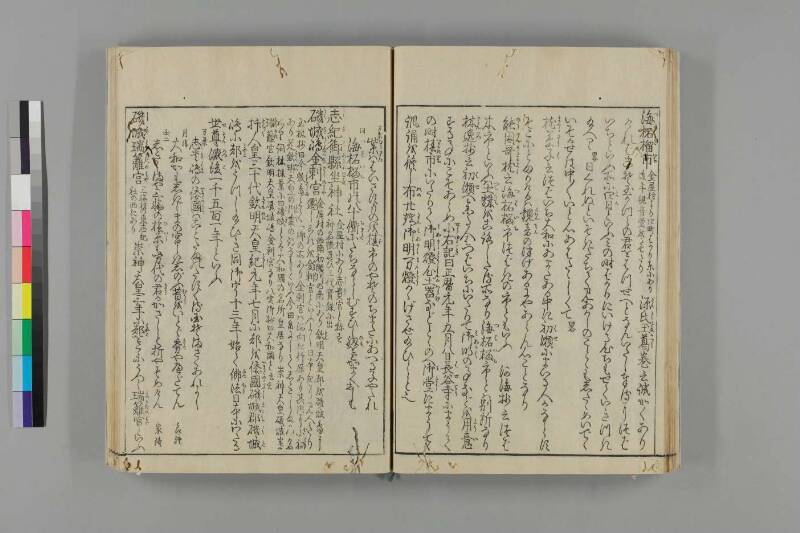
翻刻
【コマ190】
【右丁】
海柘榴市(つばきいち)《割書:金屋村より四町はかり東にあり|近年観音堂をたてたり》源氏玉葛巻(げんじたまかつら )云誠かくあり
ければこそ玉かつらの君をはつせへとなんいたし奉るにつば
いちといふ所に四日(よか)といふみの时ばかりにいける心ちもせていきつき
給へり《割書:畧》日くれぬといそきたちて見あかしのことゝもしたゝめいでゝ
いそかせは中〳〵いと心あはたゝしくて《割書:畧》
枕草子(まくらそうし)云つばいち大和あまたある中に初瀬(はせ)にまいる人かならす
そこにとまりけるは観音(くはんをん)のつげあるにやあらん心ことなり
能因哥枕(のういんうたまくら)云 海柘榴市(つばいち)つばきの市ともいふ 河海抄云つば
木市といふは土蛛(つちくも)をころしたる所なり海柘榴市(つはいち)とは別所なり
林逸抄(りんいつ )云 初瀬(はせ)へ参る人はつばいちにいたりて御明(みあかし)の事などを用意(ようい)
する事にこそあらめ小右記(せうゆうき)曰正暦元年九月八日 長谷寺(はせてら)にまうて
の时 椿市(つはきいち)にいたりて御明燈心土器(みあかしとうしんかわらけ)などとゝのへ御堂(みたう)にまうてゝ
諷誦を修し布(ぬの)廿端( たん)御明万燈(みあかしまんとう)かゝげさせ給ひしと也
【左丁】
《割書:万葉》
紫(むらさき)ははいさすものを椿市(つば )のやそのちまたにあへる子やたれ
《割書:同》
海柘榴市(つばいち)の八十衢( ちまた)にたちならしむすひし紐(ひも)をとかまくおしも
志紀御縣坐神社(しきみあがたにいます )《割書:金屋村にあり志貴宮(しき )と称す|神名帳及び三代實録に出》
磯城嶋金刺宮(しきしまかなさしのみや)《割書:金屋村の西南初瀬川の南にあり欽明天皇(きん )都を磯城島に|遷しこれを金刺宮(かなさし )といふよし日本紀に見へたり》
《割書:玉林抄曰今 敷島(しきしま)とて一郷の所あり金刺宮は河向に竹原あり其内に小祠(ほこら)|あり是 欽明天皇(きんめい )の内裏(たいり)の跡なりといふ今田畠にしてしきしまの名》
《割書:あり詞林採集に曰 磯城(しき)とは大和國の名所皇居なり崇神天皇礒城嶌| 瑞籬宮(みつかき )欽明天皇礒城嶋金刺宮なり八雲御抄曰大和國と云云》
抑(そも〳〵)人皇三十代 欽明天皇(きんめい )紀(とし)元年七月に都を倭國(やまとのくに)磯城郡(しきこほり)磯城(しき)
嶋に都(みやこ)をうつし給ひき同御宇十三年始て佛法(ぶつほう)日本にわたる
丗尊滅後(せそんめつご)一千五百一年といふ
《割書:万葉》
志貴嶋(しきしま)の倭國(やまとのくに)はことたまのたすくる国をまさくあれよし
《割書:月清》
大和かも志紀しまの宮しきしのぶ昔(むかし)をいとゞ霧(きり)やへだてん 良經
《割書:壬二》
しきしまや三輪の桧原(ひはら)も万代の君(きみ)かかさしと折やそめけん 家隆
磯城瑞籬宮(しきみつかきのみや)《割書:三輪村の東志紀|社の西にあり》崇神天皇三年に都(みやこ)をこゝにうつし瑞籬宮(みつかきのみや)といふ
現代語訳
【右丁】
**海柘榴市(つばきいち)**〔金屋村より東へ四町ほどのところにある。近年、観音堂が建てられた。〕
『源氏物語』玉鬘巻に次のように書かれている――「まことにこのようなことがあったればこそ、玉鬘の君を初瀬へとお連れ申し上げたのです。椿市(つばいち)という所に四日(よか)というみの(巳の)時分に、生きた心地もせずにたどり着きなさった」〔以下略〕。「日が暮れぬうちにと急ぎ立って、御明かしのことなどを整え出て、急がせると、なんとも気ぜわしく」〔以下略〕。
『枕草子』にいう――「椿市(つばいち)は、大和に数多くある宿場の中で、初瀬へ参る人が必ずそこに泊まるのは、観音のお告げがあるのであろうか、格別に心に残る所である」。
能因の『歌枕』にいう――「海柘榴市(つばいち)」、「椿の市ともいう」。
『河海抄』にいう――「椿木市(つばきいち)というのは、土蜘蛛(つちぐも)を討ち取った場所であり、海柘榴市(つばいち)とは別の場所である」。
『林逸抄』にいう――「初瀬へ参る人は、椿市に至って御明かしのことなどを用意するのが習いであったのであろう」。
『小右記』にいわく――「正暦元年(990)九月八日、長谷寺に参詣の折、椿市(つばきいち)に至って、御明かし・燈心・土器などを整え、御堂に参って諷誦を修し、布二十端を奉納し、御明かし万燈を掲げさせなさった」とある。
【左丁】
〔万葉集〕
紫は生いさすものを 椿市(つばいち)の 八十の衢(ちまた)に 逢へる子やたれ
〔同〕
海柘榴市(つばいち)の 八十衢(やそちまた)に 立ち並らし 結びし紐(ひも)を 解かまく惜しも
---
**志紀御縣坐神社(しきみあがたにいます神社)**〔金屋村にある。志貴宮(しきのみや)と称する。神名帳および三代実録に記載がある。〕
---
**磯城嶋金刺宮(しきしまかなさしのみや)**〔金屋村の西南、初瀬川の南にある。欽明天皇が都を磯城嶋に遷し、これを金刺宮(かなさしのみや)と呼んだことが日本紀(日本書紀)に見える。〕
〔玉林抄にいわく――「今、敷島(しきしま)といって一郷の地がある。金刺宮は川の向こうに竹原があり、その中に小祠(ほこら)がある。これが欽明天皇の内裏(だいり)の跡であるという。今は田畑となっており、しきしまの名が残っている」。詞林採集にいわく――「磯城(しき)とは大和国の名所・皇居のことである。崇神天皇の磯城嶋瑞籬宮(みずかきのみや)、欽明天皇の磯城嶋金刺宮がそれである。八雲御抄にいわく、大和国のこと、云々」。〕
そもそも、第三十代・欽明天皇の御即位元年七月に、都を倭国(大和国)磯城郡の磯城嶋にお遷しになった。同じ御代の十三年に、初めて仏法が日本に渡来した。これは釈尊の入滅後、一千五百一年のことという。
〔万葉集〕
志貴嶋(しきしま)の 倭の国は 言霊(ことたま)の 助くる国ぞ まさきくあれよし
〔月清集〕
大和かも 志紀しまの宮 しきしのぶ 昔をいとど 霧やへだてん 良経
〔壬二集〕
しきしまや 三輪の桧原(ひはら)も 万代の 君がかざしと 折やそめけん 家隆
---
**磯城瑞籬宮(しきみずかきのみや)**〔三輪村の東、志紀社の西にある。〕
崇神天皇三年に、都をここに遷し、瑞籬宮(みずかきのみや)と称した。
英語訳
【Right Panel】
**Tsubaki-ichi (海柘榴市, "Camellia Market")**
[Located about four chō (approx. 440 meters) east of Kanaya Village. In recent years, a Kannon Hall has been built there.]
The *Genji Monogatari* ("The Tale of Genji"), in the "Tamakazura" chapter, states: "It was truly because of such circumstances that we escorted Lady Tamakazura to Hatsuse. At the place called Tsubai-chi, around the Hour of the Snake on the fourth day, she arrived feeling as if she barely clung to life." [Abridged.] "Hastening before nightfall, they prepared the votive lights and set out; urging haste made everything all the more frantic." [Abridged.]
*The Pillow Book* (*Makura no Sōshi*) states: "Tsubai-chi: among the many lodging places in Yamato, the fact that all those who go to worship at Hatsuse stay there must be due to a divine prompting from Kannon — it is a place that leaves a singular impression on the heart."
Nōin's *Utamakura* states: "[The place called] Umi-tsubaki-ichi (海柘榴市)"; "it is also called Tsubaki no Ichi." The *Kakai-shō* states: "What is called 'Tsubaki-ki Ichi' is the place where the earth-spiders (*tsuchigumo*) were slain, and is a different place from Tsubai-chi." The *Rin'itsu-shō* states: "Those who go to worship at Hatsuse would stop at Tsubai-chi to prepare votive lights and other necessities." The *Shōyūki* (diary of Fujiwara no Sanesuke) records: "On the eighth day of the ninth month of the first year of Shōryaku (990), during a pilgrimage to Hasedera, [the party] reached Tsubaki-ichi and arranged the votive lamps, lamp wicks, and earthenware vessels; then went to worship at the main hall, performed the *fuju* (liturgical recitation), dedicated twenty bolts of cloth, and had ten thousand votive lamps lit."
【Left Panel】
[*Man'yōshū*]
Murasaki (purple) — does it grow here? —
At the eighty crossroads of Tsubaki-ichi,
who is this young woman I have encountered?
[Same work]
At the eighty crossroads of Tsubaki-ichi,
where I stood and waited —
how I regret to untie
the cord we tied together.
---
**Shiki Miagata-ni-imasu Shrine (志紀御縣坐神社)**
[Located in Kanaya Village; called the Shiki-no-miya. Mentioned in the *Jinmyōchō* (Register of Deities) and the *Sandai Jitsuroku* (Veritable Records of Three Reigns).]
---
**Shikishima Kanasashi Palace (磯城嶋金刺宮)**
[Located to the southwest of Kanaya Village, south of the Hase River. The *Nihon Shoki* records that Emperor Kinmei moved the capital to Shikishima and named it the Kanasashi Palace.]
[The *Gyokurin-shō* states: "There is now a district called Shikishima. Across the river from the Kanasashi Palace there is a bamboo grove, within which stands a small shrine — this is said to be the site of Emperor Kinmei's imperial residence. It is now farmland, but the name 'Shikishima' remains." The *Shirin Saishū* states: "'Shiki' refers to the noted imperial seat in Yamato Province. It encompasses Emperor Sujin's Shikishima Mizugaki Palace and Emperor Kinmei's Shikishima Kanasashi Palace. The *Yakumo Mishō* says: '[It is in] Yamato Province,' and so forth."]
Emperor Kinmei, the thirtieth sovereign, in the seventh month of the first year of his reign, moved the capital to Shikishima in Shiki District, Yamato Province. In the thirteenth year of his reign, Buddhism was first transmitted to Japan — said to be one thousand five hundred and one years after the passing of the Buddha.
[*Man'yōshū*]
Shikishima — the land of Yamato —
is a land blessed by the power of words (*kotodama*);
may all be well with you.
[*Tsukikiyoshū*]
Ah, Yamato — the Palace of Shikishima —
remembering Shiki, how much more
does the mist keep the past at a distance?
— Yoshitsune (Fujiwara no Yoshitsune)
[*Jinshū* (Jien's collection)]
At Shikishima, even the cypress plain of Miwa —
was it first plucked as a hairpin ornament
to last for ten thousand generations under our lord?
— Ietaka (Fujiwara no Ietaka)
---
**Shiki Mizugaki Palace (磯城瑞籬宮)**
[Located to the east of Miwa Village, west of the Shiki Shrine.]
In the third year of Emperor Sujin's reign, the capital was moved here, and it was named the Mizugaki Palace.